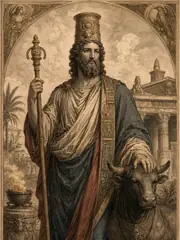
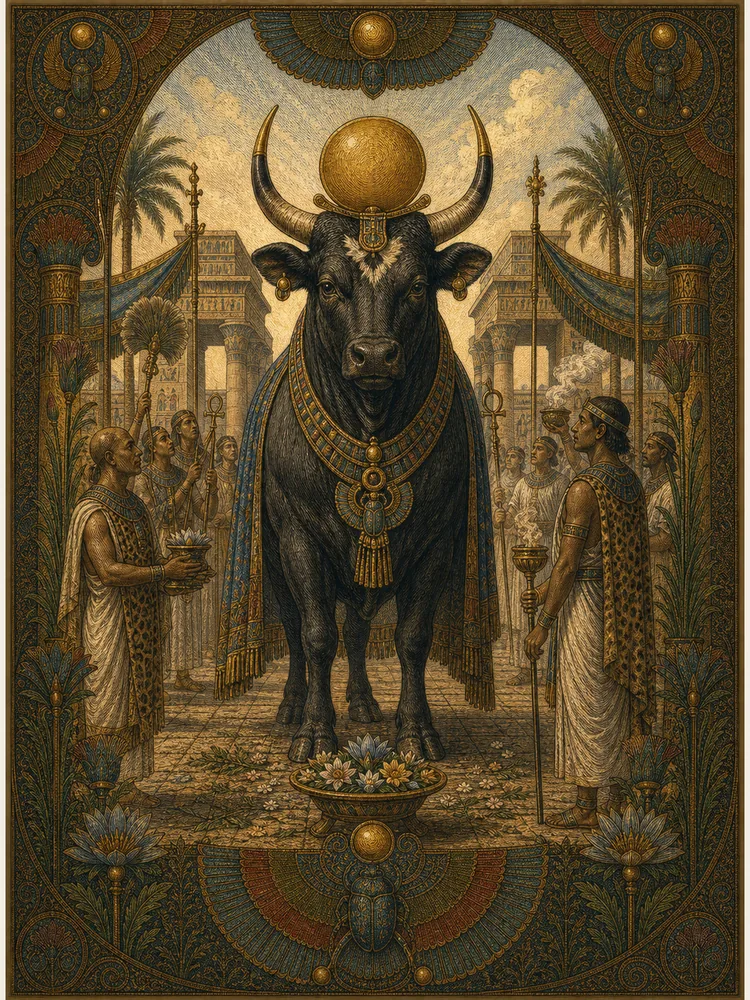
The Apis bull was the living manifestation of Ptah at Memphis — a particular bull, identified at birth by precise markings (a black hide with a white triangle on the forehead, a scarab-shaped mark on the tongue, a vulture-shaped mark on the back, a duplicated set of tail-hairs), kept in the temple of Ptah at Memphis, and treated during his lifetime with reverence appropriate to a god incarnate. He was given a luxurious stall, the choicest fodder, two herds of cows for his pleasure, and a daily program of religious ceremony that the Greek visitors recorded with great interest. When he died — naturally, or, if he reached the prescribed age of twenty-eight without dying, by ritual drowning — he was embalmed with the ceremonies of a pharaoh and buried in the great underground complex of the Serapeum at Saqqara, in a granite sarcophagus weighing many tons. A new Apis was then sought throughout the country, identified by his markings, and brought to Memphis to take up the office.
The Apis cult was very ancient — already attested in the First Dynasty — and it persisted until the closing of the Egyptian temples in late antiquity. Under the Ptolemies, the dead Apis bulls were assimilated to Osiris (Osiris-Apis, hellenized as Serapis), and the new composite god Serapis became one of the principal deities of the Hellenistic Mediterranean, with his great Serapeum at Alexandria a major pilgrimage site until its destruction by Christian mobs in 391 of our era.