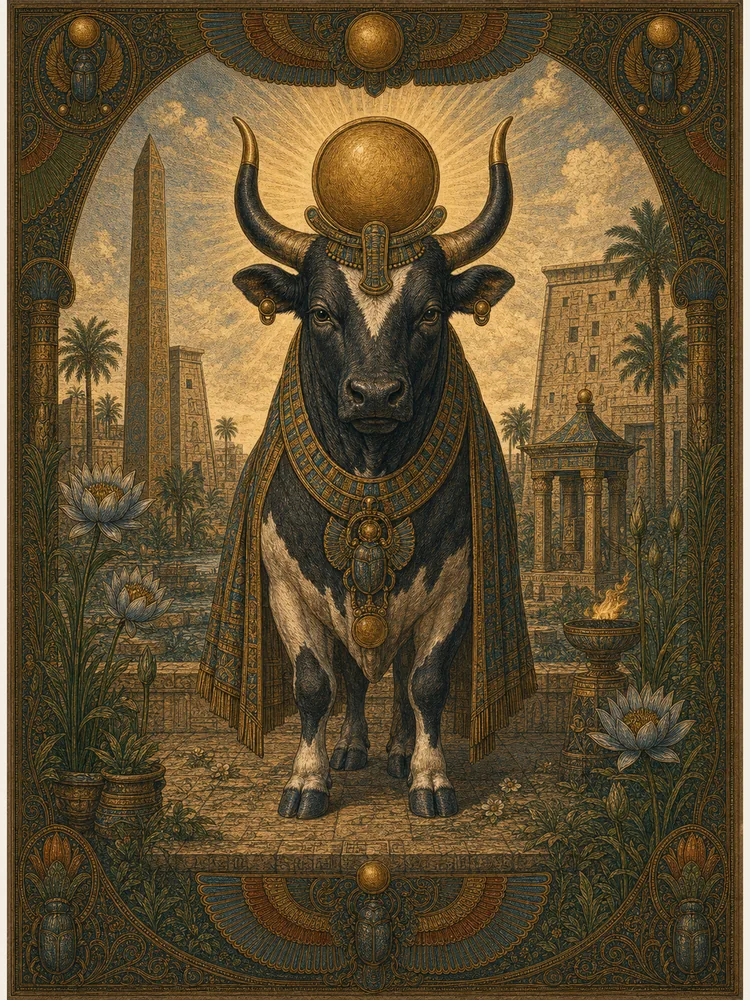
Mnevis was the sacred bull of Heliopolis, the living manifestation of Ra (or, more precisely, of Ra-Atum) at the great solar city. Like Apis at Memphis, Mnevis was a particular bull, identified by markings, kept at the temple, treated as the incarnation of the god, and buried with great pomp at his death; the Mnevis cemetery at Heliopolis, less famous than the Memphite Serapeum, has produced bull-sarcophagi and votive material in considerable quantity. Where Apis was Ptah's living image, Mnevis was Ra's; where Apis was associated with the moon (his white forehead-marking being held to be lunar), Mnevis was associated with the sun, and was sometimes depicted with the solar disk between his horns.
 Before thisApis
 Next on the wallBuchis
Curator’s note
What the sources say, and what later tradition added. The sources for this bay
Mnevis is less well documented than Apis, owing to the more thorough destruction of Heliopolis (which was extensively quarried for stone in the medieval period; little remains above ground). His cult is attested from the Old Kingdom through the Roman period. The bull-cult complex at modern Arab el-Tawil (ancient Heliopolis) has produced burials of Mnevis bulls and the cows held to be his "mother," attesting to the same kind of animal-husbandry-as-religion that the Apis cult exemplifies.
When the sources speak
Dated witnesses for The Cities and the Sacred Animals. A date marks when the evidence was written down, not when the belief began. The whole timeline
- c. 4000–3100 BCE
- Predynastic regional symbols, burials, standards, and animal cults provide the deep background to later divine iconography.
- c. 3100–2686 BCE
- Early Dynastic kingship joins royal ideology to local cult centers and establishes many durable divine emblems.
- c. 2686–2181 BCE
- Old Kingdom pyramid complexes and the Pyramid Texts preserve the earliest large religious corpus.
- c. 2181–1650 BCE
- First Intermediate and Middle Kingdom traditions broaden mortuary access; Coffin Texts develop older royal materials.
- c. 1550–1070 BCE
- New Kingdom temple wealth, royal hymns, underworld books, and the Book of Going Forth by Day greatly expand the record.
- c. 1353–1336 BCE
- Akhenaten’s Aten program reorganizes royal cult but does not permanently erase the older divine plurality.
- c. 1070–664 BCE
- Third Intermediate Period priestly and regional powers reshape cult administration and divine kingship.
- 664–332 BCE
- Late Period archaism, animal cults, and temple scholarship preserve and reinterpret older forms.