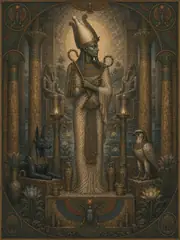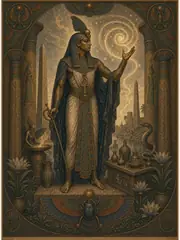
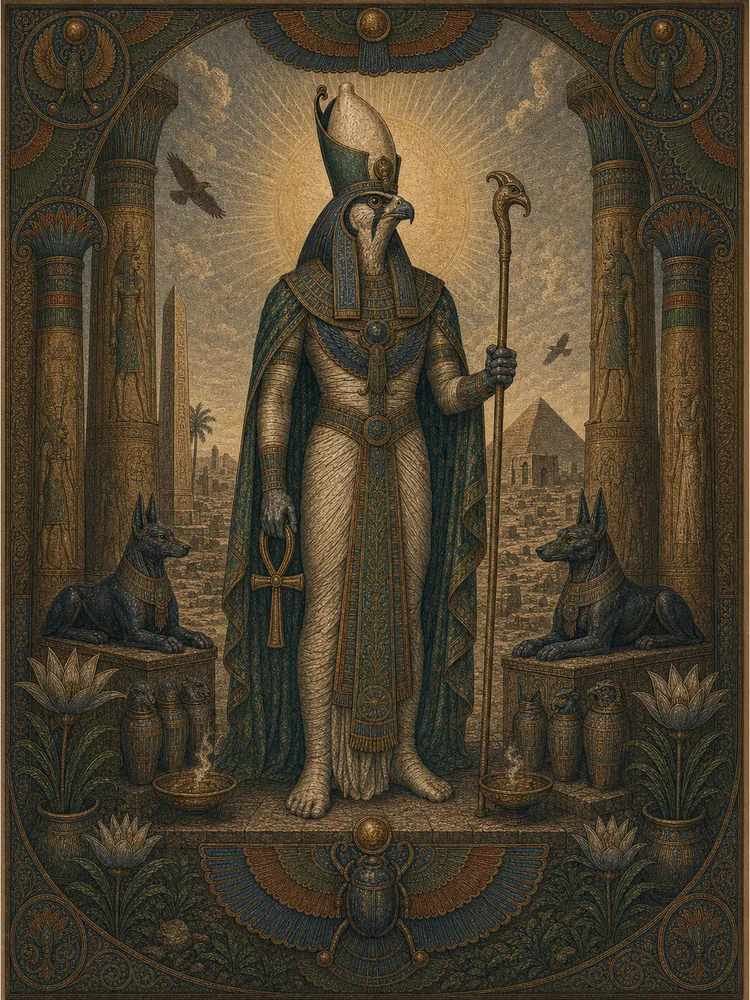
At Memphis, before the rise of the great Osirian doctrine, the dead were entrusted to Sokar. He was an ancient god of the desert burial-places that lay west of the city, beyond the cultivated land, where the long ridges of limestone hid the rock-cut tombs of the noble dead. Sokar was depicted as a man with the head of a falcon, but his falcon was unlike that of Horus: it was a still and watchful bird, the falcon of the silent places, who guarded the threshold between the living world and the country of the West.
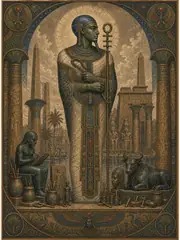
When the great mythology of Osiris took shape, Sokar did not vanish; he was joined to Osiris as Osiris-Sokar and later, when Ptah of Memphis was added to the compound, as Ptah-Sokar-Osiris. This triple-named god expressed the full Memphite theology of death: Ptah the maker, Sokar the keeper of the silent place, Osiris the god who himself had passed through death and risen. Small mummiform figures of Ptah-Sokar-Osiris, hollowed within to receive a folded papyrus of the Book of the Dead, were placed in tombs of the New Kingdom and after, that the deceased might have all three names of the Memphite afterlife at hand.
The festival of Sokar was held at Memphis in the fourth month of inundation, and was one of the great civic celebrations of the city. The image of the god was drawn through the streets upon a sledge in the form of his sacred bark, the Henu-bark, with its prow lifted in the curved shape of an antelope's head; and the people walked about the bark singing, that the boundary between the living and the dead might be once again traversed and the world be reaffirmed.