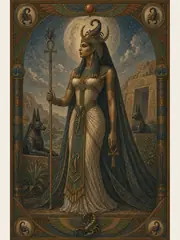
When the body of the deceased was prepared for burial, the embalmers removed the four organs — the liver, the lungs, the stomach, and the intestines — and laid them up in four vessels of stone or pottery. Each of these vessels was set under the protection of one of the four sons of Horus, who in turn stood under the protection of one of the four great mother-goddesses, that the dead might lie complete and incorruptible in the country of the West.
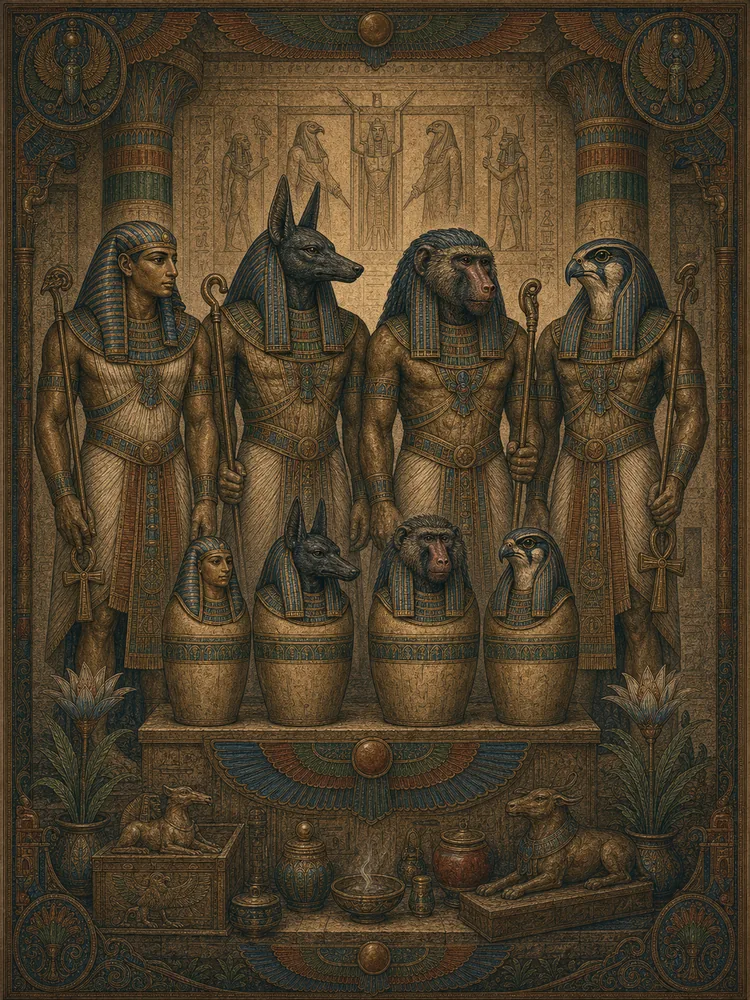
Imsety, who had the face of a man, watched over the liver and stood under the wing of Isis. Hapi — not the Nile, but the second of that name, the canopic Hapi — had the face of a baboon and guarded the lungs, with Nephthys his protectress. Duamutef bore the long muzzle of a jackal and kept the stomach, with Neith. And Qebehsenuef, who had the head of a falcon, kept the intestines, with Serqet the scorpion-goddess. So the four great mothers and the four sons together encircled the dead and held him whole.
In the Pyramid Texts the four are already invoked as helpers of the deceased king, his sons by Horus or by Osiris, who climb up to heaven that he might mount upon their backs and reach the sky. By the New Kingdom they had become the standard protectors of the canopic equipment, and their lids — bearing the heads of the man, baboon, jackal, and falcon — are among the most recognizable objects in the Egyptian collection of any modern museum. Their cardinal alignment was fixed: Imsety to the south, Hapi to the north, Duamutef to the east, and Qebehsenuef to the west, that the body be guarded on every side.
Curator’s note
What the sources say, and what later tradition added. The sources for this bay
The Four Sons of Horus are attested from the Pyramid Texts (notably Spells 215, 552, 619) onward through the Coffin Texts and the Book of the Dead, especially Spell 17 and the spells of the canopic equipment. Their names mean approximately: Imsety, of unknown etymology (perhaps 'the kindly'); Hapi, distinct from the Nile-god, of disputed meaning; Duamutef, 'he who praises his mother'; and Qebehsenuef, 'he who refreshes his brothers' (the libation-pourer). The convention of the four animal-headed lids became canonical in the Eighteenth Dynasty and persisted to the close of pharaonic civilization. The four are paired with Isis, Nephthys, Neith, and Serqet (Selket) — the same four goddesses who stand at the corners of certain royal sarcophagi, including the great gilded shrines of Tutankhamun. By the Late Period the four sons' role had expanded to include general protection of the deceased's body, even when the canopic organs were (as became fashionable) returned to the body cavity rather than separately preserved.
When the sources speak
Dated witnesses for The Osirian Cycle. A date marks when the evidence was written down, not when the belief began. The whole timeline
- c. 4000–3100 BCE
- Predynastic regional symbols, burials, standards, and animal cults provide the deep background to later divine iconography.
- c. 3100–2686 BCE
- Early Dynastic kingship joins royal ideology to local cult centers and establishes many durable divine emblems.
- c. 2686–2181 BCE
- Old Kingdom pyramid complexes and the Pyramid Texts preserve the earliest large religious corpus.
- c. 2181–1650 BCE
- First Intermediate and Middle Kingdom traditions broaden mortuary access; Coffin Texts develop older royal materials.
- c. 1550–1070 BCE
- New Kingdom temple wealth, royal hymns, underworld books, and the Book of Going Forth by Day greatly expand the record.
- c. 1353–1336 BCE
- Akhenaten’s Aten program reorganizes royal cult but does not permanently erase the older divine plurality.
- c. 1070–664 BCE
- Third Intermediate Period priestly and regional powers reshape cult administration and divine kingship.
- 664–332 BCE
- Late Period archaism, animal cults, and temple scholarship preserve and reinterpret older forms.