A Compendium of the Ancient Gods
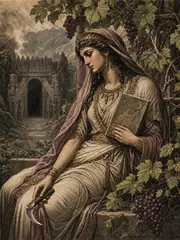
Nephthys, plate

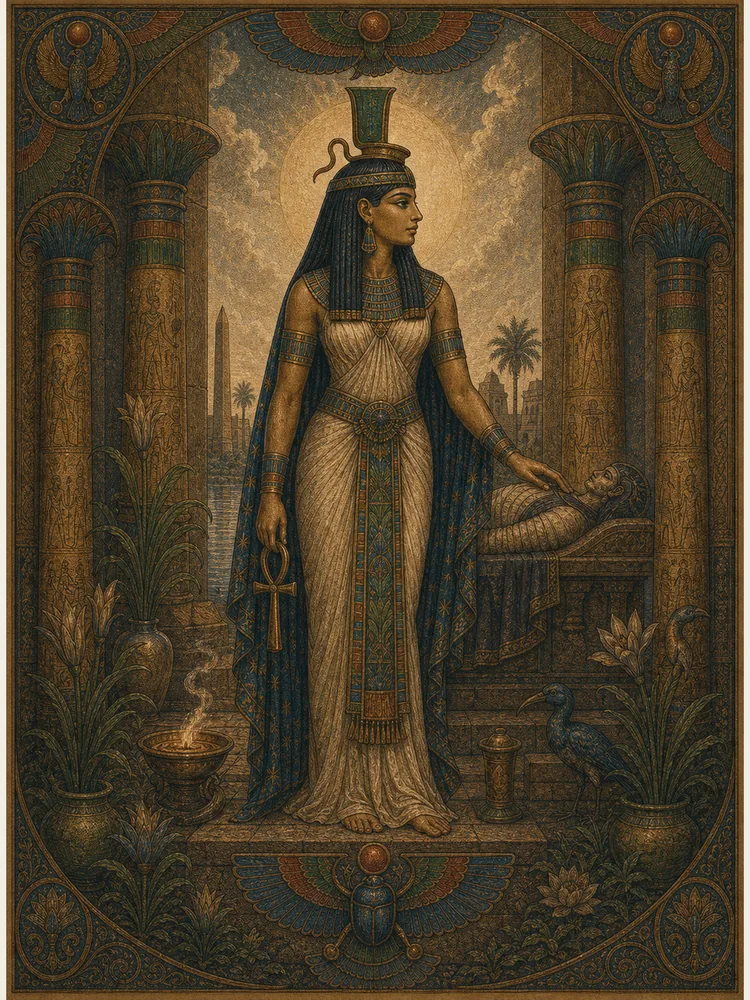
Nephthys was the youngest of the children of Geb and Nut, born on the fifth of the five extra days. She was the wife of Set, but in her sympathies she was always with her sister Isis. The Egyptian myth held that Nephthys, longing for a child whom Set could not give her (for he was barren in some traditions, or refused her, or could only get the desert-creatures with her), disguised herself as Isis and lay with Osiris in his living kingship; from this union was born Anubis. When Osiris was killed, Nephthys joined her sister in the long search; the two of them together were the principal mourners of the slain god, and the Lamentations of Isis and Nephthys, sung antiphonally by two priestesses at every Osirian funeral, were among the most affecting liturgical texts of the Egyptian church.

Nephthys's name in Egyptian was Nebet-Hut, "Lady of the House," the house in question being either the temple itself (in which case she was the protector of sacred precincts) or, by extension, the funerary temple — for she was the mistress of mourning. In iconography she stood at the head of the bier, while Isis stood at the foot; in the canopic jar arrangement, she protected the jar that held the lungs of the dead. She was the gentler of the two sister-goddesses, the one whose role was less to remedy than to weep — and the Egyptian theological imagination accorded weeping a high dignity, for the tears of the goddesses were held to be themselves a kind of efficacious mourning that aided the dead's transition.
Curator’s note

What the sources say, and what later tradition added. The sources for this bay

The Lamentations of Isis and Nephthys are preserved most fully in the Bremner-Rhind Papyrus (British Museum, Late Period) and in a parallel Berlin manuscript; they were used liturgically in the Khoiak festival, when the death and resurrection of Osiris were enacted ritually. The motif of the antiphonal lamentation by two female mourners is widely attested in the ancient Near East — the goddesses Inanna and Geshtinanna lament Dumuzi in similar fashion — and in modern times, descendants of the same liturgical pattern survived in certain Coptic Christian Holy Week observances and in the Egyptian folk practice of the wailing-women at funerals. The conception of Anubis as son of Nephthys by Osiris is Plutarchian; the Egyptian sources are less clear, and Anubis may originally have been understood as the son of Bastet or of an unspecified consort of Osiris.

Kin in the sources

Each tie is quoted from the entry that states it.

When the sources speak

Dated witnesses for The Osirian Cycle. A date marks when the evidence was written down, not when the belief began. The whole timeline

c. 4000–3100 BCE
Predynastic regional symbols, burials, standards, and animal cults provide the deep background to later divine iconography.
c. 3100–2686 BCE
Early Dynastic kingship joins royal ideology to local cult centers and establishes many durable divine emblems.
c. 2686–2181 BCE
Old Kingdom pyramid complexes and the Pyramid Texts preserve the earliest large religious corpus.
c. 2181–1650 BCE
First Intermediate and Middle Kingdom traditions broaden mortuary access; Coffin Texts develop older royal materials.
c. 1550–1070 BCE
New Kingdom temple wealth, royal hymns, underworld books, and the Book of Going Forth by Day greatly expand the record.
c. 1353–1336 BCE
Akhenaten’s Aten program reorganizes royal cult but does not permanently erase the older divine plurality.
c. 1070–664 BCE
Third Intermediate Period priestly and regional powers reshape cult administration and divine kingship.
664–332 BCE
Late Period archaism, animal cults, and temple scholarship preserve and reinterpret older forms.

Floor plan

The rooms follow one another in the order their peoples first appear in the written record.

  1. The Cradle of Citiesc. 3400 BCE to 395 CE. 115 works
  2. The Gift of the Nilec. 4000 BCE to 395 CE. 73 works
  3. The Olympian Orderc. 1600 BCE to 750 CE. 152 works
  4. The Persian Worldc. 2000 BCE to 1010 CE. 30 works
  5. The Levantine Borderlandsc. 1200 BCE to 500 CE. 20 works
  6. The Edges of Empirec. 2000 BCE to 1500 CE. 33 works
  7. The Etruscan Worldc. 900 BCE to 750 CE. 22 works
  8. The Roman Inheritancec. 1200 BCE to 500 CE. 58 works
  9. The Northern Inheritancec. 2000 BCE to 1600 CE. 131 works