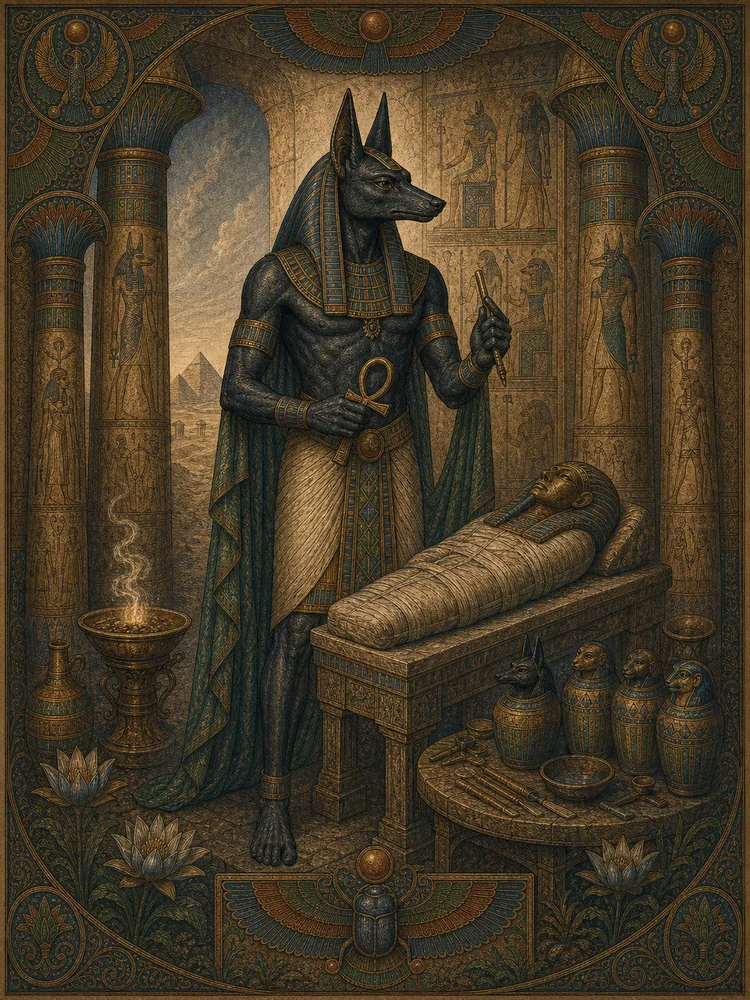
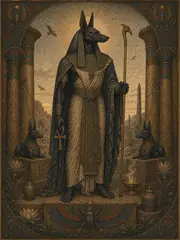
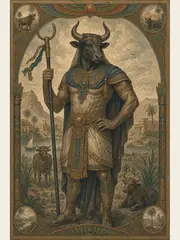
Anubis was the jackal-god, the lord of the embalming-shop and of the necropolis. He was depicted either as a man with the head of a jackal (or a black canine that may be a stylized jackal-and-dog hybrid) or, less often, as a wholly canine animal couchant upon a shrine. His skin or pelage was painted black — not the natural tawny color of the jackal, but the black of bitumen, of the resin of embalming, and of the rich silt of the inundation — for blackness in Egyptian symbolism was the color of resurrection, of the fertile soil, of the dead made anew.
His office was twofold. He was the embalmer-god, who in mythic time had performed the original embalming of Osiris's recovered body, and whose priests, working in the embalming-shops of every Egyptian town, wore Anubis-masks during the seventy-day rite by which the dead were prepared for burial. He was also the psychopomp, the conductor of souls — it was Anubis who took the hand of the dead at the threshold of the next world and led them into the Hall of Two Truths, before the great scale and the throne of Osiris.
His name in Egyptian was Anpu; the Greek Anubis is a transcription. He was, in the deepest stratum of Egyptian religion, the god of the dead, the lord of the necropolis, the principal funerary deity. As the Osirian cult rose in the Old Kingdom and beyond, Anubis was progressively subordinated to Osiris, and his role was redefined as that of Osiris's faithful servitor and the operative of the embalming and judgment processes; but Anubis is much older than Osiris in the sphere of the dead, and his image and his cult sit at a deeper layer of Egyptian religion than the Osirian narrative that incorporates them.
Curator’s note
What the sources say, and what later tradition added. The sources for this bay
Anubis's antiquity is attested by his appearance in some of the earliest Pyramid Texts, often in roles that the later tradition assigns to Osiris; the priority of Anubis over Osiris in the funerary sphere is the consensus of modern Egyptology. The black-jackal iconography — couchant upon a shrine, the symbol of the necropolis — is among the most stable in Egyptian art, persisting essentially unchanged from the Old Kingdom to the Roman period. Anubis's identification with the Greek Hermes Psychopompos was effected in the Hellenistic period, producing the figure of Hermanubis, who appears in late Greco-Egyptian iconography (catacomb paintings at Kom el-Shoqafa, Alexandria, c. 2nd c. CE) as a hybrid of the two. The sacred animal — whether jackal, wild dog, or composite — has been the subject of considerable zoological debate; the most recent view favors a stylized representation of the African golden wolf, distinct from the true jackal but related.
When the sources speak
Dated witnesses for The Osirian Cycle. A date marks when the evidence was written down, not when the belief began. The whole timeline
- c. 4000–3100 BCE
- Predynastic regional symbols, burials, standards, and animal cults provide the deep background to later divine iconography.
- c. 3100–2686 BCE
- Early Dynastic kingship joins royal ideology to local cult centers and establishes many durable divine emblems.
- c. 2686–2181 BCE
- Old Kingdom pyramid complexes and the Pyramid Texts preserve the earliest large religious corpus.
- c. 2181–1650 BCE
- First Intermediate and Middle Kingdom traditions broaden mortuary access; Coffin Texts develop older royal materials.
- c. 1550–1070 BCE
- New Kingdom temple wealth, royal hymns, underworld books, and the Book of Going Forth by Day greatly expand the record.
- c. 1353–1336 BCE
- Akhenaten’s Aten program reorganizes royal cult but does not permanently erase the older divine plurality.
- c. 1070–664 BCE
- Third Intermediate Period priestly and regional powers reshape cult administration and divine kingship.
- 664–332 BCE
- Late Period archaism, animal cults, and temple scholarship preserve and reinterpret older forms.