A Compendium of the Ancient Gods
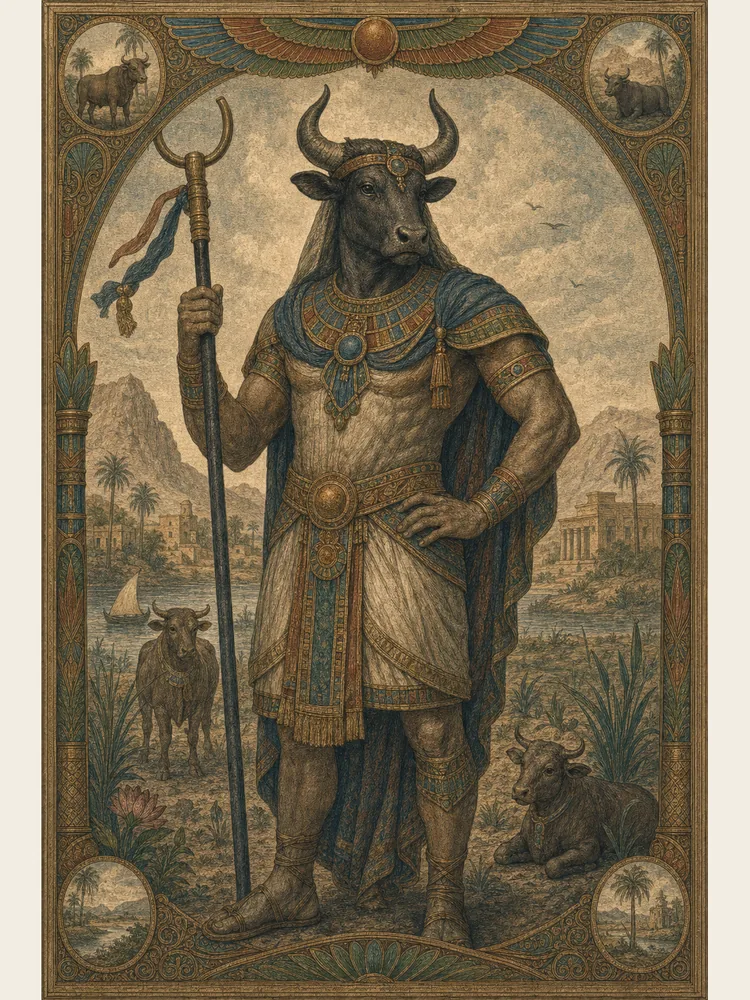
Bata, plate

Bata was a god of the Seventeenth Upper Egyptian nome, where his cult-city was Saka, near modern Asyut. He was depicted as a bull, and his cult had a small but persistent local following throughout pharaonic history. He owes his place in modern reference works, however, less to his cultic standing than to a single literary text: the New Kingdom Tale of Two Brothers (Papyrus d'Orbiney, 19th Dynasty), one of the most famous works of Egyptian literature, in which the protagonist is named Bata and is identified with the god — although the relationship between the literary character and the cultic deity is debated.

The Tale of Two Brothers tells of two brothers, Anubis and Bata, the elder married, the younger unmarried and living in his elder brother's household. The elder's wife attempts to seduce the younger Bata, who refuses; she falsely accuses him to her husband; and the elder, believing her, attempts to kill the younger. After much wandering, divine intervention, and several transformations — Bata becomes successively a tree, a bull, two persea-trees, and at length a king — the truth is revealed, the false wife is killed, and the brothers are reconciled. The plot's resemblance to the biblical story of Joseph and Potiphar's wife (Genesis 39) has been remarked since the nineteenth century; the relationship is real at the level of the folktale type (the index would call it the Spurned Seductress), but direct dependence in either direction has not been established.
Curator’s note

What the sources say, and what later tradition added. The sources for this bay

The Tale of Two Brothers is preserved on Papyrus d'Orbiney (British Museum EA 10183), copied in the reign of Seti II (c. 1200 BCE); it is one of the most-translated and most-discussed works of New Kingdom literature. Whether the protagonist Bata is identical with the Saka cult-god, or merely shares his name, is debated; the protagonist's bull-transformation suggests an authentic cultic connection. The wider folktale type — the falsely-accused younger brother fleeing the seductress's vengeance — is widely distributed across Indo-European and Near Eastern literatures, and any specific genealogical relationship between the Egyptian and the Hebrew versions is hard to establish.

Kin in the sources

Each tie is quoted from the entry that states it.

When the sources speak

Dated witnesses for The Protectors and the Sages. A date marks when the evidence was written down, not when the belief began. The whole timeline

c. 4000–3100 BCE
Predynastic regional symbols, burials, standards, and animal cults provide the deep background to later divine iconography.
c. 3100–2686 BCE
Early Dynastic kingship joins royal ideology to local cult centers and establishes many durable divine emblems.
c. 2686–2181 BCE
Old Kingdom pyramid complexes and the Pyramid Texts preserve the earliest large religious corpus.
c. 2181–1650 BCE
First Intermediate and Middle Kingdom traditions broaden mortuary access; Coffin Texts develop older royal materials.
c. 1550–1070 BCE
New Kingdom temple wealth, royal hymns, underworld books, and the Book of Going Forth by Day greatly expand the record.
c. 1353–1336 BCE
Akhenaten’s Aten program reorganizes royal cult but does not permanently erase the older divine plurality.
c. 1070–664 BCE
Third Intermediate Period priestly and regional powers reshape cult administration and divine kingship.
664–332 BCE
Late Period archaism, animal cults, and temple scholarship preserve and reinterpret older forms.

Floor plan

The rooms follow one another in the order their peoples first appear in the written record.

  1. The Cradle of Citiesc. 3400 BCE to 395 CE. 115 works
  2. The Gift of the Nilec. 4000 BCE to 395 CE. 73 works
  3. The Olympian Orderc. 1600 BCE to 750 CE. 152 works
  4. The Persian Worldc. 2000 BCE to 1010 CE. 30 works
  5. The Levantine Borderlandsc. 1200 BCE to 500 CE. 20 works
  6. The Edges of Empirec. 2000 BCE to 1500 CE. 33 works
  7. The Etruscan Worldc. 900 BCE to 750 CE. 22 works
  8. The Roman Inheritancec. 1200 BCE to 500 CE. 58 works
  9. The Northern Inheritancec. 2000 BCE to 1600 CE. 131 works