A Compendium of the Ancient Gods
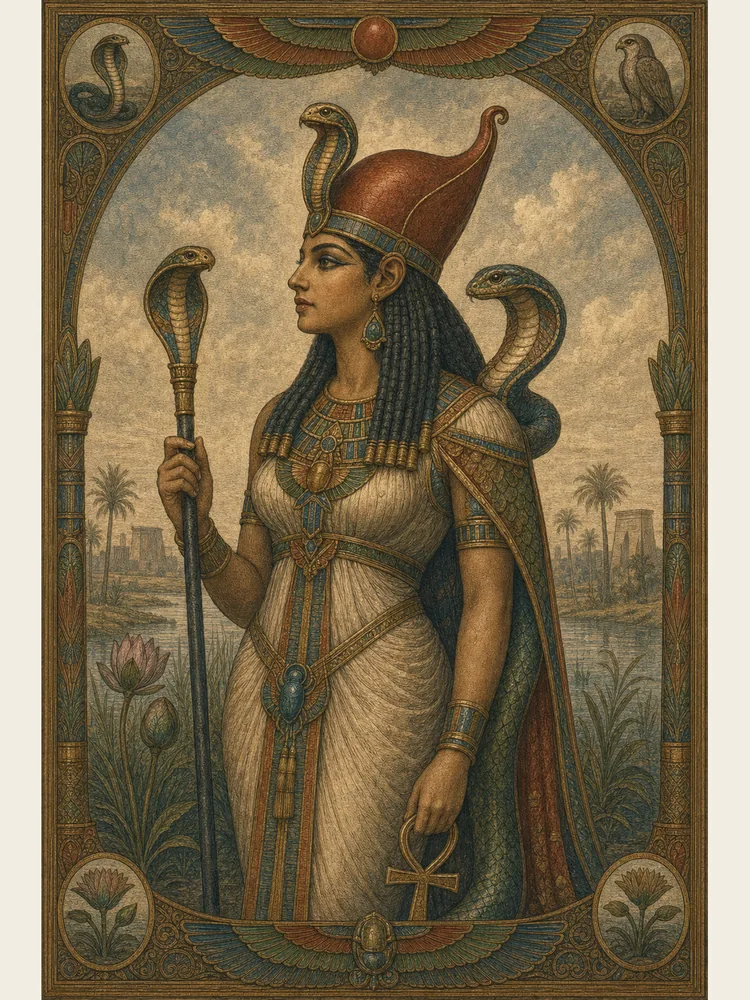
Wadjet, plate

Wadjet was the cobra-goddess of Lower Egypt, the tutelary goddess of the Delta, paired with Nekhbet as the second of the Two Ladies of pharaonic protocol. Her cult-city was Buto (Egyptian Per-Wadjet, modern Tell el-Fara'in) in the western Delta. She was depicted as a cobra alone, often with her hood inflated; or as a woman with the cobra's head; or, most famously, as the uraeus — the rearing-cobra image that adorned the brow of the pharaoh upon his crown. The uraeus was Wadjet incarnate: the spitting-cobra serpent that stood ready to strike at the king's enemies, that protected him in life and in death, and that was understood as the visible form of the goddess's protective fury. "The cobra is at her place upon thy brow," runs a familiar royal hymn; "thou hast inherited her ferocity."

Beyond her royal function, Wadjet protected the marshes and the waters of Lower Egypt, and her child Horus (in his identification with the king of Lower Egypt) was held to have been raised in her safekeeping in the Delta papyrus-thickets — a story that runs in parallel to the Isis-and-Horus marsh-narrative of the Osirian cycle, and that may represent an older, separate Lower Egyptian tradition of the divine child's hidden upbringing.
Curator’s note

What the sources say, and what later tradition added. The sources for this bay

Wadjet's cult at Buto is attested from the earliest dynasties; her role as Lower Egyptian counterpart to Upper Egyptian Nekhbet is canonical from the First Dynasty. The uraeus image as her manifestation is among the most stable and widespread of Egyptian royal symbols, found on virtually every royal crown for three thousand years. The Buto-papyrus-marsh upbringing of Horus the child is sometimes treated as a Lower Egyptian variant tradition that was harmonized with the Isiac upbringing in later theology; the two narratives may have been originally independent.

Kin in the sources

Each tie is quoted from the entry that states it.

When the sources speak

Dated witnesses for The Protectors and the Sages. A date marks when the evidence was written down, not when the belief began. The whole timeline

c. 4000–3100 BCE
Predynastic regional symbols, burials, standards, and animal cults provide the deep background to later divine iconography.
c. 3100–2686 BCE
Early Dynastic kingship joins royal ideology to local cult centers and establishes many durable divine emblems.
c. 2686–2181 BCE
Old Kingdom pyramid complexes and the Pyramid Texts preserve the earliest large religious corpus.
c. 2181–1650 BCE
First Intermediate and Middle Kingdom traditions broaden mortuary access; Coffin Texts develop older royal materials.
c. 1550–1070 BCE
New Kingdom temple wealth, royal hymns, underworld books, and the Book of Going Forth by Day greatly expand the record.
c. 1353–1336 BCE
Akhenaten’s Aten program reorganizes royal cult but does not permanently erase the older divine plurality.
c. 1070–664 BCE
Third Intermediate Period priestly and regional powers reshape cult administration and divine kingship.
664–332 BCE
Late Period archaism, animal cults, and temple scholarship preserve and reinterpret older forms.

Floor plan

The rooms follow one another in the order their peoples first appear in the written record.

  1. The Cradle of Citiesc. 3400 BCE to 395 CE. 115 works
  2. The Gift of the Nilec. 4000 BCE to 395 CE. 73 works
  3. The Olympian Orderc. 1600 BCE to 750 CE. 152 works
  4. The Persian Worldc. 2000 BCE to 1010 CE. 30 works
  5. The Levantine Borderlandsc. 1200 BCE to 500 CE. 20 works
  6. The Edges of Empirec. 2000 BCE to 1500 CE. 33 works
  7. The Etruscan Worldc. 900 BCE to 750 CE. 22 works
  8. The Roman Inheritancec. 1200 BCE to 500 CE. 58 works
  9. The Northern Inheritancec. 2000 BCE to 1600 CE. 131 works