A Compendium of the Ancient Gods
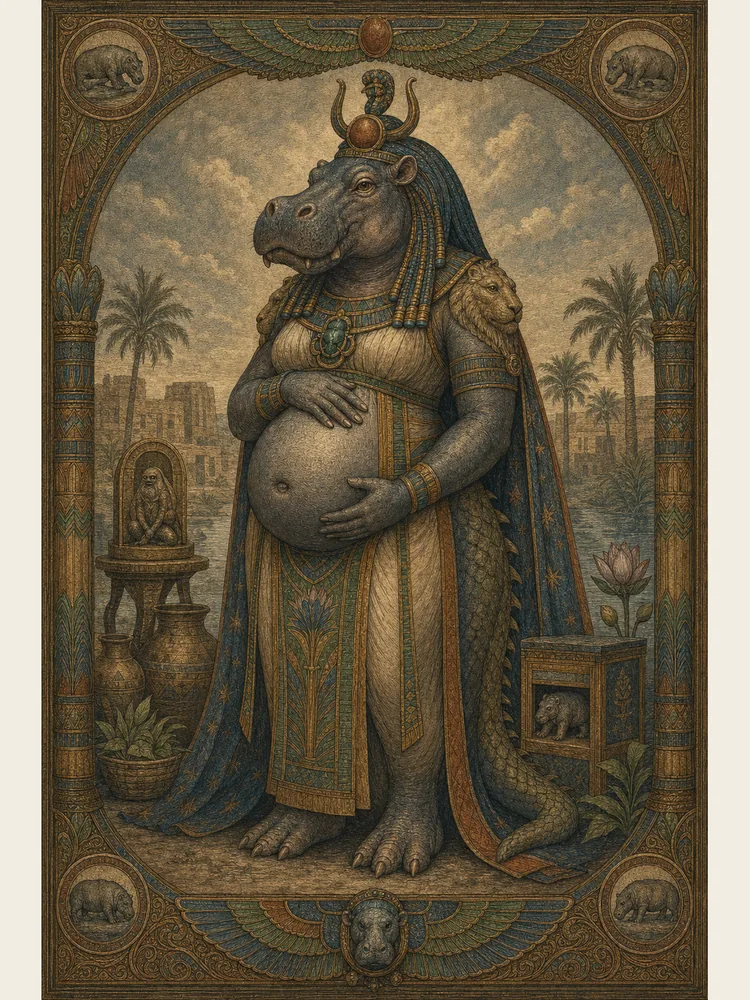
Taweret, plate

Taweret was the hippopotamus-goddess, the protector of women in childbirth, paired with Bes as the chief domestic guardian of the pregnant and the newly-born. She was depicted in a striking composite form: the body of a pregnant hippopotamus standing upright, the limbs of a lioness, the back and tail of a crocodile, and pendulous human breasts. The composite image was the visual representation of her protective function: each component beast was, in life, a danger to women and children, and the goddess took into herself their menacing forms in order to turn their force against the threats that menaced the household. She typically held a sa-amulet (a knot-symbol of protection) and a knife, with which she could cut through any harm.

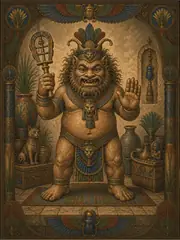
Like Bes, Taweret had no great temple cult; her presence was domestic. Her amulets were worn during pregnancy; her image was placed by the bedside of women in labor; she protected the newborn in his first days. She was also, more obscurely, a celestial figure: the constellation she gave her name to (Egyptian Reret, "the female hippopotamus") was one of the great northern constellations of the Egyptian sky, and her image appears on the astronomical ceilings of New Kingdom and Late Period tombs.
Curator’s note

What the sources say, and what later tradition added. The sources for this bay

Taweret's iconography — the pregnant upright hippopotamus with leonine and crocodilian features — is attested from the Middle Kingdom and continues stably through the Roman period. Faience and stone amulets of Taweret survive in great numbers, and her image was carved onto the ivory "magic wands" or "birth tusks" used in birth-rituals throughout the New Kingdom. The astronomical Taweret constellation is depicted on the ceiling of the tomb of Senenmut (the architect-favorite of Hatshepsut) and on the famous Dendera Zodiac, where she stands in the northern sky among the circumpolar stars.

Kin in the sources

Each tie is quoted from the entry that states it.

When the sources speak

Dated witnesses for The Protectors and the Sages. A date marks when the evidence was written down, not when the belief began. The whole timeline

c. 4000–3100 BCE
Predynastic regional symbols, burials, standards, and animal cults provide the deep background to later divine iconography.
c. 3100–2686 BCE
Early Dynastic kingship joins royal ideology to local cult centers and establishes many durable divine emblems.
c. 2686–2181 BCE
Old Kingdom pyramid complexes and the Pyramid Texts preserve the earliest large religious corpus.
c. 2181–1650 BCE
First Intermediate and Middle Kingdom traditions broaden mortuary access; Coffin Texts develop older royal materials.
c. 1550–1070 BCE
New Kingdom temple wealth, royal hymns, underworld books, and the Book of Going Forth by Day greatly expand the record.
c. 1353–1336 BCE
Akhenaten’s Aten program reorganizes royal cult but does not permanently erase the older divine plurality.
c. 1070–664 BCE
Third Intermediate Period priestly and regional powers reshape cult administration and divine kingship.
664–332 BCE
Late Period archaism, animal cults, and temple scholarship preserve and reinterpret older forms.

Floor plan

The rooms follow one another in the order their peoples first appear in the written record.

  1. The Cradle of Citiesc. 3400 BCE to 395 CE. 115 works
  2. The Gift of the Nilec. 4000 BCE to 395 CE. 73 works
  3. The Olympian Orderc. 1600 BCE to 750 CE. 152 works
  4. The Persian Worldc. 2000 BCE to 1010 CE. 30 works
  5. The Levantine Borderlandsc. 1200 BCE to 500 CE. 20 works
  6. The Edges of Empirec. 2000 BCE to 1500 CE. 33 works
  7. The Etruscan Worldc. 900 BCE to 750 CE. 22 works
  8. The Roman Inheritancec. 1200 BCE to 500 CE. 58 works
  9. The Northern Inheritancec. 2000 BCE to 1600 CE. 131 works