A Compendium of the Ancient Gods
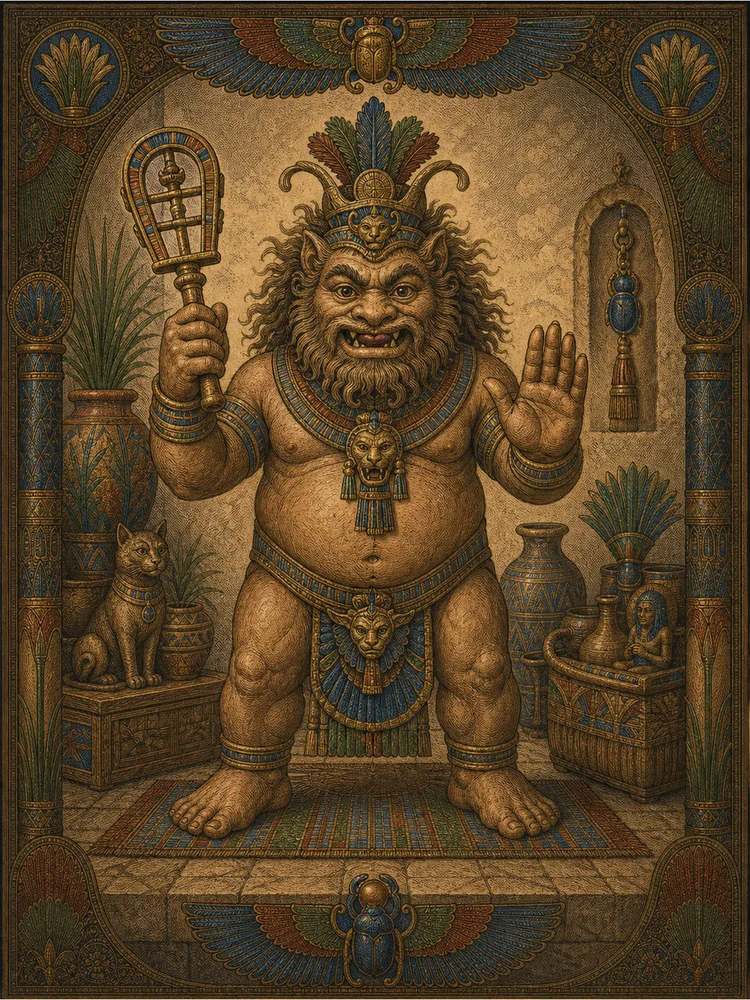
Bes, plate

Bes was the dwarf-god of the household, the protector of women in childbirth and of children in their cradles, the guardian against snakes and scorpions, the patron of music and dance and of the comforts of the home. He was depicted in a manner unlike any other Egyptian god: not in profile, but frontally — staring straight out at the viewer, with a comically grotesque face (broad nose, lolling tongue, exaggerated eyebrows), short bowed legs, prominent belly, and a lion's mane and tail. He often wore a feathered headdress and carried a tambourine or a knife. The frontal depiction was apotropaic: the god's grotesque face stared at any threatening force and frightened it away. Bes was painted on the walls of bedrooms, carved into the legs of beds and chairs, worn as amulets, and stamped onto cosmetic implements and household furniture; his presence was meant to be everywhere in the home that mattered.

He had no great mythological cycle, no temple of imperial scale, no priesthood of grand titles. He was a god of the everyday, of small dangers and small comforts, and he was probably more often invoked in private prayer than any of the great gods of the official cult. His origins are obscure — possibly Nubian or African, possibly genuinely indigenous — but his cult flourished from the Middle Kingdom through the Roman period, and beyond the borders of Egypt his image traveled widely: Bes amulets are found in Phoenician contexts, in Cypriot, in southern Italian, and across the Hellenistic and Roman Mediterranean.
Curator’s note

What the sources say, and what later tradition added. The sources for this bay

Bes's iconography — frontal-facing, grotesque, leonine — is among the most distinctive in Egyptian art, and is one of the few cases in which the Egyptian artistic convention of strict profile was systematically broken. His association with childbirth is documented in the so-called "birth-bricks," the bricks upon which Egyptian women squatted in delivery, several of which survive painted with images of Bes and Taweret. His export beyond Egypt is well documented archaeologically; Bes amulets are among the most common Egyptian-derived items found in Phoenician and other Mediterranean contexts. His African origins have been argued from his physiognomy and his association with leonine features; the question is unresolved.

Kin in the sources

Each tie is quoted from the entry that states it.

When the sources speak

Dated witnesses for The Protectors and the Sages. A date marks when the evidence was written down, not when the belief began. The whole timeline

c. 4000–3100 BCE
Predynastic regional symbols, burials, standards, and animal cults provide the deep background to later divine iconography.
c. 3100–2686 BCE
Early Dynastic kingship joins royal ideology to local cult centers and establishes many durable divine emblems.
c. 2686–2181 BCE
Old Kingdom pyramid complexes and the Pyramid Texts preserve the earliest large religious corpus.
c. 2181–1650 BCE
First Intermediate and Middle Kingdom traditions broaden mortuary access; Coffin Texts develop older royal materials.
c. 1550–1070 BCE
New Kingdom temple wealth, royal hymns, underworld books, and the Book of Going Forth by Day greatly expand the record.
c. 1353–1336 BCE
Akhenaten’s Aten program reorganizes royal cult but does not permanently erase the older divine plurality.
c. 1070–664 BCE
Third Intermediate Period priestly and regional powers reshape cult administration and divine kingship.
664–332 BCE
Late Period archaism, animal cults, and temple scholarship preserve and reinterpret older forms.

Floor plan

The rooms follow one another in the order their peoples first appear in the written record.

  1. The Cradle of Citiesc. 3400 BCE to 395 CE. 115 works
  2. The Gift of the Nilec. 4000 BCE to 395 CE. 73 works
  3. The Olympian Orderc. 1600 BCE to 750 CE. 152 works
  4. The Persian Worldc. 2000 BCE to 1010 CE. 30 works
  5. The Levantine Borderlandsc. 1200 BCE to 500 CE. 20 works
  6. The Edges of Empirec. 2000 BCE to 1500 CE. 33 works
  7. The Etruscan Worldc. 900 BCE to 750 CE. 22 works
  8. The Roman Inheritancec. 1200 BCE to 500 CE. 58 works
  9. The Northern Inheritancec. 2000 BCE to 1600 CE. 131 works