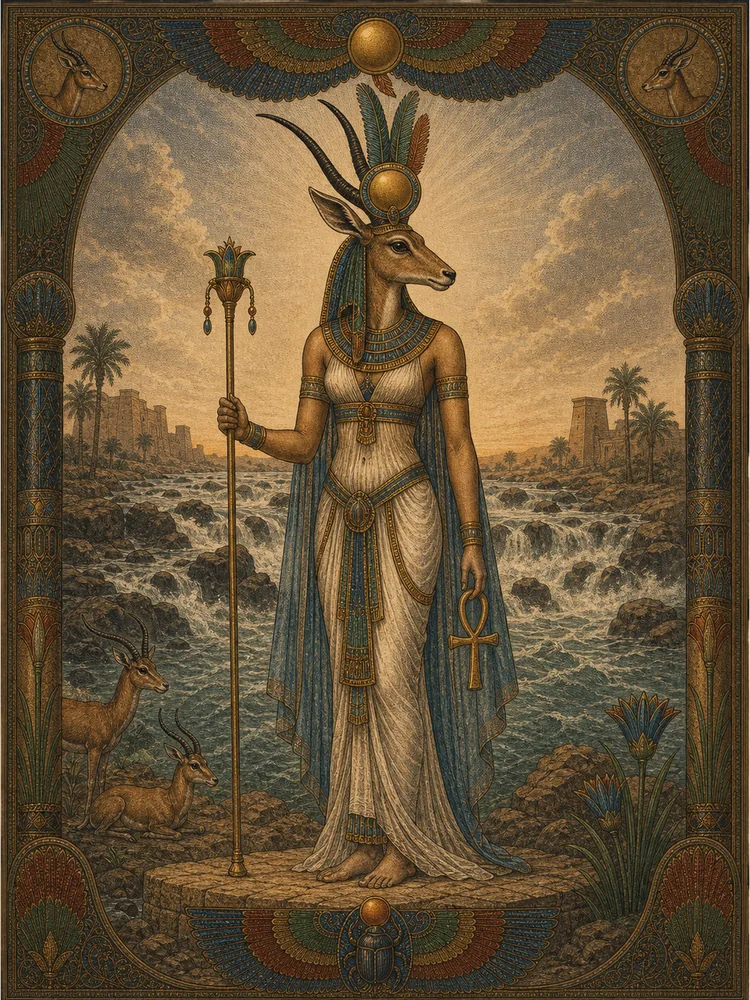
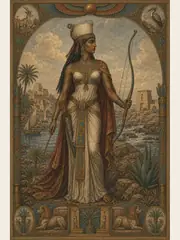
Anuket was a goddess of the southern frontier, of the cataract at Aswan where the Nile flows out of the rocks, and of the inundation that the priests of Elephantine credited her with releasing each summer from her father Khnum's caverns. She was depicted as a woman wearing a high feather crown, sometimes shown with the gazelle as her sacred animal; her cult-island was Sehel, just upstream of Elephantine, where her sanctuary stood. With Khnum and Satet, she completed the triad of the cataract, and her annual festival celebrated the arrival of the inundation flood at the Egyptian frontier.
 Before thisAker
 Next on the wallBes
Curator’s note
What the sources say, and what later tradition added. The sources for this bay
Anuket's cult is attested from at least the Middle Kingdom; she is well documented in Nubian inscriptions also, where her cult extended south into Lower Nubia. The gazelle as her sacred animal is somewhat unusual in the Egyptian repertoire; the connection to her cataract setting may be that gazelles were native to the desert margins of the Aswan region. The triad of Khnum-Satet-Anuket is parallel in structure to the Theban triad of Amun-Mut-Khonsu and the Memphite triad of Ptah-Sekhmet-Nefertum, exemplifying the Egyptian preference for triadic family-groups in civic theology.
Kin in the sources
Each tie is quoted from the entry that states it.
 Child ofKhnum
releasing each summer from her father Khnum's caverns
- Consort ofKhnum
His consort was Anuket, the gazelle-goddess of the cataract
 Child ofSatis
Khnum the father, Satis the mother, and Anuket their daughter
When the sources speak
Dated witnesses for The Protectors and the Sages. A date marks when the evidence was written down, not when the belief began. The whole timeline
- c. 4000–3100 BCE
- Predynastic regional symbols, burials, standards, and animal cults provide the deep background to later divine iconography.
- c. 3100–2686 BCE
- Early Dynastic kingship joins royal ideology to local cult centers and establishes many durable divine emblems.
- c. 2686–2181 BCE
- Old Kingdom pyramid complexes and the Pyramid Texts preserve the earliest large religious corpus.
- c. 2181–1650 BCE
- First Intermediate and Middle Kingdom traditions broaden mortuary access; Coffin Texts develop older royal materials.
- c. 1550–1070 BCE
- New Kingdom temple wealth, royal hymns, underworld books, and the Book of Going Forth by Day greatly expand the record.
- c. 1353–1336 BCE
- Akhenaten’s Aten program reorganizes royal cult but does not permanently erase the older divine plurality.
- c. 1070–664 BCE
- Third Intermediate Period priestly and regional powers reshape cult administration and divine kingship.
- 664–332 BCE
- Late Period archaism, animal cults, and temple scholarship preserve and reinterpret older forms.