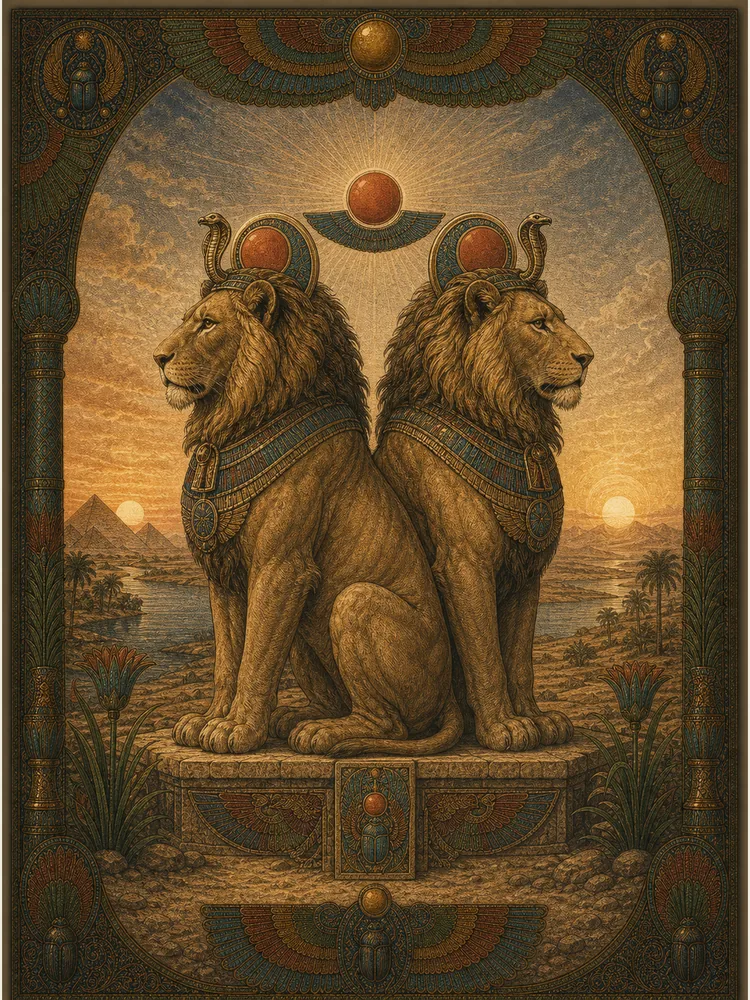
Aker was the personification of the horizon — the threshold between day and night, between this world and the next, between the visible and the hidden. He was depicted as a strip of land with two lion-heads, one looking east and one looking west, marking the rising and setting of the sun; or simply as two recumbent lions back to back, between which the solar disk passed at dawn and at dusk. The hieroglyph for "horizon" itself, akhet, depicted the sun rising between two mountains, and Aker was the divine personification of this image. He was a guardian of the dead in their transit through the underworld — the two lions opening their jaws to admit the solar barque on its night journey — and his image was placed on tomb walls as protection against the dangers of the threshold.
 Next on the wallAnuket
Curator’s note
What the sources say, and what later tradition added. The sources for this bay
Aker is attested from the Old Kingdom and continuously through the New Kingdom and Late Period. His double-lion image is depicted in the Amduat (the New Kingdom underworld text inscribed in royal tombs) and in many funerary papyri. The Sphinx at Giza has been speculatively associated with Aker by some commentators on the basis of its leonine form and its position at the eastern horizon of the Giza plateau, but the Sphinx is more securely identified with the solar god Horemakhet ("Horus of the Horizon") in its New Kingdom and Late Period cult.
When the sources speak
Dated witnesses for The Protectors and the Sages. A date marks when the evidence was written down, not when the belief began. The whole timeline
- c. 4000–3100 BCE
- Predynastic regional symbols, burials, standards, and animal cults provide the deep background to later divine iconography.
- c. 3100–2686 BCE
- Early Dynastic kingship joins royal ideology to local cult centers and establishes many durable divine emblems.
- c. 2686–2181 BCE
- Old Kingdom pyramid complexes and the Pyramid Texts preserve the earliest large religious corpus.
- c. 2181–1650 BCE
- First Intermediate and Middle Kingdom traditions broaden mortuary access; Coffin Texts develop older royal materials.
- c. 1550–1070 BCE
- New Kingdom temple wealth, royal hymns, underworld books, and the Book of Going Forth by Day greatly expand the record.
- c. 1353–1336 BCE
- Akhenaten’s Aten program reorganizes royal cult but does not permanently erase the older divine plurality.
- c. 1070–664 BCE
- Third Intermediate Period priestly and regional powers reshape cult administration and divine kingship.
- 664–332 BCE
- Late Period archaism, animal cults, and temple scholarship preserve and reinterpret older forms.