A Compendium of the Ancient Gods
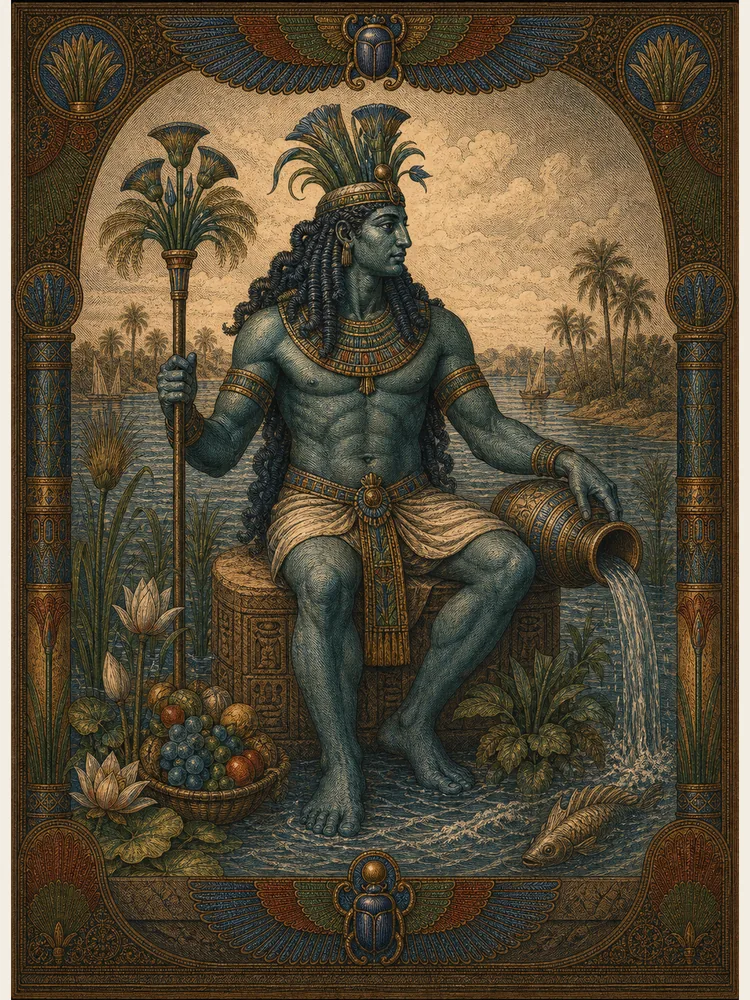
Hapi, plate

Hapi (sometimes Hapy, to distinguish him from the unrelated god Hapi the son of Horus, who was a different deity) was the personification of the annual Nile inundation — the flood that each summer rose from the cataracts, swept down the country, deposited its rich black silt upon the fields, and made Egyptian agriculture possible. He was depicted in a curious form, not common elsewhere in Egyptian iconography: a man with pendulous breasts, signifying nourishment; a thick belly, signifying abundance; blue or green skin, signifying the river's waters; and a crown of papyrus or lotus, signifying the plants of the Nile's two regions, Upper and Lower Egypt. Two Hapi figures (one for each region, the one with papyrus, the other with lotus) were often shown together, tying the plants of the two halves of Egypt around the symbol of unification — a standard motif of pharaonic iconography asserting the Egyptian state's unity from the cataract to the Delta.

Hapi had no great temple — for the inundation came everywhere, and was not localized — but small shrines at Gebel el-Silsila and elsewhere preserved his cult, and at the moment of the inundation's arrival each year, offerings were thrown into the river to thank him for his bounty. The Hymn to Hapi, preserved in a Middle Kingdom papyrus, is among the most rapturous of Egyptian devotional poems. "Praise to thee, Hapi, who comest forth from the earth, who comest to nourish Egypt.... Thou makest the granaries to overflow.... When thou art high, the land is in joy.... When thou retreatest, every face is dark."

Curator’s note

What the sources say, and what later tradition added. The sources for this bay

The Hymn to Hapi (Middle Kingdom Papyrus Sallier II and parallels) is one of the few extended hymnic texts from the Middle Kingdom; it celebrates the annual inundation's role in Egyptian survival. Hapi's iconography (the bisexual or maternal-male figure) is unusual and reflects the Egyptian conception of the inundation as a nourishing and bestowing force, neither strictly masculine nor feminine. The annual Nile inundation, central to Egyptian agriculture for five thousand years, was effectively ended by the construction of the Aswan High Dam (1970), which now controls the river's flow; the seasonal flooding that gave Hapi his cult and his hymns no longer occurs. Whether anything is to be made of this from a historical-religious standpoint is left to the reader.

When the sources speak

Dated witnesses for The Protectors and the Sages. A date marks when the evidence was written down, not when the belief began. The whole timeline

c. 4000–3100 BCE
Predynastic regional symbols, burials, standards, and animal cults provide the deep background to later divine iconography.
c. 3100–2686 BCE
Early Dynastic kingship joins royal ideology to local cult centers and establishes many durable divine emblems.
c. 2686–2181 BCE
Old Kingdom pyramid complexes and the Pyramid Texts preserve the earliest large religious corpus.
c. 2181–1650 BCE
First Intermediate and Middle Kingdom traditions broaden mortuary access; Coffin Texts develop older royal materials.
c. 1550–1070 BCE
New Kingdom temple wealth, royal hymns, underworld books, and the Book of Going Forth by Day greatly expand the record.
c. 1353–1336 BCE
Akhenaten’s Aten program reorganizes royal cult but does not permanently erase the older divine plurality.
c. 1070–664 BCE
Third Intermediate Period priestly and regional powers reshape cult administration and divine kingship.
664–332 BCE
Late Period archaism, animal cults, and temple scholarship preserve and reinterpret older forms.

Floor plan

The rooms follow one another in the order their peoples first appear in the written record.

  1. The Cradle of Citiesc. 3400 BCE to 395 CE. 115 works
  2. The Gift of the Nilec. 4000 BCE to 395 CE. 73 works
  3. The Olympian Orderc. 1600 BCE to 750 CE. 152 works
  4. The Persian Worldc. 2000 BCE to 1010 CE. 30 works
  5. The Levantine Borderlandsc. 1200 BCE to 500 CE. 20 works
  6. The Edges of Empirec. 2000 BCE to 1500 CE. 33 works
  7. The Etruscan Worldc. 900 BCE to 750 CE. 22 works
  8. The Roman Inheritancec. 1200 BCE to 500 CE. 58 works
  9. The Northern Inheritancec. 2000 BCE to 1600 CE. 131 works