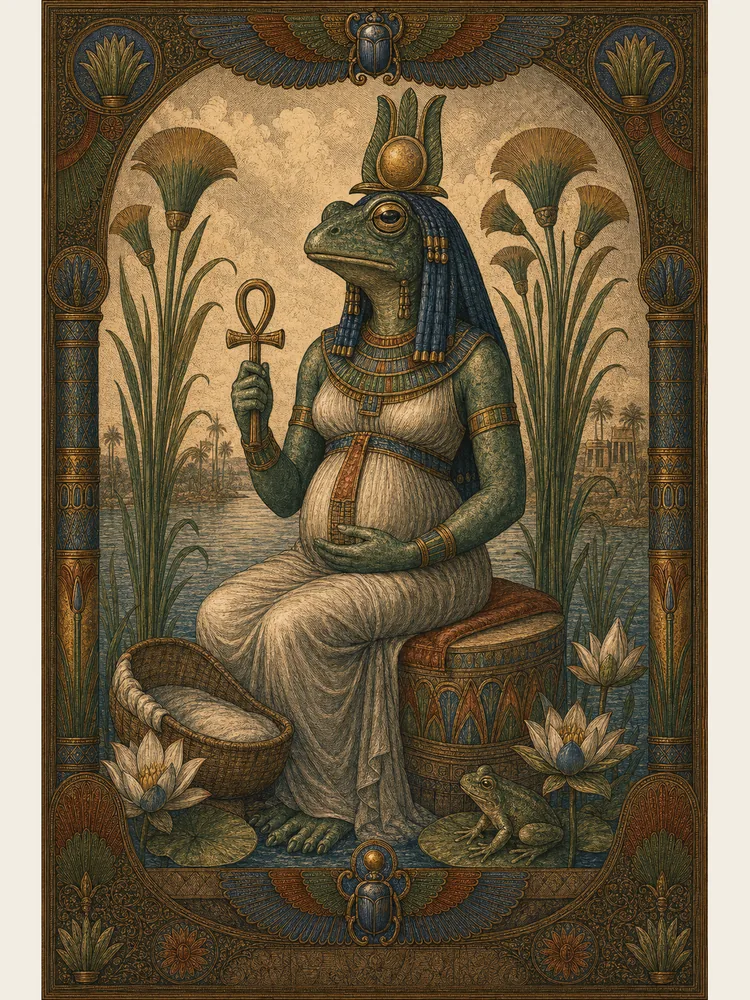
Heqet was a frog-headed goddess of childbirth, depicted as a woman with the head of a frog or as a wholly frog-form figure. The frog was sacred to her because the frogs of the Nile, multiplying after the annual inundation in great numbers, were a symbol of fertility and renewal; her presence at births was believed to assist the delivery, and small Heqet-amulets in the form of frogs were worn by pregnant women throughout pharaonic history. She was paired with Khnum in some local theologies, particularly in the upper Nile, where Khnum at his potter's wheel was held to fashion the body of the child while Heqet breathed life into it.
 Before thisHapi
 Next on the wallMehen
Curator’s note
What the sources say, and what later tradition added. The sources for this bay
Heqet is attested from the Old Kingdom; her cult was widespread but never central, the kind of practical-helping deity who is invoked daily but never builds great temples. Her role at birth is described in the New Kingdom Tale of King Cheops's Court (Westcar Papyrus), in which she and other goddesses appear in disguise to assist at the birth of the three royal children destined for the throne. The Christian-era persistence of frog imagery in Egyptian devotional contexts (small lamps in the form of frogs, with Christian inscriptions) has been argued to reflect a continuity from Heqet's older cult, though the case is not certain.
Kin in the sources
Each tie is quoted from the entry that states it.
 Companion ofKhnum
She was paired with Khnum in some local theologies, particularly in the upper Nile
When the sources speak
Dated witnesses for The Protectors and the Sages. A date marks when the evidence was written down, not when the belief began. The whole timeline
- c. 4000–3100 BCE
- Predynastic regional symbols, burials, standards, and animal cults provide the deep background to later divine iconography.
- c. 3100–2686 BCE
- Early Dynastic kingship joins royal ideology to local cult centers and establishes many durable divine emblems.
- c. 2686–2181 BCE
- Old Kingdom pyramid complexes and the Pyramid Texts preserve the earliest large religious corpus.
- c. 2181–1650 BCE
- First Intermediate and Middle Kingdom traditions broaden mortuary access; Coffin Texts develop older royal materials.
- c. 1550–1070 BCE
- New Kingdom temple wealth, royal hymns, underworld books, and the Book of Going Forth by Day greatly expand the record.
- c. 1353–1336 BCE
- Akhenaten’s Aten program reorganizes royal cult but does not permanently erase the older divine plurality.
- c. 1070–664 BCE
- Third Intermediate Period priestly and regional powers reshape cult administration and divine kingship.
- 664–332 BCE
- Late Period archaism, animal cults, and temple scholarship preserve and reinterpret older forms.