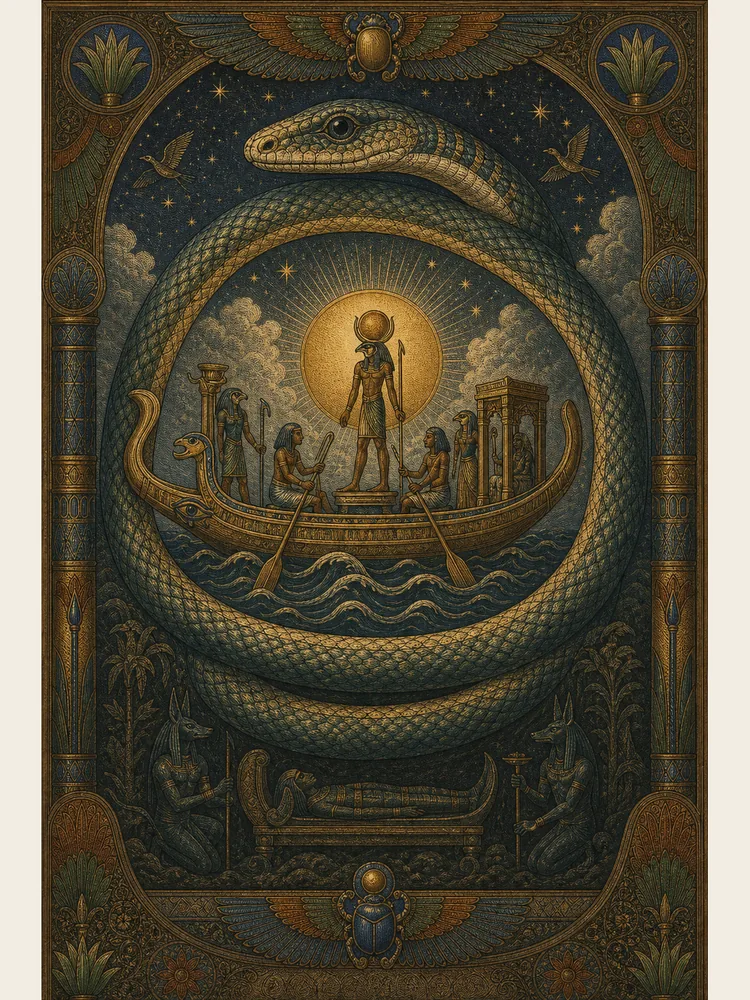
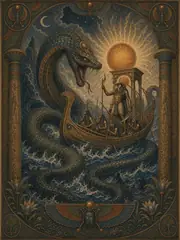
Mehen was a great serpent who coiled himself around the solar barque each night to protect it from the attacks of Apep. Where Apep was the chaos-serpent that threatened the sun, Mehen was the protective serpent that defended it; his coiled body formed a kind of mobile fortress around the cabin of Ra in the night-barque. The image of the coiled Mehen is a standard feature of the underworld books inscribed in the royal tombs, where he is depicted with his coils enclosing Ra's shrine. Mehen gave his name to a board game of the Old Kingdom, played upon a circular spiral track in the form of a coiled snake; the connection between the game and the protective serpent is presumed to be religious, but the rules of the game are not preserved.
 Before thisHeqet
 Next on the wallNefertum
Curator’s note
What the sources say, and what later tradition added. The sources for this bay
The Mehen game-boards are attested from the Old Kingdom into the Middle Kingdom, after which the game seems to have fallen out of use; they are among the earliest preserved board games in the world, but the rules of play are unknown. The serpent-deity Mehen continues to appear in funerary literature long after the game has disappeared. The protective coiling motif — a serpent enclosing a sacred space — is widespread in the ancient Near East and may underlie certain Greek images of the Ouroboros (the serpent biting its own tail) and various medieval European serpentine protective symbols, though the lines of transmission are not always clear.
Kin in the sources
Each tie is quoted from the entry that states it.
 Rival ofApep
coiled himself around the solar barque each night to protect it from the attacks of Apep
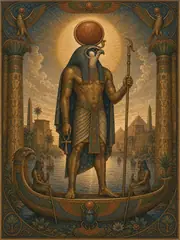 Companion ofRa
he is depicted with his coils enclosing Ra's shrine
When the sources speak
Dated witnesses for The Protectors and the Sages. A date marks when the evidence was written down, not when the belief began. The whole timeline
- c. 4000–3100 BCE
- Predynastic regional symbols, burials, standards, and animal cults provide the deep background to later divine iconography.
- c. 3100–2686 BCE
- Early Dynastic kingship joins royal ideology to local cult centers and establishes many durable divine emblems.
- c. 2686–2181 BCE
- Old Kingdom pyramid complexes and the Pyramid Texts preserve the earliest large religious corpus.
- c. 2181–1650 BCE
- First Intermediate and Middle Kingdom traditions broaden mortuary access; Coffin Texts develop older royal materials.
- c. 1550–1070 BCE
- New Kingdom temple wealth, royal hymns, underworld books, and the Book of Going Forth by Day greatly expand the record.
- c. 1353–1336 BCE
- Akhenaten’s Aten program reorganizes royal cult but does not permanently erase the older divine plurality.
- c. 1070–664 BCE
- Third Intermediate Period priestly and regional powers reshape cult administration and divine kingship.
- 664–332 BCE
- Late Period archaism, animal cults, and temple scholarship preserve and reinterpret older forms.