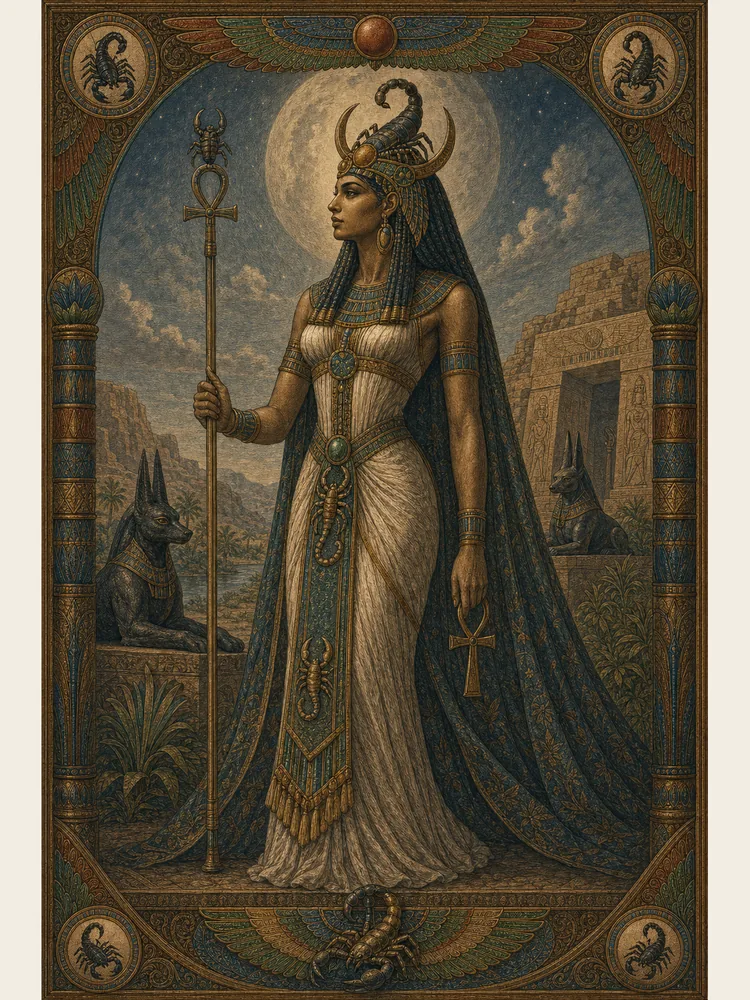
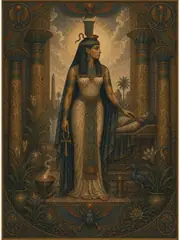
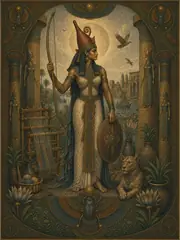
Serqet (sometimes Selket or Selqet) was the scorpion-goddess, depicted as a woman with a scorpion crowning her head, or sometimes as a woman with a scorpion's body. She was a goddess of healing the bites and stings of poisonous creatures — and her priests, who were also physicians and snake-charmers, served the same protective function — and a funerary goddess of the canopic system, where she protected the canopic jar that contained the intestines of the dead. She is most familiar to modern visitors to museums from the great gilded statue of her, with her arms outstretched to protect the canopic shrine of Tutankhamun, that stands now in the Egyptian Museum in Cairo; the statue, with its delicate forward stride and protective gesture, is among the most beautiful examples of New Kingdom royal art.
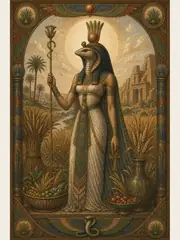 Before thisRenenutet
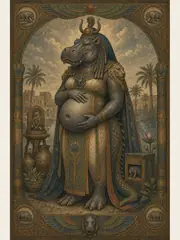 Next on the wallTaweret
Curator’s note
What the sources say, and what later tradition added. The sources for this bay
Serqet's cult is attested from the Old Kingdom; her protective role over the canopic jar of the intestines (alongside Isis for the liver, Nephthys for the lungs, and Neith for the stomach) is canonical. The Tutankhamun statue is one of four matching figures placed at the four corners of the canopic shrine in the king's tomb. The scorpion-and-serpent priests of Serqet, attested from several Late Period sources, were a specialized order of healing-magicians whose practice combined medical, magical, and herpetological knowledge in a manner that the modern reader may find quite reasonable for the management of envenomation in a country well stocked with poisonous wildlife.
Kin in the sources
Each tie is quoted from the entry that states it.
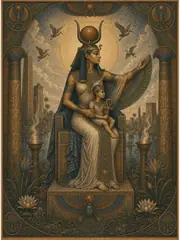 Companion ofIsis
alongside Isis for the liver, Nephthys for the lungs, and Neith for the stomach
 Companion ofNephthys
alongside Isis for the liver, Nephthys for the lungs, and Neith for the stomach
 Companion ofNeith
alongside Isis for the liver, Nephthys for the lungs, and Neith for the stomach
When the sources speak
Dated witnesses for The Protectors and the Sages. A date marks when the evidence was written down, not when the belief began. The whole timeline
- c. 4000–3100 BCE
- Predynastic regional symbols, burials, standards, and animal cults provide the deep background to later divine iconography.
- c. 3100–2686 BCE
- Early Dynastic kingship joins royal ideology to local cult centers and establishes many durable divine emblems.
- c. 2686–2181 BCE
- Old Kingdom pyramid complexes and the Pyramid Texts preserve the earliest large religious corpus.
- c. 2181–1650 BCE
- First Intermediate and Middle Kingdom traditions broaden mortuary access; Coffin Texts develop older royal materials.
- c. 1550–1070 BCE
- New Kingdom temple wealth, royal hymns, underworld books, and the Book of Going Forth by Day greatly expand the record.
- c. 1353–1336 BCE
- Akhenaten’s Aten program reorganizes royal cult but does not permanently erase the older divine plurality.
- c. 1070–664 BCE
- Third Intermediate Period priestly and regional powers reshape cult administration and divine kingship.
- 664–332 BCE
- Late Period archaism, animal cults, and temple scholarship preserve and reinterpret older forms.