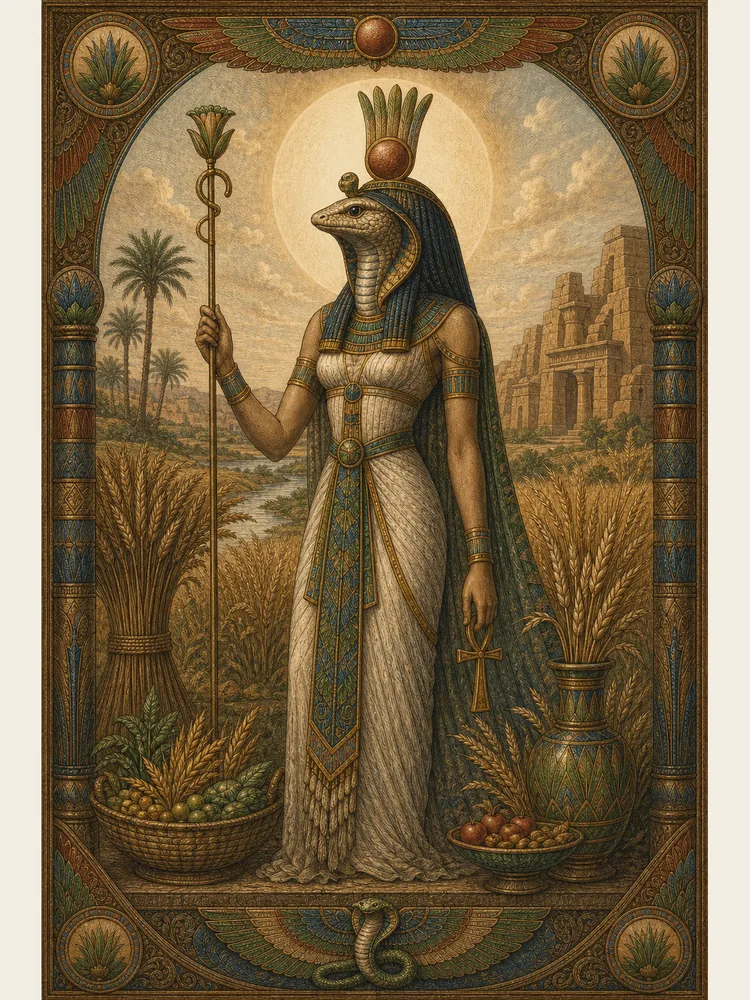
Renenutet was a cobra-goddess of the harvest and of the granary, the protector of the threshing-floor and the bestower of the children's names (her name itself signifies "she who nourishes" or possibly "she who names"). She was depicted as a woman with the head of a cobra, or as a cobra alone with a solar disk between her hood-flaps. Her festivals fell at the harvest, when her image was brought out to bless the threshing-floor and the granary; small images of her were set up in granaries throughout Egypt as protectors of the stored grain against rodents, against rot, and against the hunger of the year to come. She was associated also with the naming of children: at the birth, the goddess was held to pronounce the child's true name, the inner name that determined his fate, and parents in their devotion to her hoped that her pronouncement would be kind.
 Before thisNekhbet
 Next on the wallSerqet
Curator’s note
What the sources say, and what later tradition added. The sources for this bay
Renenutet's cult is attested from the Old Kingdom; her harvest associations are documented archaeologically by small cobra-shrines found in granaries and threshing-floor contexts, particularly at Deir el-Medina (the workmen's village near the Theban necropolis), where the relatively well-preserved domestic and religious life of an Egyptian community can be reconstructed in unusual detail. Her name's etymology has been debated; the connection to the Egyptian root rn, "to name," gives her one of her offices, while the nourishing function may be a secondary derivation.
When the sources speak
Dated witnesses for The Protectors and the Sages. A date marks when the evidence was written down, not when the belief began. The whole timeline
- c. 4000–3100 BCE
- Predynastic regional symbols, burials, standards, and animal cults provide the deep background to later divine iconography.
- c. 3100–2686 BCE
- Early Dynastic kingship joins royal ideology to local cult centers and establishes many durable divine emblems.
- c. 2686–2181 BCE
- Old Kingdom pyramid complexes and the Pyramid Texts preserve the earliest large religious corpus.
- c. 2181–1650 BCE
- First Intermediate and Middle Kingdom traditions broaden mortuary access; Coffin Texts develop older royal materials.
- c. 1550–1070 BCE
- New Kingdom temple wealth, royal hymns, underworld books, and the Book of Going Forth by Day greatly expand the record.
- c. 1353–1336 BCE
- Akhenaten’s Aten program reorganizes royal cult but does not permanently erase the older divine plurality.
- c. 1070–664 BCE
- Third Intermediate Period priestly and regional powers reshape cult administration and divine kingship.
- 664–332 BCE
- Late Period archaism, animal cults, and temple scholarship preserve and reinterpret older forms.