A Compendium of the Ancient Gods
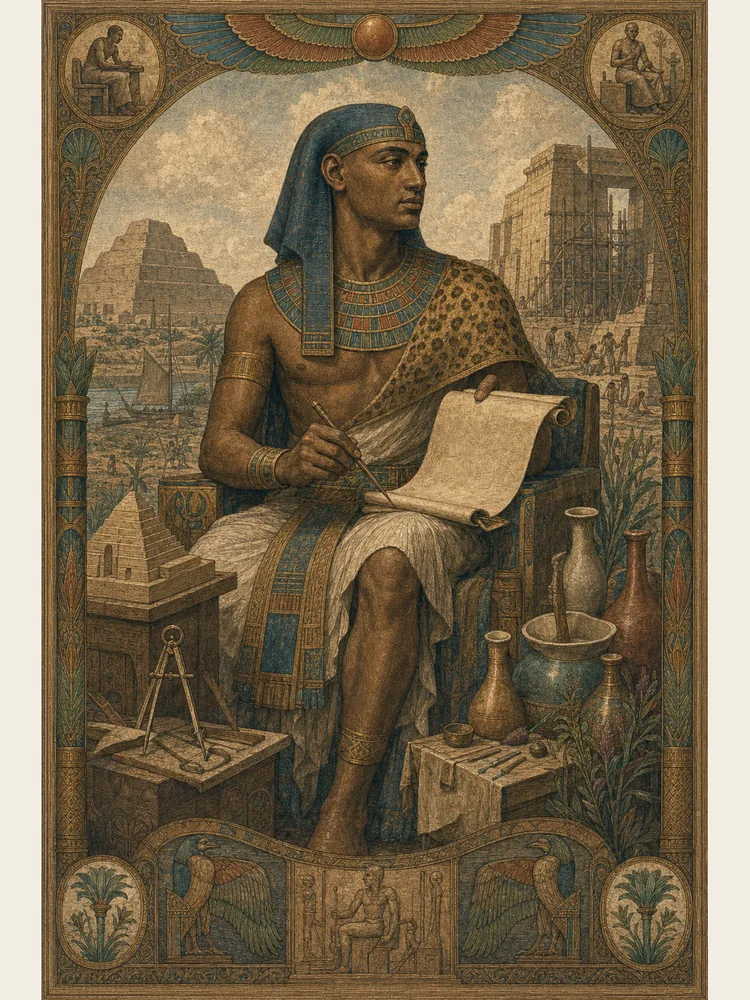
Imhotep, plate

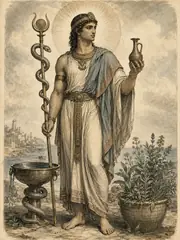
Imhotep was a historical mortal — the chancellor and chief architect of King Djoser of the Third Dynasty, in the early twenty-seventh century before the common era — who, by reason of his exceptional accomplishments, was elevated after his death into the company of the gods. He was the architect of the Step Pyramid at Saqqara, the first monumental stone construction in human history (before Imhotep, Egyptian royal tombs had been mud-brick mastabas; he conceived and executed the stacking of mastabas one upon another to form a stepped pyramid, and the building of it in carved limestone rather than mud-brick, and so set the entire subsequent course of pyramid-building in motion). He was credited in Egyptian tradition with the founding of medicine, with the composition of wisdom-texts, with proverbs preserved across millennia. He was, in his own lifetime, a vizier of Lower Egypt, a high priest of Heliopolis, and a master of all the arts of the literate.

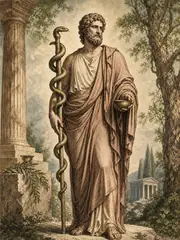
His deification proceeded gradually. Already in the Middle Kingdom, the Egyptians were addressing him as the patron of scribes; by the Late Period (after 700 BCE) he had become a fully divine figure, with temples dedicated to him at Saqqara, at Memphis, on Philae Island, and elsewhere. The Greeks identified him with Asclepius, their own god of medicine, and pilgrims journeyed to his temples in search of healing. The Imhotepa at Saqqara — the precinct of his cult, near the Step Pyramid he had built two thousand years earlier — drew sick devotees who slept overnight in the sanctuary in hopes of receiving a healing dream from the god. The continuity from the historical architect to the healing-deity, across some twenty-five centuries, is among the most remarkable trajectories in any documented religion.
Curator’s note

What the sources say, and what later tradition added. The sources for this bay

Imhotep's historical existence is securely attested by his surviving inscription on a base-statue of King Djoser at Saqqara, where he is named with his titles and the Step Pyramid is recorded as his work. His deification is documented across Late Period and Ptolemaic sources; the major studies are Jamieson Hurry, Imhotep (1926), and Dietrich Wildung, Egyptian Saints (1977). His identification with Greek Asclepius is attested in Greek and Demotic inscriptions at his Memphite and Philae sanctuaries. The phenomenon of the deified mortal — rare in Egyptian religion, where the great pantheon was generally fixed — is paralleled in the cases of Amenhotep son of Hapu (the New Kingdom architect of Amenhotep III, deified locally at Thebes) and a small number of others. Imhotep's pyramid at Saqqara, badly damaged by earthquakes and weathering over the millennia, has been the subject of ongoing restoration work in modern times.

Kin in the sources

Each tie is quoted from the entry that states it.

The same god in other rooms

The ancient sources themselves name these as one god under different names. See Eshmun, Imhotep and Asclepius hung together

When the sources speak

Dated witnesses for The Protectors and the Sages. A date marks when the evidence was written down, not when the belief began. The whole timeline

c. 4000–3100 BCE
Predynastic regional symbols, burials, standards, and animal cults provide the deep background to later divine iconography.
c. 3100–2686 BCE
Early Dynastic kingship joins royal ideology to local cult centers and establishes many durable divine emblems.
c. 2686–2181 BCE
Old Kingdom pyramid complexes and the Pyramid Texts preserve the earliest large religious corpus.
c. 2181–1650 BCE
First Intermediate and Middle Kingdom traditions broaden mortuary access; Coffin Texts develop older royal materials.
c. 1550–1070 BCE
New Kingdom temple wealth, royal hymns, underworld books, and the Book of Going Forth by Day greatly expand the record.
c. 1353–1336 BCE
Akhenaten’s Aten program reorganizes royal cult but does not permanently erase the older divine plurality.
c. 1070–664 BCE
Third Intermediate Period priestly and regional powers reshape cult administration and divine kingship.
664–332 BCE
Late Period archaism, animal cults, and temple scholarship preserve and reinterpret older forms.

Floor plan

The rooms follow one another in the order their peoples first appear in the written record.

  1. The Cradle of Citiesc. 3400 BCE to 395 CE. 115 works
  2. The Gift of the Nilec. 4000 BCE to 395 CE. 73 works
  3. The Olympian Orderc. 1600 BCE to 750 CE. 152 works
  4. The Persian Worldc. 2000 BCE to 1010 CE. 30 works
  5. The Levantine Borderlandsc. 1200 BCE to 500 CE. 20 works
  6. The Edges of Empirec. 2000 BCE to 1500 CE. 33 works
  7. The Etruscan Worldc. 900 BCE to 750 CE. 22 works
  8. The Roman Inheritancec. 1200 BCE to 500 CE. 58 works
  9. The Northern Inheritancec. 2000 BCE to 1600 CE. 131 works