A Compendium of the Ancient Gods
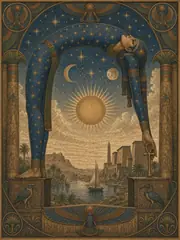
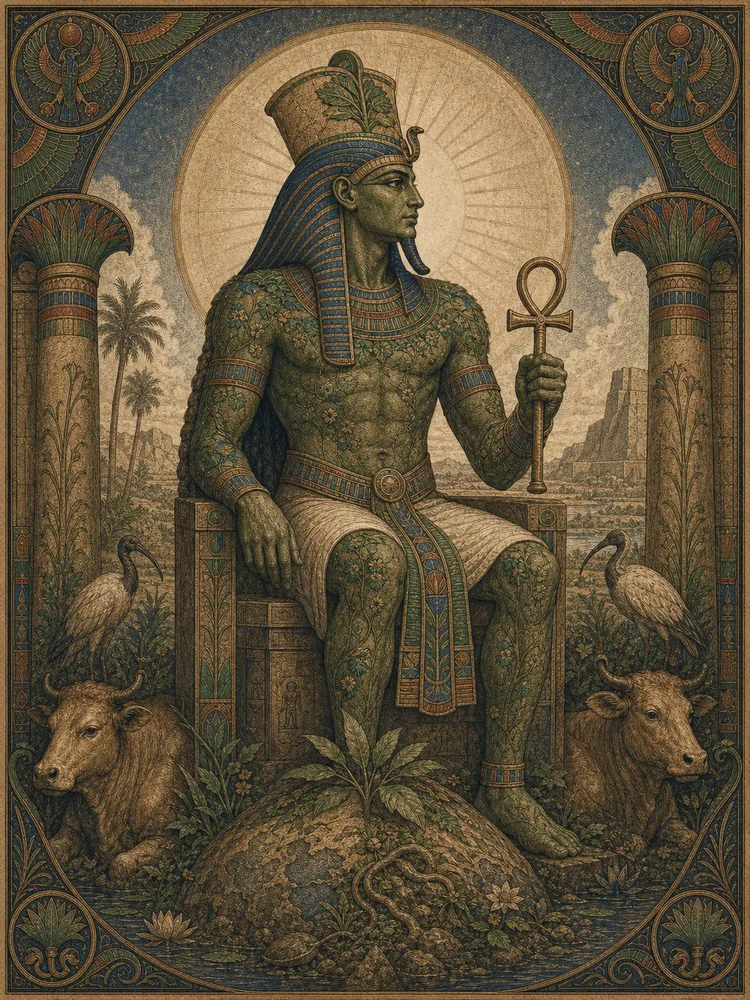
Geb, plate

Geb was the earth, the green and brown body upon which all things grow and beneath which all things are buried. He was a son of Shu and Tefnut, and the brother and consort of Nut the sky; and from their union came the four great gods of the Osirian generation. He was depicted as a man stretched upon the ground, his body sometimes painted green to mark the vegetation that grew upon him, sometimes spotted with grain or with reeds; in the funerary papyri he lies upon his back, his knees drawn up to make the hills and valleys of the world, while above him Nut his sister-wife arches as the vault of heaven. The earthquake was Geb's laughter; the harvest was his bounty; the dead were taken into his keeping.

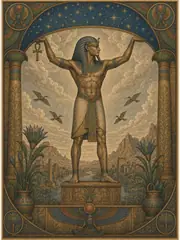
There is a curious tale in the Heliopolitan tradition about the parting of Geb and Nut. Their embrace had been so close that there was no space between earth and sky, and nothing could grow there. Their father Shu was therefore compelled to step between them and lift Nut up, and so the world was opened into the three-fold form it now possesses: earth below, air between, sky above. But Geb was sorrowful at the separation, for he had loved Nut; and from his weeping the rivers were born.
Curator’s note

What the sources say, and what later tradition added. The sources for this bay

Geb appears throughout the Pyramid and Coffin Texts; the parting-of-the-sky narrative is depicted graphically in many tombs and funerary papyri, where Shu is shown standing with arms upraised, holding Nut aloft above the supine Geb. The motif is one of the most distinctive in Egyptian religious iconography and finds no exact parallel elsewhere in the ancient Near East. Geb's role is largely cosmographic; he has fewer narrative myths than his more dramatic descendants. He was sometimes called "the Great Cackler" for the goose-cry by which (in some accounts) he laid the cosmic egg from which the sun was born — a Hermopolitan rather than Heliopolitan tradition that was occasionally absorbed into his cult.

Kin in the sources

Each tie is quoted from the entry that states it.

When the sources speak

Dated witnesses for The Cosmogonies. A date marks when the evidence was written down, not when the belief began. The whole timeline

c. 4000–3100 BCE
Predynastic regional symbols, burials, standards, and animal cults provide the deep background to later divine iconography.
c. 3100–2686 BCE
Early Dynastic kingship joins royal ideology to local cult centers and establishes many durable divine emblems.
c. 2686–2181 BCE
Old Kingdom pyramid complexes and the Pyramid Texts preserve the earliest large religious corpus.
c. 2181–1650 BCE
First Intermediate and Middle Kingdom traditions broaden mortuary access; Coffin Texts develop older royal materials.
c. 1550–1070 BCE
New Kingdom temple wealth, royal hymns, underworld books, and the Book of Going Forth by Day greatly expand the record.
c. 1353–1336 BCE
Akhenaten’s Aten program reorganizes royal cult but does not permanently erase the older divine plurality.
c. 1070–664 BCE
Third Intermediate Period priestly and regional powers reshape cult administration and divine kingship.
664–332 BCE
Late Period archaism, animal cults, and temple scholarship preserve and reinterpret older forms.

Floor plan

The rooms follow one another in the order their peoples first appear in the written record.

  1. The Cradle of Citiesc. 3400 BCE to 395 CE. 115 works
  2. The Gift of the Nilec. 4000 BCE to 395 CE. 73 works
  3. The Olympian Orderc. 1600 BCE to 750 CE. 152 works
  4. The Persian Worldc. 2000 BCE to 1010 CE. 30 works
  5. The Levantine Borderlandsc. 1200 BCE to 500 CE. 20 works
  6. The Edges of Empirec. 2000 BCE to 1500 CE. 33 works
  7. The Etruscan Worldc. 900 BCE to 750 CE. 22 works
  8. The Roman Inheritancec. 1200 BCE to 500 CE. 58 works
  9. The Northern Inheritancec. 2000 BCE to 1600 CE. 131 works