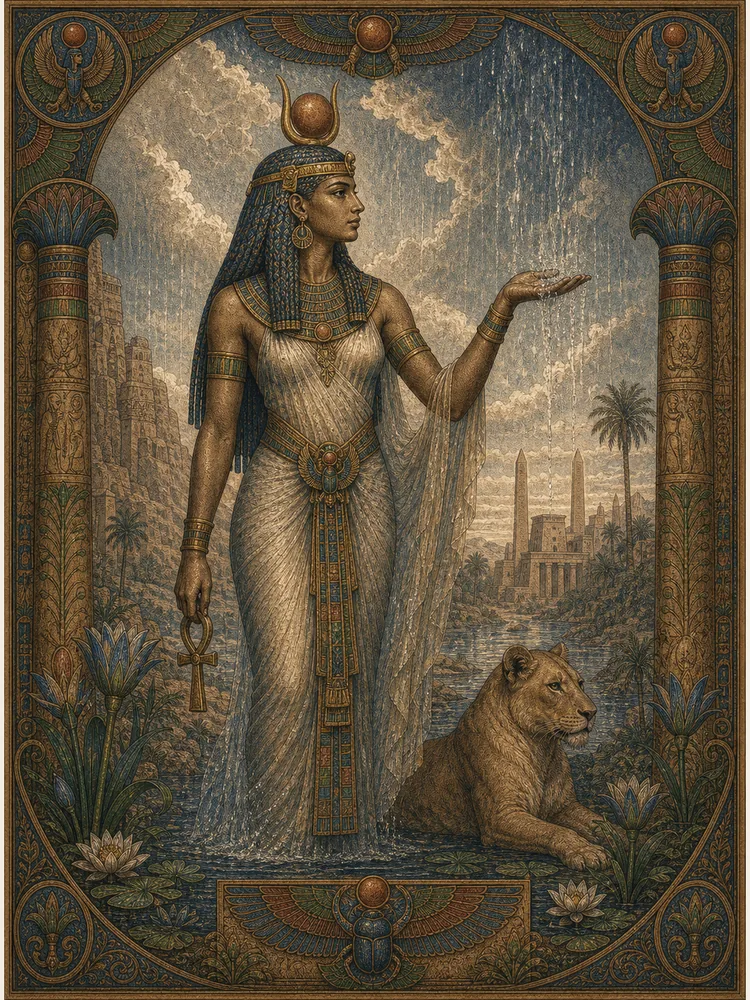
Tefnut was the moisture, the dew and the rain, the principle of dampness within the dry air. She was sister and consort to Shu, daughter of Atum, mother of Geb and Nut. She was depicted as a woman with the head of a lioness, sometimes wholly leonine, often wearing the solar disk and the uraeus serpent. In one notable myth, preserved in fragments of the so-called Tale of the Eye of Ra and elaborated in the late temple texts of Esna and Philae, Tefnut quarreled with her father Atum-Ra and departed in fury into the wilderness of Nubia, where she ranged in lioness-form, savage and ungovernable. The world without her became dry, and Ra was bereft. He sent the wise Thoth and Shu to recover her; and Thoth, by stratagem and persuasion — telling her parables of the lion who fled and was sorry, of the cat who lost her companions — coaxed her at length to return. Her return to Egypt was celebrated in great processions, and she was bathed and welcomed back, her ferocity quenched in the sacred waters; and the country was glad of the rains that came with her.
 Before thisShu
 Next on the wallAmun
Curator’s note
What the sources say, and what later tradition added. The sources for this bay
The Myth of the Wandering Goddess (variously called the Tale of the Eye of Ra or the Tale of the Distant One) is preserved in fragmentary form in a Demotic papyrus from Tebtunis (1st–2nd c. CE), with parallel versions inscribed at Philae and elsewhere. The story is closely linked to that of Hathor-Sekhmet's near-destruction of mankind (told under Sekhmet below), and the figure of the wandering, returning, lion-goddess covers both Tefnut and Sekhmet according to the local theology. The same pattern of departure and reconciliation, marked by ritual processions and the bringing of the goddess back upstream, was attested in the Bubastis festival of Bastet and at the great mid-summer festival of Mut at Karnak.
Kin in the sources
Each tie is quoted from the entry that states it.
- Sibling ofShu
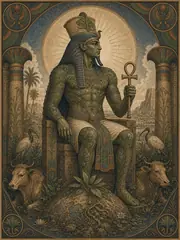
She was sister and consort to Shu, daughter of Atum, mother of Geb and Nut
- Consort ofShu
She was sister and consort to Shu, daughter of Atum, mother of Geb and Nut
 Child ofAtum
She was sister and consort to Shu, daughter of Atum, mother of Geb and Nut
 Parent ofGeb
She was sister and consort to Shu, daughter of Atum, mother of Geb and Nut
 Parent ofNut
She was sister and consort to Shu, daughter of Atum, mother of Geb and Nut
 Companion ofThoth
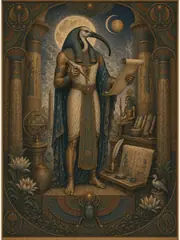
He sent the wise Thoth and Shu to recover her
When the sources speak
Dated witnesses for The Cosmogonies. A date marks when the evidence was written down, not when the belief began. The whole timeline
- c. 4000–3100 BCE
- Predynastic regional symbols, burials, standards, and animal cults provide the deep background to later divine iconography.
- c. 3100–2686 BCE
- Early Dynastic kingship joins royal ideology to local cult centers and establishes many durable divine emblems.
- c. 2686–2181 BCE
- Old Kingdom pyramid complexes and the Pyramid Texts preserve the earliest large religious corpus.
- c. 2181–1650 BCE
- First Intermediate and Middle Kingdom traditions broaden mortuary access; Coffin Texts develop older royal materials.
- c. 1550–1070 BCE
- New Kingdom temple wealth, royal hymns, underworld books, and the Book of Going Forth by Day greatly expand the record.
- c. 1353–1336 BCE
- Akhenaten’s Aten program reorganizes royal cult but does not permanently erase the older divine plurality.
- c. 1070–664 BCE
- Third Intermediate Period priestly and regional powers reshape cult administration and divine kingship.
- 664–332 BCE
- Late Period archaism, animal cults, and temple scholarship preserve and reinterpret older forms.