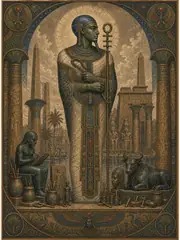
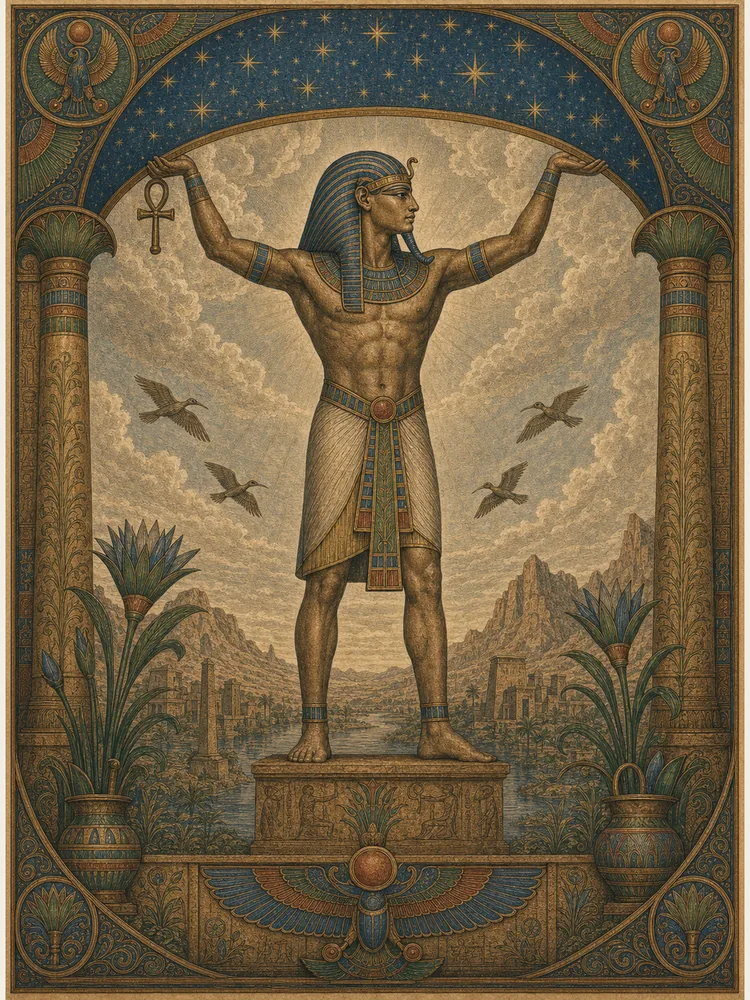
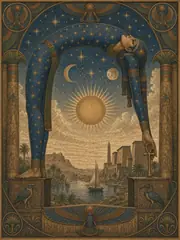
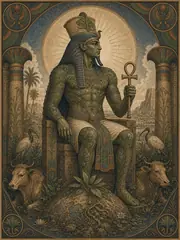
Shu was the air — the dry breath, the wind, the empty space that holds apart the earth from the sky. He was a son of Atum, born together with his sister-consort Tefnut from the creator's solitary act of self-generation; and he was the first to interpose himself within creation, lifting his daughter Nut up from the embrace of his son Geb, and standing thereafter eternally between them. The familiar Egyptian image of the bowed figure with arms upraised, supporting the body of the sky-goddess upon his hands, is Shu in his cosmographic posture. He held up the heavens; without him, sky and earth would collapse together, and creation would end.
He was depicted as a man with an ostrich-feather upon his head — the same feather that was the symbol of Maat, truth — and his name was held to mean "the empty," both as the air is empty and as truth is unencumbered.
When the sources speak
Dated witnesses for The Cosmogonies. A date marks when the evidence was written down, not when the belief began. The whole timeline
- c. 4000–3100 BCE
- Predynastic regional symbols, burials, standards, and animal cults provide the deep background to later divine iconography.
- c. 3100–2686 BCE
- Early Dynastic kingship joins royal ideology to local cult centers and establishes many durable divine emblems.
- c. 2686–2181 BCE
- Old Kingdom pyramid complexes and the Pyramid Texts preserve the earliest large religious corpus.
- c. 2181–1650 BCE
- First Intermediate and Middle Kingdom traditions broaden mortuary access; Coffin Texts develop older royal materials.
- c. 1550–1070 BCE
- New Kingdom temple wealth, royal hymns, underworld books, and the Book of Going Forth by Day greatly expand the record.
- c. 1353–1336 BCE
- Akhenaten’s Aten program reorganizes royal cult but does not permanently erase the older divine plurality.
- c. 1070–664 BCE
- Third Intermediate Period priestly and regional powers reshape cult administration and divine kingship.
- 664–332 BCE
- Late Period archaism, animal cults, and temple scholarship preserve and reinterpret older forms.