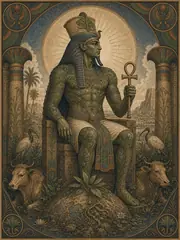
In the beginning, there was nothing — or rather, there was Nun, the dark unmoving water, the formless deep that knew neither time nor place. Within Nun, alone, drifting as a thought without a thinker, lay Atum the not-yet-existent. And Atum, of his own will, made himself to exist; he raised himself out of Nun, and stood upon a small mound of earth — the primeval hill, the first solid place — and looked about him at the formlessness, and resolved to make a world.
Then Atum, having no consort and no companion, brought forth from his own body the first divine pair. By one account, he sneezed Shu (the air) out of his nostrils, and spat Tefnut (the moisture) from his mouth. By another, more frankly anatomical, he masturbated, and from his ejaculate brought them forth: "I copulated with my own fist; I joined myself with my own hand; the seed fell from my mouth, and I sneezed forth Shu, I spat forth Tefnut." The Pyramid Texts give the second version with no embarrassment whatever, and the great commentary of Coffin Text Spell 80 elaborates that the hand of Atum was, in some sense, the first goddess — the female principle latent within the self-existent male. Such was the creator's solitude that he had no other partner.
From Shu and Tefnut were born Geb the earth and Nut the sky, and these in their turn brought forth the four children of the Ennead: Osiris, Isis, Set, and Nephthys, of whom much shall be told in the second book of this volume. Atum thus stood at the head of nine gods — the Great Ennead of Heliopolis — and as the source of all generation he was the principle of fatherhood for the entire pantheon.
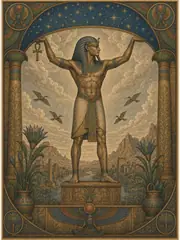
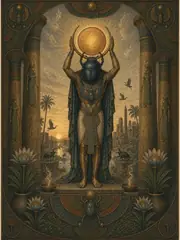
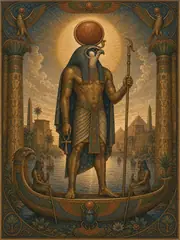
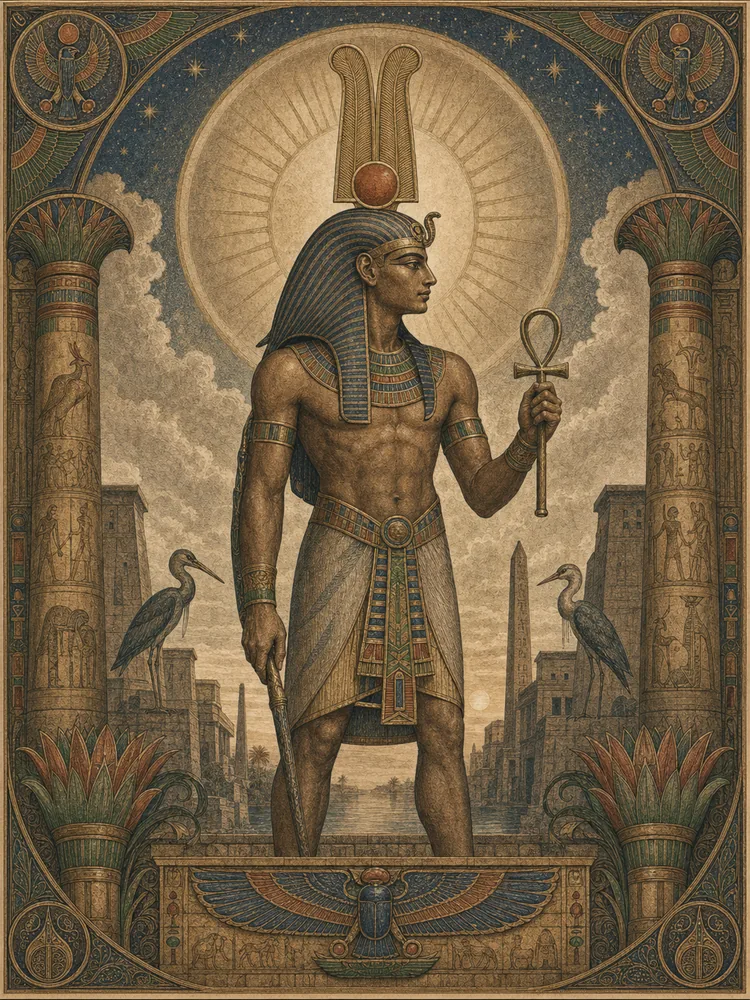
Atum was depicted as a man crowned with the double crown of Egypt, holding the ankh and the was-scepter; he was the evening sun, the sun at the close of his journey, descending into the western horizon. His morning aspect was the scarab Khepri, his midday aspect Ra; the three were aspects of one solar power, and were addressed in the great hymns as the trinity of the sun's three phases.