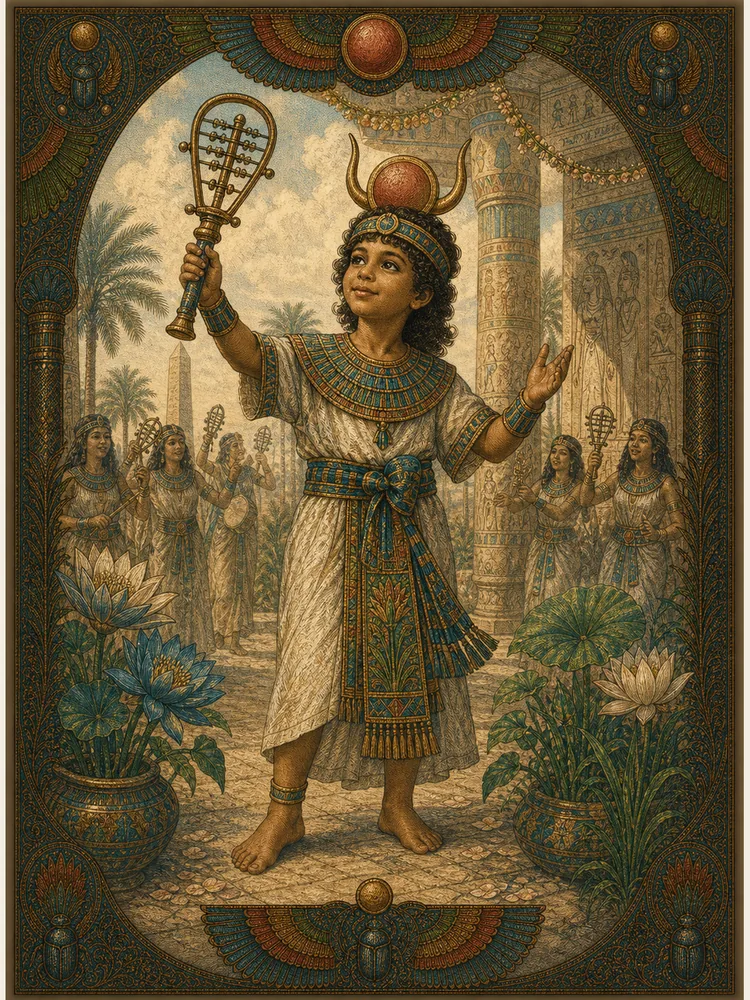
He was the son of Hathor and Horus, born at Dendera where Hathor's great temple stood, and he was the divine child whose music was the music of his mother's joy. He bore in his hand the sistrum, the looped rattle of bronze that the priestesses of Hathor shook in her processions, and as he shook it the goddess was pleased and the dance began. He was depicted as a small naked child, his finger raised to his lips in the gesture of childhood, with the sidelock of youth falling beside his cheek.
His name meant 'sistrum-player,' for that was his office in the cult of his mother. He had no developed mythology of his own; he stood always beside Hathor, and his role was wholly that of her divine child, the boy whose music renewed the goddess's good cheer and whose shaken sistrum drove away the powers of harm. At Dendera the great temple of Hathor preserved an entire chapel devoted to him, with reliefs of the boy-god in the company of the seven Hathors, the seven manifestations of his mother who pronounced fate at the birth of a child.
Curator’s note
What the sources say, and what later tradition added. The sources for this bay
Ihy (Egyptian Ỉḥy) is attested from the Coffin Texts (where Spell 334 contains a long invocation of him) onward and is most fully developed in the Ptolemaic temple of Hathor at Dendera, where his chapel and inscriptions are preserved in nearly complete state. His parentage is sometimes given as Hathor and Horus of Edfu, sometimes Hathor and Atum, with the local theology varying. He belongs to the broad Egyptian category of divine children — Harpocrates, Khonsu the child, Nefertum, Heka the child — each functioning as the youthful third member of a temple triad. His characteristic instrument, the sistrum, was associated with Hathor cult from the Old Kingdom; thousands of sistra survive from votive contexts, including faience and bronze examples in nearly every Egyptian collection. Plutarch (De Iside et Osiride 63) gives a charming if somewhat fanciful interpretation of the sistrum's symbolism that draws on Egyptian temple lore.
When the sources speak
Dated witnesses for The Cities and the Sacred Animals. A date marks when the evidence was written down, not when the belief began. The whole timeline
- c. 4000–3100 BCE
- Predynastic regional symbols, burials, standards, and animal cults provide the deep background to later divine iconography.
- c. 3100–2686 BCE
- Early Dynastic kingship joins royal ideology to local cult centers and establishes many durable divine emblems.
- c. 2686–2181 BCE
- Old Kingdom pyramid complexes and the Pyramid Texts preserve the earliest large religious corpus.
- c. 2181–1650 BCE
- First Intermediate and Middle Kingdom traditions broaden mortuary access; Coffin Texts develop older royal materials.
- c. 1550–1070 BCE
- New Kingdom temple wealth, royal hymns, underworld books, and the Book of Going Forth by Day greatly expand the record.
- c. 1353–1336 BCE
- Akhenaten’s Aten program reorganizes royal cult but does not permanently erase the older divine plurality.
- c. 1070–664 BCE
- Third Intermediate Period priestly and regional powers reshape cult administration and divine kingship.
- 664–332 BCE
- Late Period archaism, animal cults, and temple scholarship preserve and reinterpret older forms.