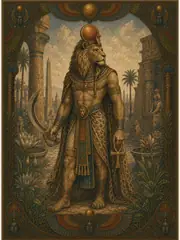
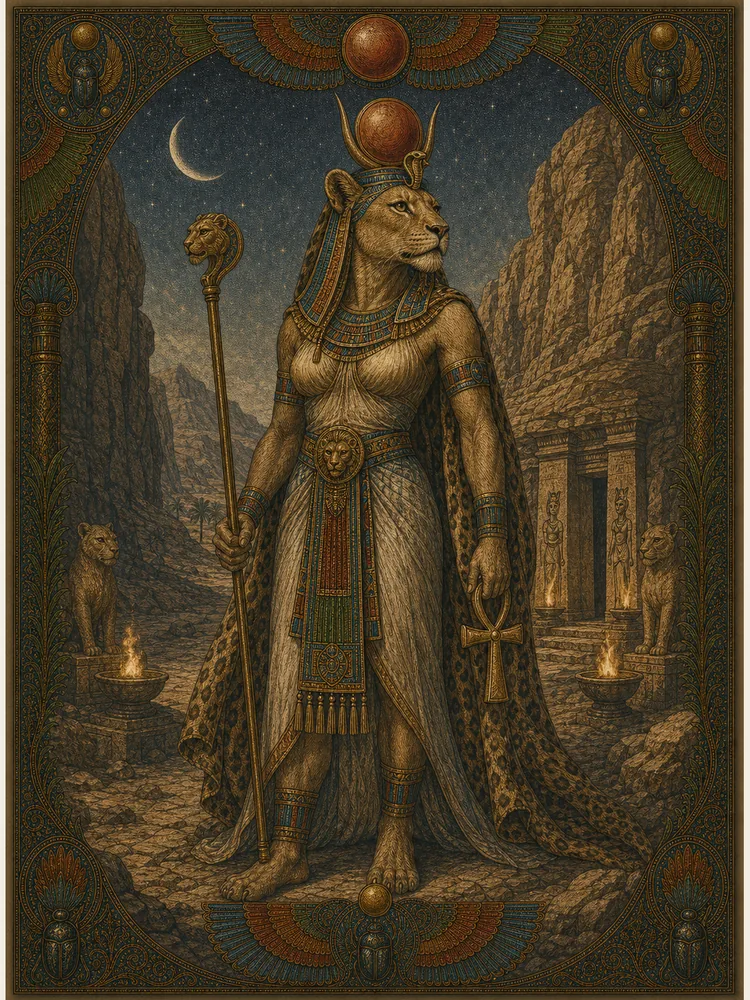
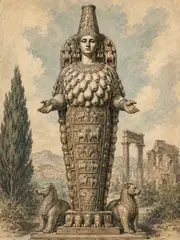
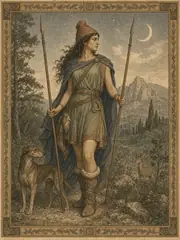
In the cliffs east of the Middle Egyptian town of Beni Hasan, where the desert breaks against the cultivated plain and the wadis open into the cliffs, there was a goddess whose haunt was the wild places. She was Pakhet, the Tearer, a lioness who walked the dry valleys at night and hunted the small game of the desert; and she had a particular care for the women of the region, who came to her shrine to ask deliverance from the dangers that beset them.
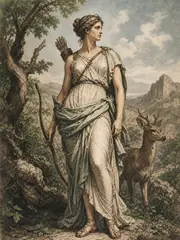
Her great rock-cut temple, hewn into the cliff at the place the Greeks called Speos Artemidos — the Cave of Artemis, for the Greeks identified Pakhet with Artemis the huntress — was begun by Hatshepsut and extended by later kings. The queen's dedication, carved into the temple wall, names Pakhet as a goddess of the wadi who tears the enemies of the king with her claws. Beyond her cliff-shrine she was little known; she was a goddess of one place, and her power was tied to the topography of the eastern desert at that single point.
Curator’s note
What the sources say, and what later tradition added. The sources for this bay
Pakhet (Egyptian Pꜣḫt, 'she who tears') is attested chiefly through the Speos Artemidos temple at Beni Hasan, dedicated by Hatshepsut (Eighteenth Dynasty) and decorated by her and her successors. The Greek identification with Artemis is recorded in classical sources and gave the temple its modern name. She belongs to the same broad category as Sekhmet, Bastet, Tefnut in lioness aspect, and Mehit — Egypt produced a remarkable variety of lioness-goddesses, each tied to a particular locality and ecological niche. The eastern desert location is significant: Pakhet is a goddess of the marginal land between the cultivated valley and the open desert, and her function is partly to mediate between the safe zone and the dangerous zone for travelers and herders. She survived as a recognized deity through the Roman period at her cliff-temple but seems not to have spread beyond it.
When the sources speak
Dated witnesses for The Cities and the Sacred Animals. A date marks when the evidence was written down, not when the belief began. The whole timeline
- c. 4000–3100 BCE
- Predynastic regional symbols, burials, standards, and animal cults provide the deep background to later divine iconography.
- c. 3100–2686 BCE
- Early Dynastic kingship joins royal ideology to local cult centers and establishes many durable divine emblems.
- c. 2686–2181 BCE
- Old Kingdom pyramid complexes and the Pyramid Texts preserve the earliest large religious corpus.
- c. 2181–1650 BCE
- First Intermediate and Middle Kingdom traditions broaden mortuary access; Coffin Texts develop older royal materials.
- c. 1550–1070 BCE
- New Kingdom temple wealth, royal hymns, underworld books, and the Book of Going Forth by Day greatly expand the record.
- c. 1353–1336 BCE
- Akhenaten’s Aten program reorganizes royal cult but does not permanently erase the older divine plurality.
- c. 1070–664 BCE
- Third Intermediate Period priestly and regional powers reshape cult administration and divine kingship.
- 664–332 BCE
- Late Period archaism, animal cults, and temple scholarship preserve and reinterpret older forms.