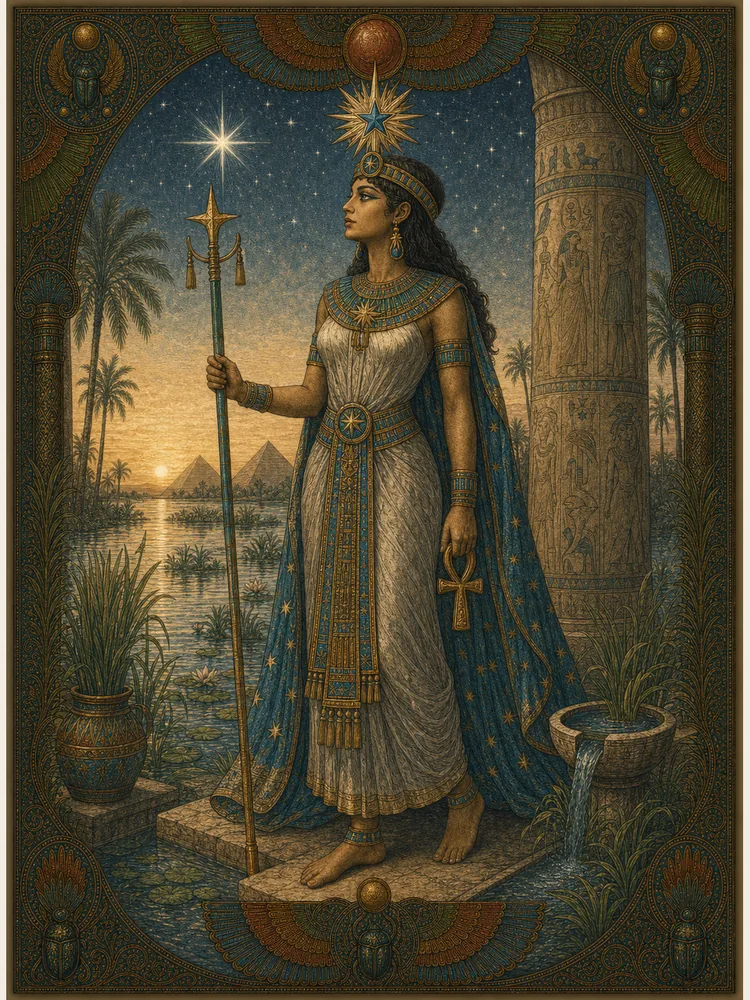
The Egyptian year began when Sirius rose at dawn after a period of invisibility — the heliacal rising of the Dog Star — and that morning, in which the brightest star of the heavens reappeared in the eastern sky, was the morning of the goddess Sopdet. She was the divine person of Sirius itself, and her appearance was the great sign that the inundation was about to come. Within days of her rising the Nile would begin to swell, the brown waters of the flood would push north into the Delta, and a new agricultural year would commence.
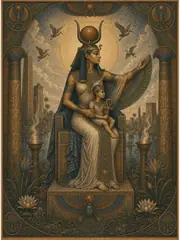
She was depicted as a woman wearing upon her head a tall conical headdress topped with a star, and she was identified as the celestial form of Isis: for the soul of Isis, after her mourning for Osiris, was said to have ascended into the heavens and become the bright star Sothis, which the Egyptians called Sopdet. Her consort was Sopdu the Eastern Star, sometimes identified with Orion (which Egyptian astronomy called Sah), and their child was Sopd the morning star — though the genealogies vary by period and by city.
Upon Sopdet hung the entire structure of the Egyptian calendar. The civil year of 365 days slipped against the true solar year by a quarter-day each year, so that the Egyptian months drifted out of register with the inundation; but Sopdet's heliacal rising was a fixed astronomical event, and the priests kept careful note of when in the civil year she rose. The interval between coincidences of her rising with the start of the civil year was 1,460 years — the so-called Sothic cycle — and this provides modern Egyptologists with one of the most precise chronological anchors available for the dating of New Kingdom and earlier reigns.