A Compendium of the Ancient Gods
Sopdu, plate

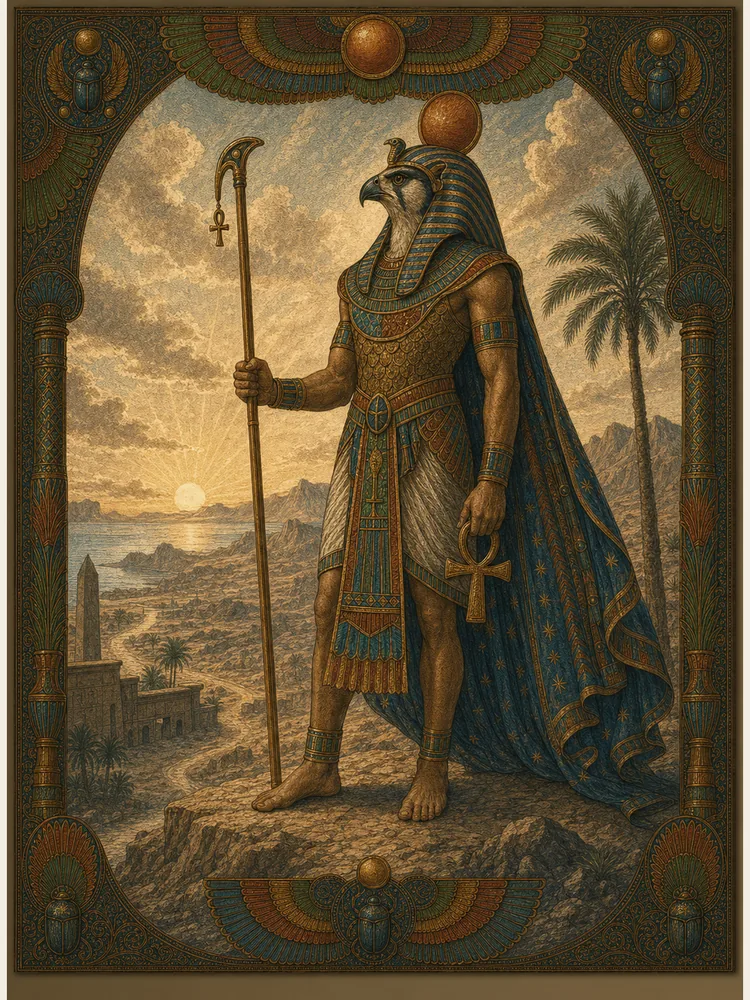
He was the god of the eastern frontier of Egypt, of the desert tracks that led from the Delta out through the Wadi Tumilat toward the Sinai and the Red Sea. The eastern desert was a place of mines and of nomads, of the turquoise of Serabit el-Khadim and the copper of Wadi Maghara, of caravan routes and military expeditions; and over all that landscape Sopdu was the watchful god, falcon-headed and hawk-eyed, who saw the king's enemies before they could approach.

He bore the title 'Lord of the East,' and his cult-center was at Per-Sopdu in the eastern Delta, near the modern Saft el-Hinna. He was depicted in two principal forms: as a falcon-headed man with two long plumes upon his head, holding a was-scepter, in his guise of the divine warrior; and as a crouching falcon mummiform, in his guise of the celestial body identified with the morning star or sometimes with Orion. He was reckoned the consort of Sopdet by some traditions, the father of Sopd the morning star, and an ancient guardian of the eastern boundary of the kingdom.

In the campaigns of the New Kingdom into the Sinai and the Levant, Sopdu was invoked as the god who went before the army; the great king Senusret III was depicted offering to him before setting out on his expeditions, and the inscriptions of Hatshepsut at Punt include him among the gods of the eastern lands. He persisted through the Roman period as a god of the frontier, and small bronzes of him in his falcon-mummiform are well attested in the votive deposits of the eastern Delta.

Curator’s note

What the sources say, and what later tradition added. The sources for this bay

Sopdu (Egyptian Spdw) is attested from the Old Kingdom and was the principal god of the twentieth nome of Lower Egypt. His cult-centre Per-Sopdu (modern Saft el-Hinna) has been excavated; the temple foundation and many small votives have been recovered. The relationship of Sopdu to Sopdet was variously construed: some sources make them consorts, others siblings, and the genealogies of the eastern star-deities are not consistent. As the god of the eastern frontier, Sopdu was particularly important during periods of military activity in the Sinai and the Levant, and his iconography appears on military stelae of the Twelfth Dynasty and the New Kingdom. The double-plumed headdress is his most distinctive identifying feature in two-dimensional art; in three dimensions, the crouching falcon-mummiform is more common in surviving votives.

Kin in the sources

Each tie is quoted from the entry that states it.

When the sources speak

Dated witnesses for The Cities and the Sacred Animals. A date marks when the evidence was written down, not when the belief began. The whole timeline

c. 4000–3100 BCE
Predynastic regional symbols, burials, standards, and animal cults provide the deep background to later divine iconography.
c. 3100–2686 BCE
Early Dynastic kingship joins royal ideology to local cult centers and establishes many durable divine emblems.
c. 2686–2181 BCE
Old Kingdom pyramid complexes and the Pyramid Texts preserve the earliest large religious corpus.
c. 2181–1650 BCE
First Intermediate and Middle Kingdom traditions broaden mortuary access; Coffin Texts develop older royal materials.
c. 1550–1070 BCE
New Kingdom temple wealth, royal hymns, underworld books, and the Book of Going Forth by Day greatly expand the record.
c. 1353–1336 BCE
Akhenaten’s Aten program reorganizes royal cult but does not permanently erase the older divine plurality.
c. 1070–664 BCE
Third Intermediate Period priestly and regional powers reshape cult administration and divine kingship.
664–332 BCE
Late Period archaism, animal cults, and temple scholarship preserve and reinterpret older forms.

Floor plan

The rooms follow one another in the order their peoples first appear in the written record.

  1. The Cradle of Citiesc. 3400 BCE to 395 CE. 115 works
  2. The Gift of the Nilec. 4000 BCE to 395 CE. 73 works
  3. The Olympian Orderc. 1600 BCE to 750 CE. 152 works
  4. The Persian Worldc. 2000 BCE to 1010 CE. 30 works
  5. The Levantine Borderlandsc. 1200 BCE to 500 CE. 20 works
  6. The Edges of Empirec. 2000 BCE to 1500 CE. 33 works
  7. The Etruscan Worldc. 900 BCE to 750 CE. 22 works
  8. The Roman Inheritancec. 1200 BCE to 500 CE. 58 works
  9. The Northern Inheritancec. 2000 BCE to 1600 CE. 131 works