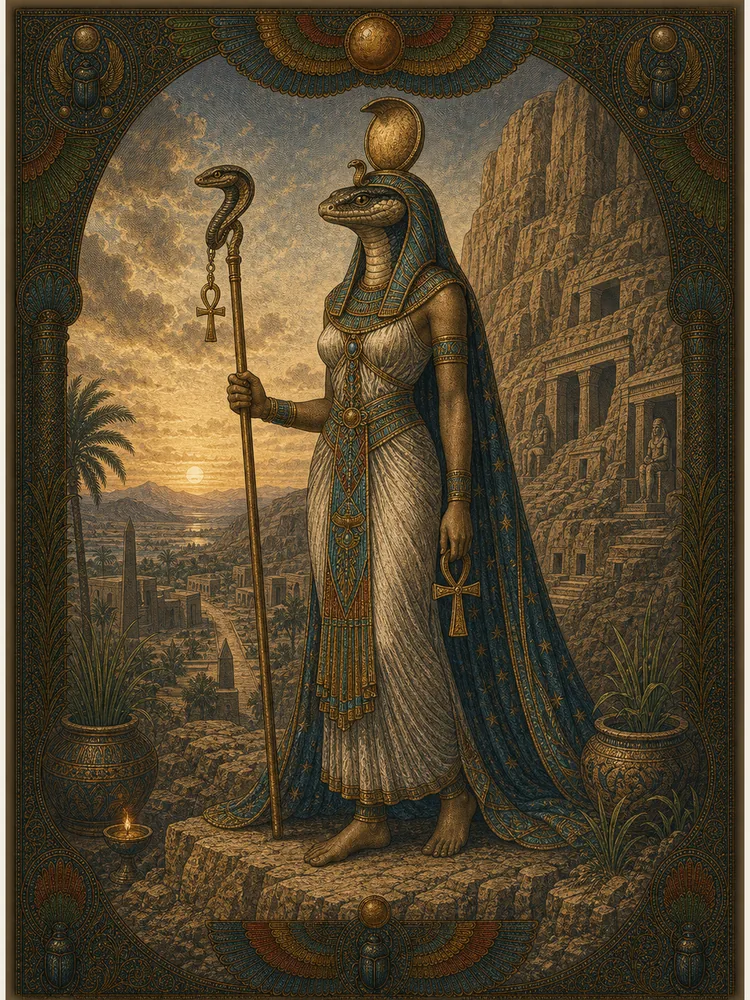
Above the great cemetery of western Thebes, where the kings of the New Kingdom lay in their rock-cut tombs and the workmen of the royal necropolis lived in the village of Deir el-Medina, there rose a peak of pale limestone, pyramidal in shape, that the Egyptians called the Peak of the West. This peak was a goddess: she was Mertseger, 'She Who Loves Silence,' the cobra-spirit of the necropolis hill, and the workmen of Deir el-Medina were her chief devotees.
She was depicted as a coiled cobra, often with a woman's head, sometimes triple-headed; she was both the protector of the tombs against violation and the punisher of the village's sins. The men who carved the king's tomb knew her as a strict and proximate goddess, who would strike with blindness or with the venom of a snake any who broke an oath or behaved with impiety. The personal stelae from Deir el-Medina record several remarkable confessions: a workman who has spoken falsely or who has neglected his offerings declares himself to have been smitten by Mertseger, and now repenting, asks her mercy — and the inscriptions sometimes record that she has heard him and lifted the affliction.
These confessional stelae are unusual in the Egyptian record, which generally avoids public acknowledgment of personal moral failure; but the closeness of Mertseger to her village, her presence in the very rock above their houses, made her the object of a personal religion of unusual intensity. When the village was abandoned at the end of the Twentieth Dynasty her cult faded, but the stelae remain among the most direct testimony we possess to the personal piety of ordinary Egyptians.