A Compendium of the Ancient Gods
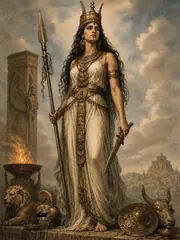
Dedun, plate

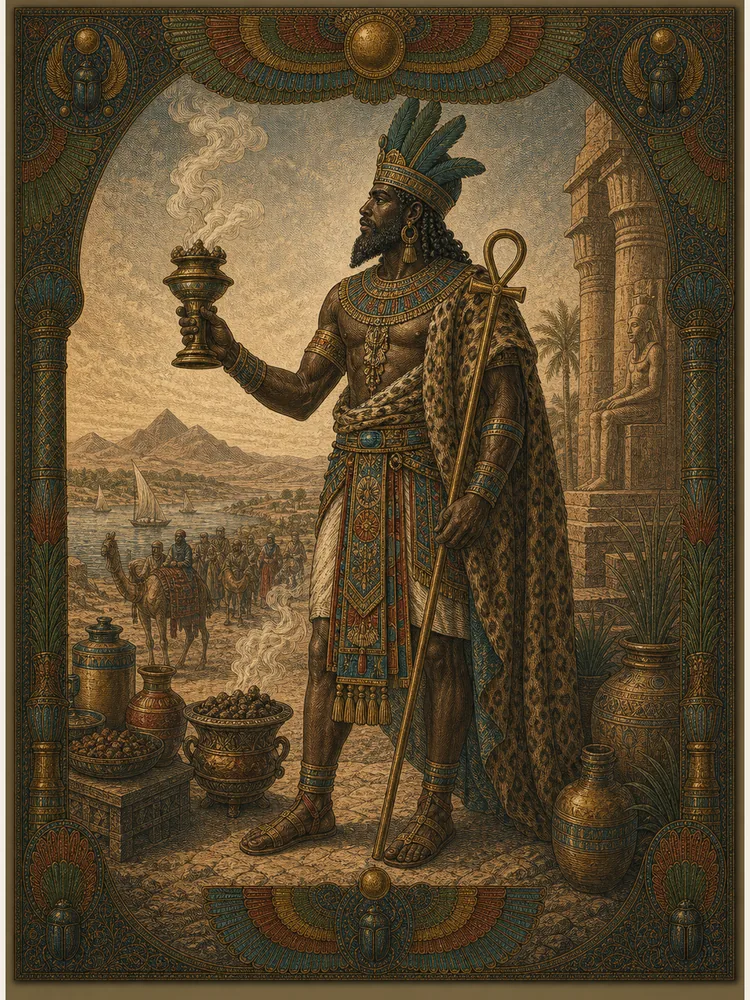
He was the god of the lands south of Egypt, of Nubia and Kush; and though Egyptian in his cult-form, he was acknowledged to be of southern origin. The Pyramid Texts already speak of Dedun as 'the youth of the south who came forth from Nubia,' and he is associated throughout the historical period with the products of those southern lands — gold, ivory, ebony, and above all incense, the costly resin without which no temple could maintain its daily offerings.

He was depicted most often as a man with a slender lithe figure, sometimes lion-headed, sometimes wholly human in form, wearing the kilt and the conventional regalia of an Egyptian god. His role was to bring up the wealth of the south to the temples of the north; he was honored at the great fortresses of Lower Nubia — Buhen, Mirgissa, Semna — where the Egyptian governors of the New Kingdom kept up his cult, and at the great Nubian capital of Kerma in earlier times he had been honored under what the Egyptians took to be his proper name.

His character is somewhat ambiguous in the Egyptian record. He is unambiguously a god of the southern lands, and his cult was honored most actively when Egypt held those lands; yet he is invoked by Egyptian kings as a god of their own pantheon, and his image is carved in their southern temples in the same conventions as those of Horus or Amun. He represents, in his single figure, the long Egyptian engagement with Nubia, in which conquest and honor and exchange were always commingled.
Curator’s note

What the sources say, and what later tradition added. The sources for this bay

Dedun (Egyptian Ddwn) is attested from the Old Kingdom Pyramid Texts (Spell 803) onward. He is consistently identified as a Nubian deity but appears in Egyptian temple contexts from the Middle Kingdom and especially the New Kingdom, when Egyptian control of Lower Nubia was secure. He was honored at the Nubian fortresses of the Twelfth Dynasty and at Soleb and Sedeinga (temples of Amenhotep III) and Abu Simbel (temples of Ramesses II) in the New Kingdom. The cult of incense — Dedun is sometimes called 'the youth who burns incense' — connects him directly to the southern trade routes through which the Egyptian temples obtained their frankincense and myrrh. His figure raises a methodological question for modern Egyptology, which generally restricts itself to deities of Egyptian provenance: Dedun is one of the clearest instances of a foreign god given full Egyptian incorporation, and his case stands beside those of the Asiatic Resheph, Anat, and Astarte (introduced from the Levant in the New Kingdom) as evidence of the porous boundary of the Egyptian pantheon.

Kin in the sources

Each tie is quoted from the entry that states it.

When the sources speak

Dated witnesses for The Cities and the Sacred Animals. A date marks when the evidence was written down, not when the belief began. The whole timeline

c. 4000–3100 BCE
Predynastic regional symbols, burials, standards, and animal cults provide the deep background to later divine iconography.
c. 3100–2686 BCE
Early Dynastic kingship joins royal ideology to local cult centers and establishes many durable divine emblems.
c. 2686–2181 BCE
Old Kingdom pyramid complexes and the Pyramid Texts preserve the earliest large religious corpus.
c. 2181–1650 BCE
First Intermediate and Middle Kingdom traditions broaden mortuary access; Coffin Texts develop older royal materials.
c. 1550–1070 BCE
New Kingdom temple wealth, royal hymns, underworld books, and the Book of Going Forth by Day greatly expand the record.
c. 1353–1336 BCE
Akhenaten’s Aten program reorganizes royal cult but does not permanently erase the older divine plurality.
c. 1070–664 BCE
Third Intermediate Period priestly and regional powers reshape cult administration and divine kingship.
664–332 BCE
Late Period archaism, animal cults, and temple scholarship preserve and reinterpret older forms.

Floor plan

The rooms follow one another in the order their peoples first appear in the written record.

  1. The Cradle of Citiesc. 3400 BCE to 395 CE. 115 works
  2. The Gift of the Nilec. 4000 BCE to 395 CE. 73 works
  3. The Olympian Orderc. 1600 BCE to 750 CE. 152 works
  4. The Persian Worldc. 2000 BCE to 1010 CE. 30 works
  5. The Levantine Borderlandsc. 1200 BCE to 500 CE. 20 works
  6. The Edges of Empirec. 2000 BCE to 1500 CE. 33 works
  7. The Etruscan Worldc. 900 BCE to 750 CE. 22 works
  8. The Roman Inheritancec. 1200 BCE to 500 CE. 58 works
  9. The Northern Inheritancec. 2000 BCE to 1600 CE. 131 works