A Compendium of the Ancient Gods
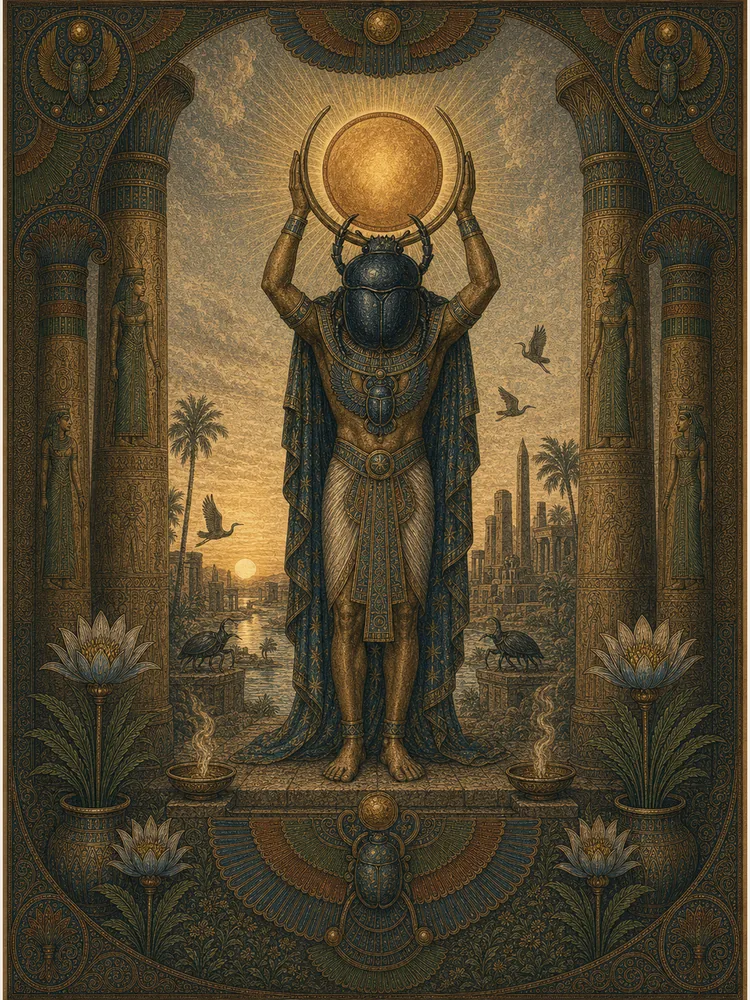
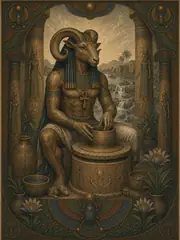
Khepri, plate

Khepri was the morning aspect of the sun-god, the rising sun, the dawn that ascends from the eastern horizon to begin the daily journey. He was depicted as a scarab beetle — sometimes alone, sometimes pushing the solar disk before him as the dung-beetle pushes its ball of dung — or as a man with a scarab for a head. The image was an act of theological observation: the Egyptians had noticed that the dung-beetle rolls its ball backwards across the ground, that within the ball the female lays her eggs, and that from the ball, in due time, new beetles emerge as if by spontaneous generation. The image of the scarab pushing its ball thus suggested both the daily rolling of the sun across the sky and the principle of self-generation, of life arising from itself; and the scarab became one of the most ubiquitous of all Egyptian sacred images. The name kheper signified both the beetle and the verb "to come into being" — and both were aspects of the same creative principle.

Khepri had no narrative myths of his own; he was rather an aspect of Ra, the morning aspect, paired with the noon aspect (Ra) and the evening aspect (Atum) to make the threefold sun. But his image — as scarab amulet, scarab seal, scarab stamp — was perhaps the single most common religious object in Egypt. Heart scarabs, carved from green stone and inscribed on their underside with a spell from the Book of the Dead (Spell 30B, addressed to the heart of the dead, instructing it not to bear false witness against its owner), were placed inside the wrappings of every mummy of any means; and small faience scarabs were worn by the living as ordinary amulets, exchanged as gifts, set into rings, and circulated in such numbers that they survive today by the hundreds of thousands.
Curator’s note

What the sources say, and what later tradition added. The sources for this bay

The scarab beetle observed by the Egyptians (Scarabaeus sacer) does indeed roll dung-balls in the manner described; the new beetles emerge from the underground brood-ball, giving the impression of self-generation that the Egyptians read theologically. Spell 30B of the Book of the Dead is the standard inscription on the underside of heart scarabs; the green stone was preferred because green was the color of resurrection. Scarabs are among the most common archaeological artifacts from Egypt, and a fully developed sub-discipline of Egyptology — scarab studies — has emerged to read them as datable objects with dynastic and royal-name inscriptions.

Kin in the sources

Each tie is quoted from the entry that states it.

The same god in other rooms

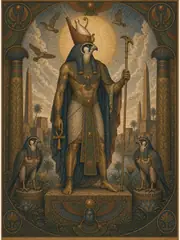
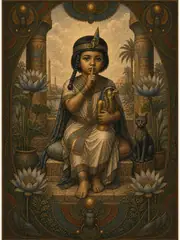
The ancient sources themselves name these as one god under different names. See Atum, Ra, Horus, Khepri and Harpocrates hung together

When the sources speak

Dated witnesses for The Cities and the Sacred Animals. A date marks when the evidence was written down, not when the belief began. The whole timeline

c. 4000–3100 BCE
Predynastic regional symbols, burials, standards, and animal cults provide the deep background to later divine iconography.
c. 3100–2686 BCE
Early Dynastic kingship joins royal ideology to local cult centers and establishes many durable divine emblems.
c. 2686–2181 BCE
Old Kingdom pyramid complexes and the Pyramid Texts preserve the earliest large religious corpus.
c. 2181–1650 BCE
First Intermediate and Middle Kingdom traditions broaden mortuary access; Coffin Texts develop older royal materials.
c. 1550–1070 BCE
New Kingdom temple wealth, royal hymns, underworld books, and the Book of Going Forth by Day greatly expand the record.
c. 1353–1336 BCE
Akhenaten’s Aten program reorganizes royal cult but does not permanently erase the older divine plurality.
c. 1070–664 BCE
Third Intermediate Period priestly and regional powers reshape cult administration and divine kingship.
664–332 BCE
Late Period archaism, animal cults, and temple scholarship preserve and reinterpret older forms.

Floor plan

The rooms follow one another in the order their peoples first appear in the written record.

  1. The Cradle of Citiesc. 3400 BCE to 395 CE. 115 works
  2. The Gift of the Nilec. 4000 BCE to 395 CE. 73 works
  3. The Olympian Orderc. 1600 BCE to 750 CE. 152 works
  4. The Persian Worldc. 2000 BCE to 1010 CE. 30 works
  5. The Levantine Borderlandsc. 1200 BCE to 500 CE. 20 works
  6. The Edges of Empirec. 2000 BCE to 1500 CE. 33 works
  7. The Etruscan Worldc. 900 BCE to 750 CE. 22 works
  8. The Roman Inheritancec. 1200 BCE to 500 CE. 58 works
  9. The Northern Inheritancec. 2000 BCE to 1600 CE. 131 works