A Compendium of the Ancient Gods
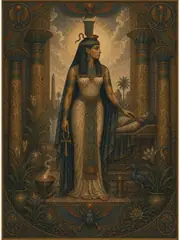
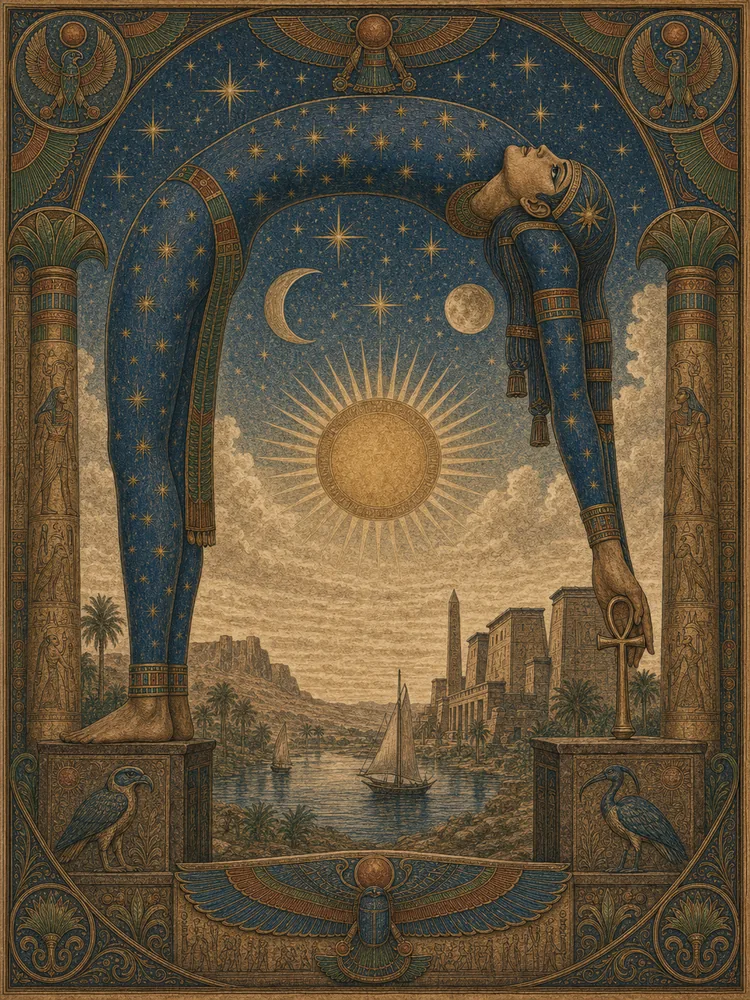
Nut, plate

Nut was the sky — the great vault above the world, painted blue and powdered with stars, beneath whose body the sun and the moon performed their daily and monthly courses. She was the daughter of Shu and Tefnut, the sister and wife of Geb the earth, and the mother of Osiris, Isis, Set, and Nephthys. She was depicted in the standard Egyptian iconography arched over the body of Geb, supported by the upraised hands of her father Shu; her elongated body bore the constellations along its length, and her mouth, at the western horizon, swallowed the sun each evening. In the night, the sun traveled through her body; in the morning, she gave birth to him at the eastern horizon, and the sky became red with the blood of her labor.

There is a tale, much elaborated in the late temple texts, of how Nut was forbidden by her father Ra to bear children in any month of the year; for it had been prophesied that her offspring would inherit the kingship from him, and he sought to prevent the birth. But Thoth the wise played at draughts with the moon and won from him five days of light, which were not part of any month — the five "epagomenal" days that the Egyptian calendar adds to the twelve thirty-day months — and on each of these days Nut bore a child. So Osiris was born on the first, Horus the Elder on the second, Set on the third, Isis on the fourth, and Nephthys on the fifth; and the prophecy was fulfilled.
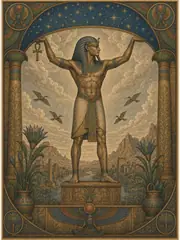
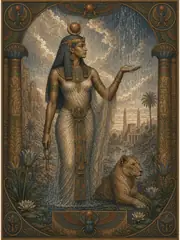
Curator’s note

What the sources say, and what later tradition added. The sources for this bay

The story of Nut's five children and the five extra days is preserved in Plutarch's De Iside et Osiride 12, and reflects an actual feature of the Egyptian civil calendar — a 360-day calendar of twelve thirty-day months, supplemented by five "days upon the year" inserted at the end. The five gods born on these days were honored on each of them in turn during the Egyptian New Year festivities. Nut's iconography — the arched, star-spangled female body forming the vault of heaven — is among the most visually distinctive in Egyptian religious art, particularly familiar from the painted ceilings of New Kingdom and Late Period tombs and the inner lids of sarcophagi, where her body protectively encloses the dead. The notion of the sky as feminine and the earth as masculine inverts the more familiar Greek pattern (Gaia and Uranus); it is among the most striking gender-inversions of cosmological symbolism in the ancient world.

Kin in the sources

Each tie is quoted from the entry that states it.

When the sources speak

Dated witnesses for The Cosmogonies. A date marks when the evidence was written down, not when the belief began. The whole timeline

c. 4000–3100 BCE
Predynastic regional symbols, burials, standards, and animal cults provide the deep background to later divine iconography.
c. 3100–2686 BCE
Early Dynastic kingship joins royal ideology to local cult centers and establishes many durable divine emblems.
c. 2686–2181 BCE
Old Kingdom pyramid complexes and the Pyramid Texts preserve the earliest large religious corpus.
c. 2181–1650 BCE
First Intermediate and Middle Kingdom traditions broaden mortuary access; Coffin Texts develop older royal materials.
c. 1550–1070 BCE
New Kingdom temple wealth, royal hymns, underworld books, and the Book of Going Forth by Day greatly expand the record.
c. 1353–1336 BCE
Akhenaten’s Aten program reorganizes royal cult but does not permanently erase the older divine plurality.
c. 1070–664 BCE
Third Intermediate Period priestly and regional powers reshape cult administration and divine kingship.
664–332 BCE
Late Period archaism, animal cults, and temple scholarship preserve and reinterpret older forms.

Floor plan

The rooms follow one another in the order their peoples first appear in the written record.

  1. The Cradle of Citiesc. 3400 BCE to 395 CE. 115 works
  2. The Gift of the Nilec. 4000 BCE to 395 CE. 73 works
  3. The Olympian Orderc. 1600 BCE to 750 CE. 152 works
  4. The Persian Worldc. 2000 BCE to 1010 CE. 30 works
  5. The Levantine Borderlandsc. 1200 BCE to 500 CE. 20 works
  6. The Edges of Empirec. 2000 BCE to 1500 CE. 33 works
  7. The Etruscan Worldc. 900 BCE to 750 CE. 22 works
  8. The Roman Inheritancec. 1200 BCE to 500 CE. 58 works
  9. The Northern Inheritancec. 2000 BCE to 1600 CE. 131 works