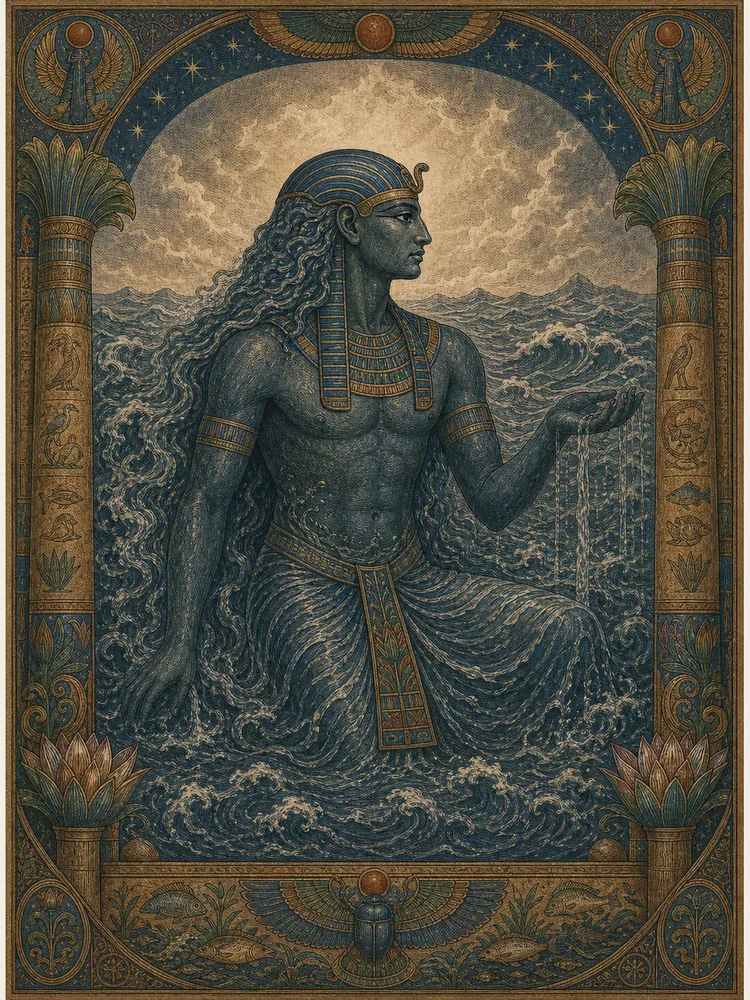
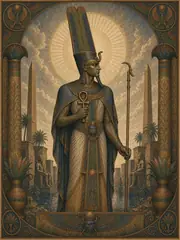
Nun was the formless dark water that lay before creation and that lies, still, beneath and around the made world. He was not so much a god as the principle of pre-divine existence — the chaos within which Atum first stirred, the abyss out of which the primeval mound emerged. He was depicted as a bearded man holding aloft the solar barque, lifting it from the waters at the dawn of each day; he was thus, in iconography, the primordial begetter of the daily sunrise, supplying from his own depths the renewed light. But he was unsettled and unsettling, the persistence of the formless within the formed; in late theology, he was held to surround the world like an outer ocean, into which all things would in time return when the cycle of creation had run its course.
 Before thisGeb
 Next on the wallNut
Curator’s note
What the sources say, and what later tradition added. The sources for this bay
Nun is attested from the Pyramid Texts onward and is part of the Hermopolitan Ogdoad — the eight primordial powers of the Hermopolitan cosmogony, four male-female pairs, of which Nun and his consort Naunet represent the primal waters. The other pairs are Heh and Hauhet (infinity), Kek and Kauket (darkness), and Amun and Amaunet (hiddenness — though Amun's later eminence at Thebes complicates his original Ogdoad position considerably). Nun has no temple cult of his own; he is invoked rather than worshipped, and is invariably treated as the precondition rather than the agent of creation.
Kin in the sources
Each tie is quoted from the entry that states it.
 Companion ofAtum
the chaos within which Atum first stirred, the abyss out of which the primeval mound emerged
 Companion ofAmun
The other pairs are Heh and Hauhet (infinity), Kek and Kauket (darkness), and Amun and Amaunet
When the sources speak
Dated witnesses for The Cosmogonies. A date marks when the evidence was written down, not when the belief began. The whole timeline
- c. 4000–3100 BCE
- Predynastic regional symbols, burials, standards, and animal cults provide the deep background to later divine iconography.
- c. 3100–2686 BCE
- Early Dynastic kingship joins royal ideology to local cult centers and establishes many durable divine emblems.
- c. 2686–2181 BCE
- Old Kingdom pyramid complexes and the Pyramid Texts preserve the earliest large religious corpus.
- c. 2181–1650 BCE
- First Intermediate and Middle Kingdom traditions broaden mortuary access; Coffin Texts develop older royal materials.
- c. 1550–1070 BCE
- New Kingdom temple wealth, royal hymns, underworld books, and the Book of Going Forth by Day greatly expand the record.
- c. 1353–1336 BCE
- Akhenaten’s Aten program reorganizes royal cult but does not permanently erase the older divine plurality.
- c. 1070–664 BCE
- Third Intermediate Period priestly and regional powers reshape cult administration and divine kingship.
- 664–332 BCE
- Late Period archaism, animal cults, and temple scholarship preserve and reinterpret older forms.