A Compendium of the Ancient Gods
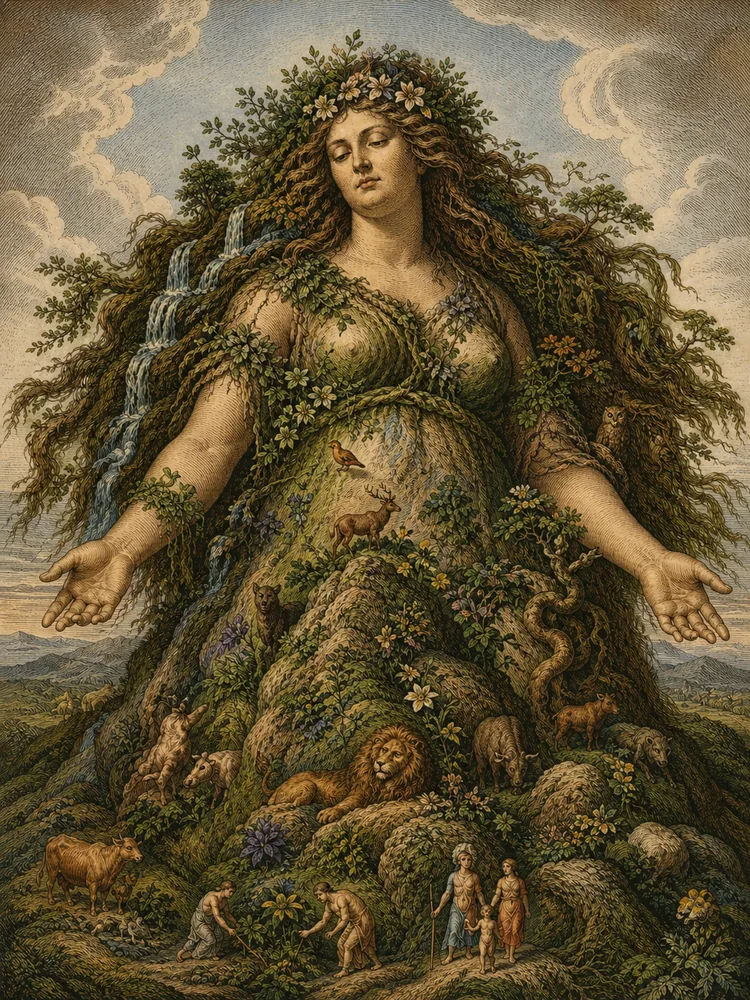
Gaia, plate

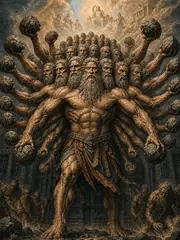
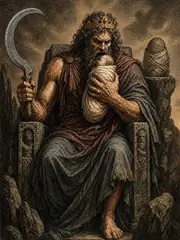
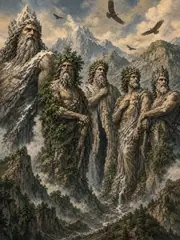
Gaia was the broad earth, the firm-set foundation of all things, the mother of the gods and the great original womb from which the divine generations proceeded. She came forth from Chaos at the beginning, and without partner she brought forth Uranus the starry sky, the Mountains, and Pontus the sea; and thereafter, joined to Uranus her son, she gave birth to the Titans, the Cyclopes, and the hundred-handed Hecatoncheires. When Uranus, fearing his children, hid them away within her body, Gaia in pain conspired with her youngest Titan-son Cronus to take vengeance; she gave him a great sickle of grey adamant, and when Uranus next came to lie upon her, Cronus emerged from concealment and cut off his father's genitals and cast them into the sea — and so the first generation passed. From the blood that fell upon Gaia were born the Erinyes, the Giants, and the ash-tree nymphs; from the foam that gathered round the cast-off members in the sea, Aphrodite was born.

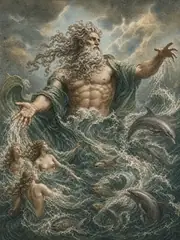
Gaia thereafter was the deep wisdom of the earth, the mother who knew the future and gave oracles before Apollo took the Delphic seat from her; she was honored at Delphi as the original holder of the oracle, and traces of her older cult persisted there beneath the Apolline overlay. She bore many further children to many fathers — to Pontus she bore Nereus, Thaumas, Phorcys, Ceto, and Eurybia; to Tartarus she bore Typhon, the great serpent who would in his turn challenge Zeus's order; to herself or to others she bore Antaeus, the giant whom Heracles would have to wrestle. As earth, she could not be killed; as mother, she persisted through every generation of gods. She was old when the Olympians were young, and she was old when the Olympians grew old.
Curator’s note

What the sources say, and what later tradition added. The sources for this bay

Hesiod, Theogony 116–138, 154–210, is the principal text for Gaia's early career; her oracular role at Delphi is attested by Aeschylus (Eumenides 1–8), who has the Pythia name Gaia as the original divinity of the site, before Themis and finally Apollo. Pausanias (10.5.5) reports the same tradition. Cult of Gaia was real but modest — small shrines existed at Athens (the Olympieion), at Delphi, at Olympia — but she was never the focus of a major civic cult. The conception of the earth as a divine mother is widespread in Indo-European religion and probably very old; the Greek Gaia, the Roman Tellus or Terra Mater, the Vedic Prithivi, and the Lithuanian Žemyna are all reflexes of a common pattern.

Kin in the sources

Each tie is quoted from the entry that states it.

When the sources speak

Dated witnesses for The Primordial Powers. A date marks when the evidence was written down, not when the belief began. The whole timeline

c. 1600–1100 BCE
Mycenaean palace tablets in Linear B record offerings and divine names, but little continuous myth.
c. 1100–800 BCE
Post-palatial oral traditions and changing cult landscapes precede the surviving alphabetic epics.
late 8th–7th centuries BCE
The Iliad, Odyssey, Hesiodic Theogony and Works and Days give influential but non-exclusive divine orders.
7th–6th centuries BCE
Homeric Hymns, lyric poetry, colonization, and local sanctuary traditions multiply regional narratives.
6th–5th centuries BCE
Orphic, Pythagorean, and mystery materials develop alternative cosmogonies and afterlife doctrines.
5th century BCE
Athenian tragedy and comedy recast heroic houses and divine justice for civic audiences.
4th century BCE
Philosophers, antiquarians, and local historians interpret or criticize inherited myth.
323–31 BCE
Hellenistic poets and scholars systematize variants across an enlarged Greek world.

Floor plan

The rooms follow one another in the order their peoples first appear in the written record.

  1. The Cradle of Citiesc. 3400 BCE to 395 CE. 115 works
  2. The Gift of the Nilec. 4000 BCE to 395 CE. 73 works
  3. The Olympian Orderc. 1600 BCE to 750 CE. 152 works
  4. The Persian Worldc. 2000 BCE to 1010 CE. 30 works
  5. The Levantine Borderlandsc. 1200 BCE to 500 CE. 20 works
  6. The Edges of Empirec. 2000 BCE to 1500 CE. 33 works
  7. The Etruscan Worldc. 900 BCE to 750 CE. 22 works
  8. The Roman Inheritancec. 1200 BCE to 500 CE. 58 works
  9. The Northern Inheritancec. 2000 BCE to 1600 CE. 131 works