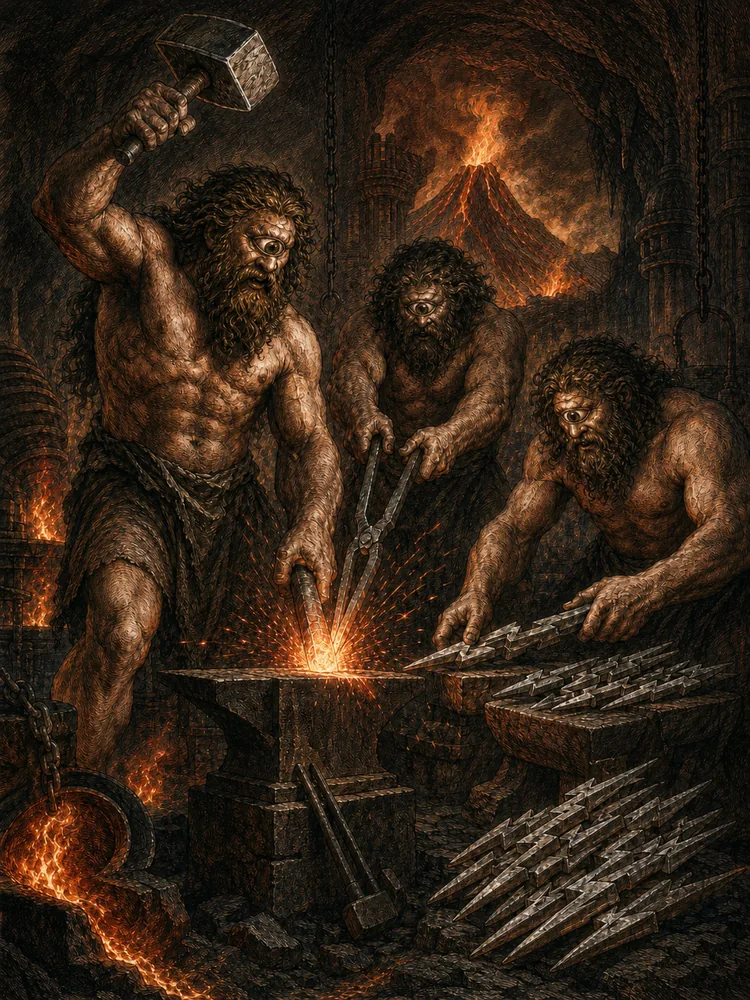
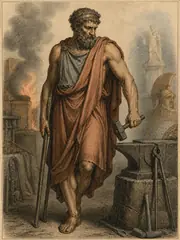
Of the children whom Gaia bore to Uranus, three were the Cyclopes — Brontes the Thunderer, Steropes the Lightning-maker, and Arges the Flashing — and they were like to the gods in all respects save one, that each had but a single eye in the midst of his forehead. They were of vast stature, and their hands were skilled beyond all others in the working of metal, for it was they who first taught the smith's art among the powers of heaven.
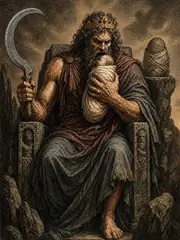
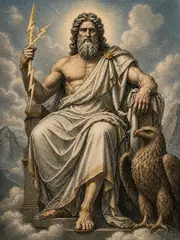
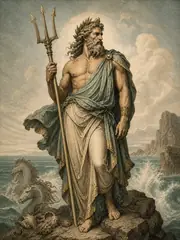
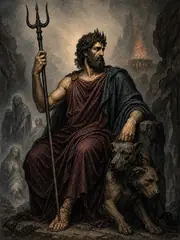
But Uranus, fearing the strength of his children, cast them down into Tartarus together with their brothers the Hecatoncheires; and there they remained through the long reign of the Titans, for Cronus too feared them and would not release them. Only when Zeus made war against his father did the young god descend into Tartarus and free the Cyclopes, and they in their gratitude forged for him the thunderbolt that became his weapon — and for Poseidon the trident, and for Hades the helm of darkness that rendered its wearer invisible. With these gifts the Olympians overcame the Titans and divided the world among themselves.
Thereafter the Cyclopes labored in the smithy beneath Mount Etna in Sicily, where in later ages Hephaestus would join them; and what they wrought there was the armor and weapons of the gods. They are not to be confused with that other Cyclops, Polyphemus, whom Odysseus blinded — for he was a child of Poseidon and a savage of his island, of the same one-eyed kind but lawless, where the elder Cyclopes were craftsmen and benefactors of the gods. The Greek imagination held the two kindreds distinct, though their single eye was common to both.
Curator’s note
What the sources say, and what later tradition added. The sources for this bay
The primordial Cyclopes — Brontes, Steropes, Arges — are introduced in Hesiod's Theogony 139-146 and 501-506, where their imprisonment, release by Zeus, and gift of the thunderbolt are recounted. The Pseudo-Apollodoran Bibliotheca (1.1.2, 1.2.1) follows Hesiod. The savage Cyclopes who appear in Odyssey 9, of whom Polyphemus is one, are a separate kindred; Hesiod does not connect them, and the ancient commentators were already aware of the distinction. A third group, the 'Cyclopean wall-builders' to whom the great cyclopean masonry of Mycenaean fortresses was attributed, appears in Pausanias and Strabo. Modern scholarship (Glenn 1971, Mondi 1983) has explored the relationship among the three groups; the consensus is that they were originally separate traditions assimilated under a common name, not a single mythological lineage.
When the sources speak
Dated witnesses for The Primordial Powers. A date marks when the evidence was written down, not when the belief began. The whole timeline
- c. 1600–1100 BCE
- Mycenaean palace tablets in Linear B record offerings and divine names, but little continuous myth.
- c. 1100–800 BCE
- Post-palatial oral traditions and changing cult landscapes precede the surviving alphabetic epics.
- late 8th–7th centuries BCE
- The Iliad, Odyssey, Hesiodic Theogony and Works and Days give influential but non-exclusive divine orders.
- 7th–6th centuries BCE
- Homeric Hymns, lyric poetry, colonization, and local sanctuary traditions multiply regional narratives.
- 6th–5th centuries BCE
- Orphic, Pythagorean, and mystery materials develop alternative cosmogonies and afterlife doctrines.
- 5th century BCE
- Athenian tragedy and comedy recast heroic houses and divine justice for civic audiences.
- 4th century BCE
- Philosophers, antiquarians, and local historians interpret or criticize inherited myth.
- 323–31 BCE
- Hellenistic poets and scholars systematize variants across an enlarged Greek world.