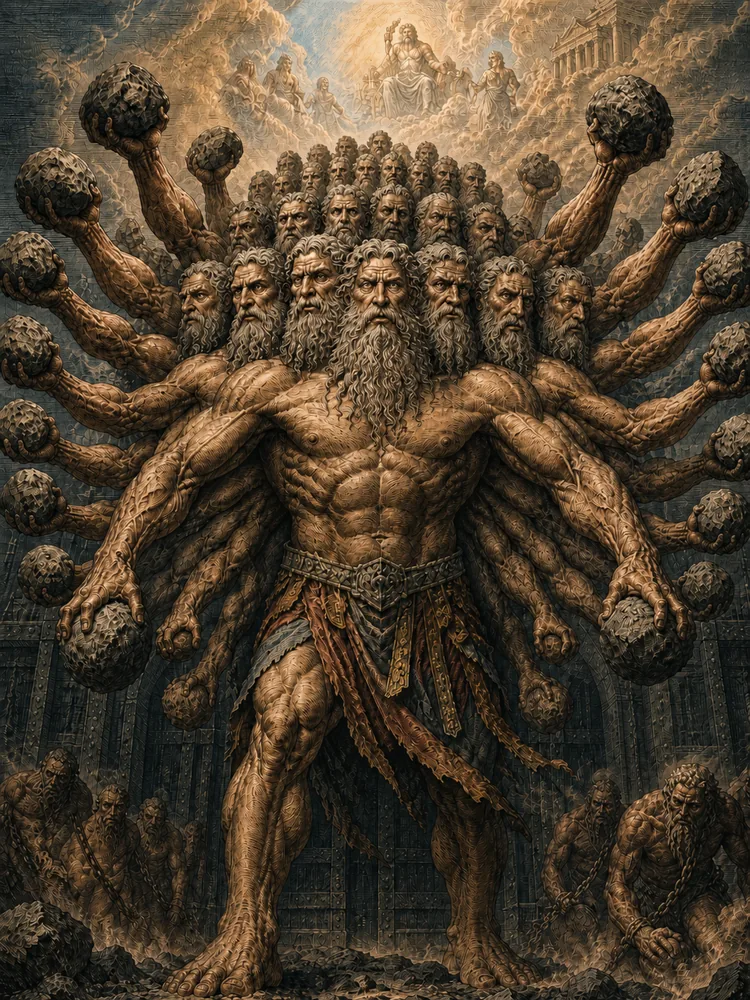
Greater than the Cyclopes, and more terrible to behold, were the Hecatoncheires — the Hundred-Handed — three brothers each of whom had fifty heads upon his shoulders and a hundred arms growing from his sides. They were Briareus (whom the gods called Aegaeon), Cottus, and Gyges, and they were the eldest sons of Gaia and Uranus, born before the Cyclopes and before the Titans. Their strength was beyond reckoning, and the earth shook when they moved.
Like their brothers the Cyclopes, they were cast down into Tartarus by Uranus, who feared them; and there they lay through the reign of Cronus also. But when at last Zeus had been at war with the Titans for nine years and could not prevail, Gaia counseled him to release the Hundred-Handed, for in their hands lay the victory. So Zeus descended into Tartarus and brought them forth, and gave them ambrosia and nectar to restore their strength; and they in their gratitude took up their place beside the Olympians.
When the final battle came, the three Hundred-Handed stood in the foremost rank, and from their three hundred hands they hurled three hundred boulders at the Titans — a storm of stones that darkened the sky and beat down the elder gods, until at length Cronus and his brothers were overcome and bound. The Hecatoncheires were then appointed by Zeus as the wardens of the Titans in Tartarus; and there they remain to this day, holding the great gates beyond which the elder gods are imprisoned forever.
Briareus alone of the three has any further story. Once when Hera, Poseidon, and Athena conspired to bind Zeus, Thetis the sea-goddess summoned Briareus from the depths, and at his appearance the conspirators released their lord; for none, not even three Olympians together, dared face the Hundred-Handed. Thereafter Briareus dwelt with Poseidon in the sea, and was given the sea-nymph Cymopolea to wife.