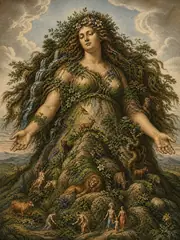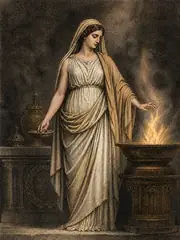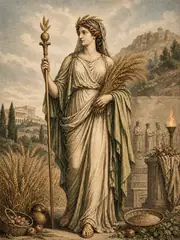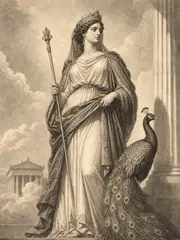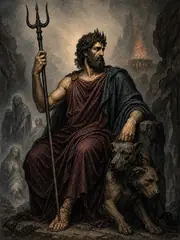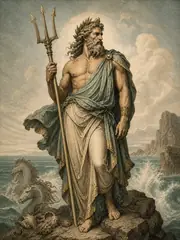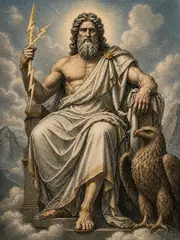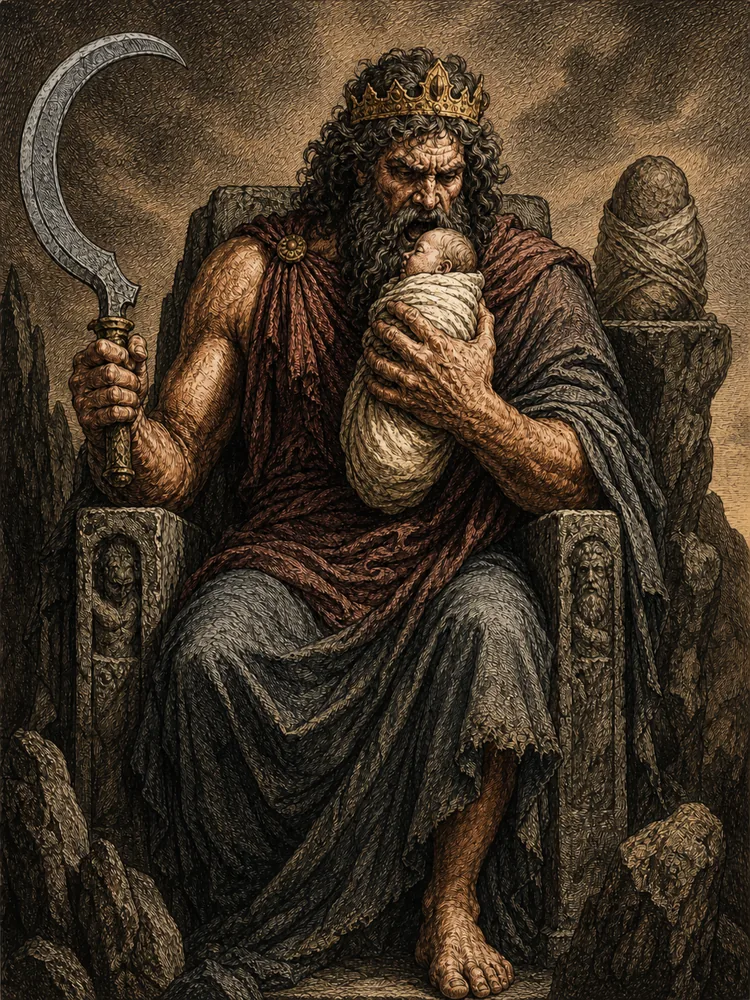
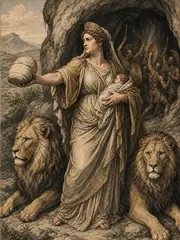
Cronus was the youngest of the twelve Titans, the son who agreed when his mother Gaia could find no other to take vengeance upon his oppressing father; with the sickle she gave him he castrated Uranus and assumed the kingship of heaven. He took to wife his sister Rhea, and by her begot the next generation: Hestia, Demeter, Hera, Hades, Poseidon, and Zeus. But Cronus had been warned, by his vanquished father and by Gaia, that he too would be overthrown by his own son; and he resolved to prevent it by swallowing each of his children at birth. Rhea bore them; Cronus swallowed them; and so the future Olympians passed each in turn down their father's throat — Hestia first, then Demeter, then Hera, then Hades, then Poseidon. When Rhea was great with the sixth, Zeus, she went down in secret to Crete, gave birth in a cave on Mount Ida, hid the infant with the nymphs of the mountain to be raised, and presented to Cronus a stone wrapped in swaddling-cloth, which he duly swallowed without examination.
Zeus grew to manhood in the Cretan cave, fed on the milk of the goat Amaltheia and on honey, defended from his father's notice by the Curetes whose clashing weapons drowned out his cries. When he was grown, he returned to confront his father; he tricked Cronus (or, in some versions, was assisted by Metis the daughter of Oceanus, who gave Cronus an emetic) into vomiting up the stone and the five swallowed children. The siblings, freed, joined Zeus against their father. Their war — the Titanomachy — lasted ten years, fought between Olympus (where Zeus and his siblings made their stand) and Othrys (the seat of the Titans). At length Zeus released the Hundred-Handed Ones from their imprisonment in Tartarus; with their hundred arms each, they hurled rocks against the Titans and the Titans broke; Zeus cast Cronus and his loyal brothers down into Tartarus, where they were imprisoned forever — except that, by some traditions, Cronus was eventually reconciled and went to rule in the Isles of the Blessed, where the souls of the heroes had their afterlife.
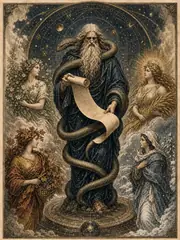
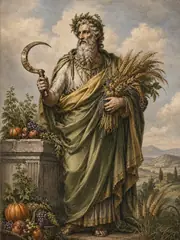
The deposed Cronus presented an ambiguous figure in later Greek thought. He was, on the one hand, the cruel father who swallowed his children; on the other, he was the king of a Golden Age that Greek poetry remembered as a time of plenty and ease, when men lived without toil under his benign rule. Hesiod's Works and Days gives the contradictory accounts: in his theogonic role Cronus is the swallowing tyrant, but in his Golden-Age role he is the king of a vanished happiness. The Romans identified him with their agricultural god Saturn, and made his Saturnalia, in December, a festival of social inversion in remembrance of the Golden Age.