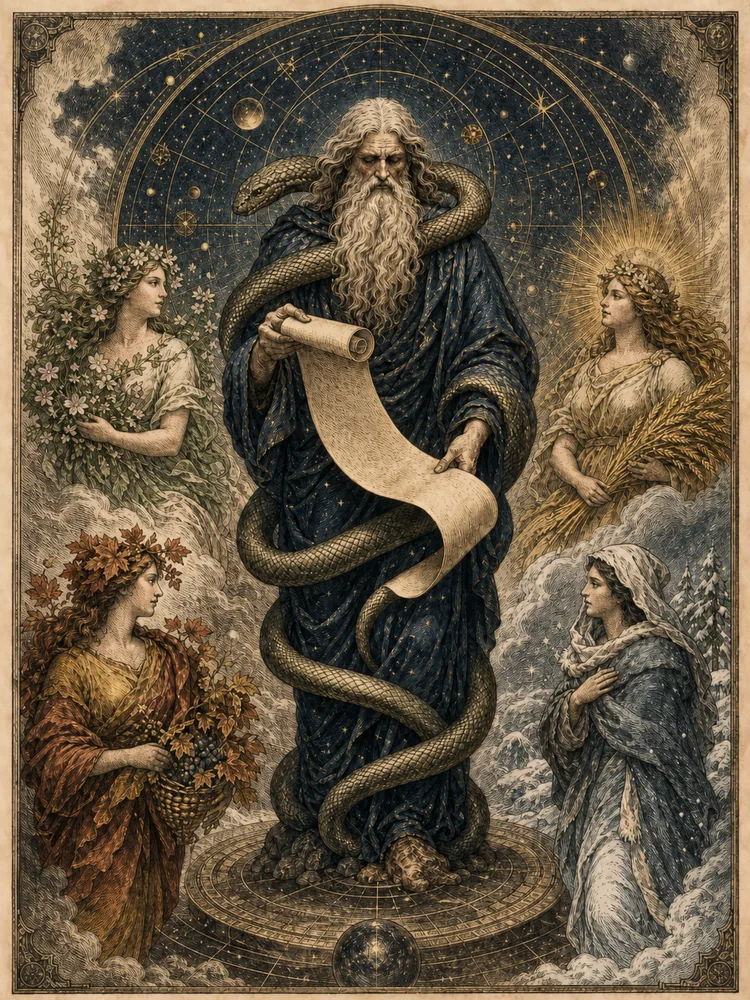
Chronos was Time — and the Greek language unfortunately gave a near-identical name to a quite distinct Titan, Cronus the father of Zeus, with whom Time was repeatedly conflated in late antiquity and in the Western tradition descended from it. The two were originally separate. Chronos was a primordial power of the Orphic theogonies — the unaging principle of duration, paired with Ananke (Necessity), wound about the cosmic order from the beginning. The Orphic Hymns address him; the late Roman iconography of Chronos as a serpent-bound figure with the ages of man written upon him owes something to Orphic, something to Mithraic (the Aionic figure of the Mithraic mysteries), and something to the late conflation with Cronus the Titan, who in his Roman form Saturn had become the patron of the Saturnalia and an old man with a scythe — the prototype of the modern Father Time. The reader will benefit by holding firmly to the distinction in any pre-Hellenistic context: Chronos is Time, Cronus is the second-generation sky-king who castrated his father Uranus and was overthrown by his son Zeus.
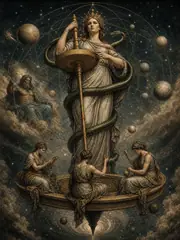 Before thisAnanke
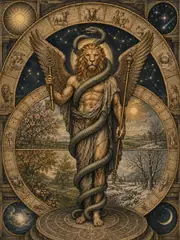 Next on the wallAion
Curator’s note
What the sources say, and what later tradition added. The sources for this bay
Chronos as a primordial is principally an Orphic figure, attested in the Orphic theogonies (preserved in fragments through Damascius and the Derveni Papyrus) and in the Orphic Hymns. The conflation with Cronus the Titan begins in the Hellenistic period and was systematized in late antiquity; by the time of Macrobius (5th c. CE), Cronus, Saturn, and Chronos had been merged into a single composite figure, and from this composite descends the Western iconographic tradition of Father Time with scythe and hourglass. The distinction is recoverable but requires care.
Kin in the sources
Each tie is quoted from the entry that states it.
- Companion ofAnanke
paired with Ananke (Necessity), wound about the cosmic order from the beginning
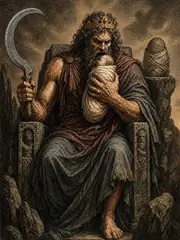 Named as the same god asCronus
by the time of Macrobius (5th c. CE), Cronus, Saturn, and Chronos had been merged into a single composite figure
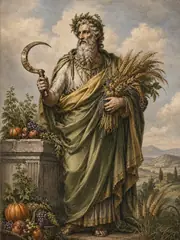 Named as the same god asSaturn
by the time of Macrobius (5th c. CE), Cronus, Saturn, and Chronos had been merged into a single composite figure
- Compared withAion
something to Mithraic (the Aionic figure of the Mithraic mysteries)
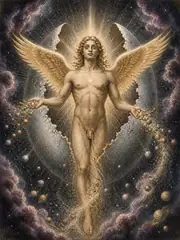 Parent ofPhanes
Chronos and Ananke (Time and Necessity) wound themselves about the precosmic abyss and laid a great silver egg; from this egg Phanes was born
The same god in other rooms
The ancient sources themselves name these as one god under different names. See Chronos, Cronus and Saturn hung together
When the sources speak
Dated witnesses for The Primordial Powers. A date marks when the evidence was written down, not when the belief began. The whole timeline
- c. 1600–1100 BCE
- Mycenaean palace tablets in Linear B record offerings and divine names, but little continuous myth.
- c. 1100–800 BCE
- Post-palatial oral traditions and changing cult landscapes precede the surviving alphabetic epics.
- late 8th–7th centuries BCE
- The Iliad, Odyssey, Hesiodic Theogony and Works and Days give influential but non-exclusive divine orders.
- 7th–6th centuries BCE
- Homeric Hymns, lyric poetry, colonization, and local sanctuary traditions multiply regional narratives.
- 6th–5th centuries BCE
- Orphic, Pythagorean, and mystery materials develop alternative cosmogonies and afterlife doctrines.
- 5th century BCE
- Athenian tragedy and comedy recast heroic houses and divine justice for civic audiences.
- 4th century BCE
- Philosophers, antiquarians, and local historians interpret or criticize inherited myth.
- 323–31 BCE
- Hellenistic poets and scholars systematize variants across an enlarged Greek world.