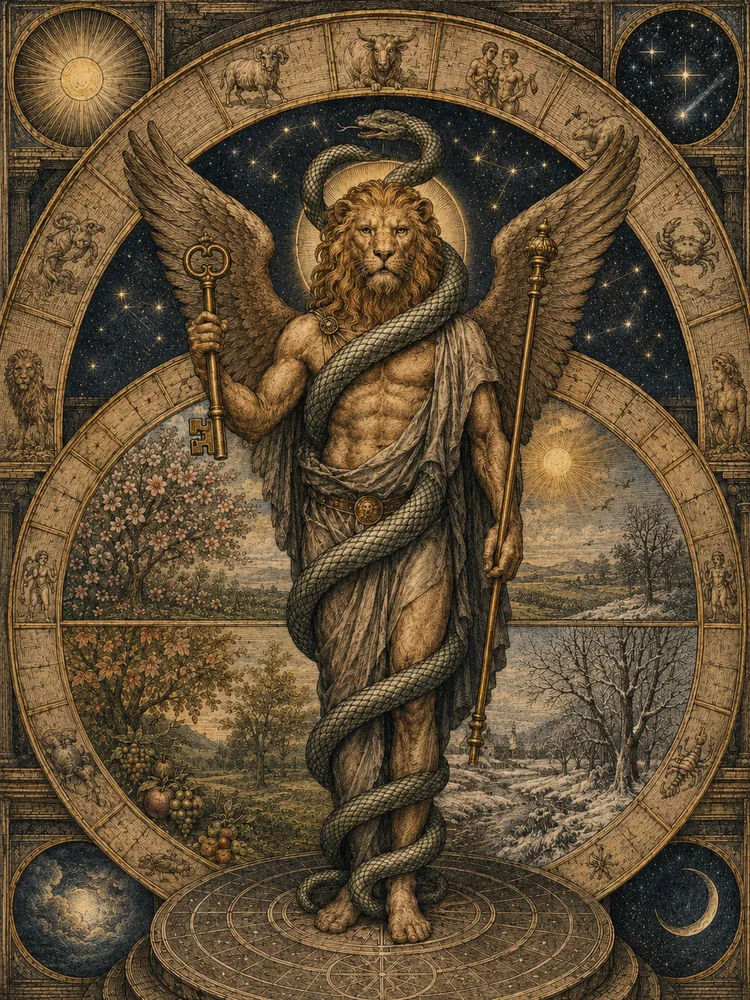
Aion was Eternity — the unbounded age, the totality of duration, distinguished in Greek philosophical thought from Chronos (which was time considered as it passes, the time of clocks and seasons). Aion was the time of the gods and of eternity; Chronos was the time of mortals and of becoming. The distinction was sharpened in Plato (Timaeus 37c–d, where time is described as "a moving image of eternity") and was foundational for later Greek philosophical theology. As a personified cosmic power, Aion was venerated in several mystery cults, particularly those of Mithras and of Hellenistic Alexandria, where his image — a serpent-bound figure with lion's head, the four seasons or ages depicted upon him — became a standard icon. The Aion of the Mithraic mysteries was depicted in temple-statuary as a winged man entwined by a serpent, a key in his hand.
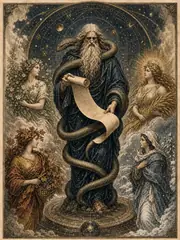 Before thisChronos
 Next on the wallPhanes
Curator’s note
What the sources say, and what later tradition added. The sources for this bay
The distinction between Aion (eternity, unbounded age) and Chronos (passing time) is principally Platonic; Plato, Timaeus 37c–38c, is the foundational text. The cult of Aion is attested in Hellenistic Alexandria, where his festival on the night of January 5/6 may stand behind certain features of the later Christian Epiphany; the Mithraic Aion-statues are attested archaeologically (the so-called "Lion-headed god" or Leontocephalus) and have been the subject of extensive scholarship since Cumont's day. The figure shaded into the late Roman cult of Eternity (Aeternitas) and was assimilated by the Imperial cult to the eternity of the Roman state.
Kin in the sources
Each tie is quoted from the entry that states it.
 Companion ofMithras (Roman)
Aion was venerated in several mystery cults, particularly those of Mithras and of Hellenistic Alexandria
When the sources speak
Dated witnesses for The Primordial Powers. A date marks when the evidence was written down, not when the belief began. The whole timeline
- c. 1600–1100 BCE
- Mycenaean palace tablets in Linear B record offerings and divine names, but little continuous myth.
- c. 1100–800 BCE
- Post-palatial oral traditions and changing cult landscapes precede the surviving alphabetic epics.
- late 8th–7th centuries BCE
- The Iliad, Odyssey, Hesiodic Theogony and Works and Days give influential but non-exclusive divine orders.
- 7th–6th centuries BCE
- Homeric Hymns, lyric poetry, colonization, and local sanctuary traditions multiply regional narratives.
- 6th–5th centuries BCE
- Orphic, Pythagorean, and mystery materials develop alternative cosmogonies and afterlife doctrines.
- 5th century BCE
- Athenian tragedy and comedy recast heroic houses and divine justice for civic audiences.
- 4th century BCE
- Philosophers, antiquarians, and local historians interpret or criticize inherited myth.
- 323–31 BCE
- Hellenistic poets and scholars systematize variants across an enlarged Greek world.