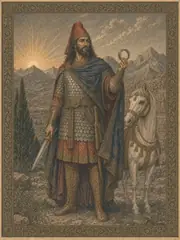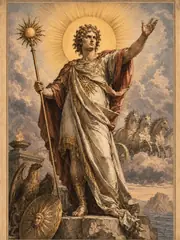
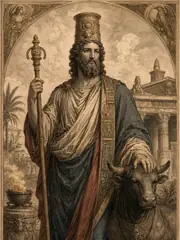
The Roman cult of Mithras was a mystery religion of the second through fourth centuries of our era, particularly popular among Roman soldiers, slaves of the imperial bureaucracy, and freedmen, with subterranean temples (mithraea) attested across the entire Roman world from Britain and the Rhine frontier to Dura-Europos in Syria. Some six hundred mithraea have been archaeologically identified. The cult took its name from the Persian god Mithra (a deity of contracts and oaths, treated in his Persian dimension elsewhere in the present anthology), but the Roman Mithras was substantially distinct from the Persian — he was a different figure with a different mythology, despite his name's origin, and the precise relationship between the Roman mystery and any Iranian cult of similar name is among the most debated questions in modern study of ancient religion.
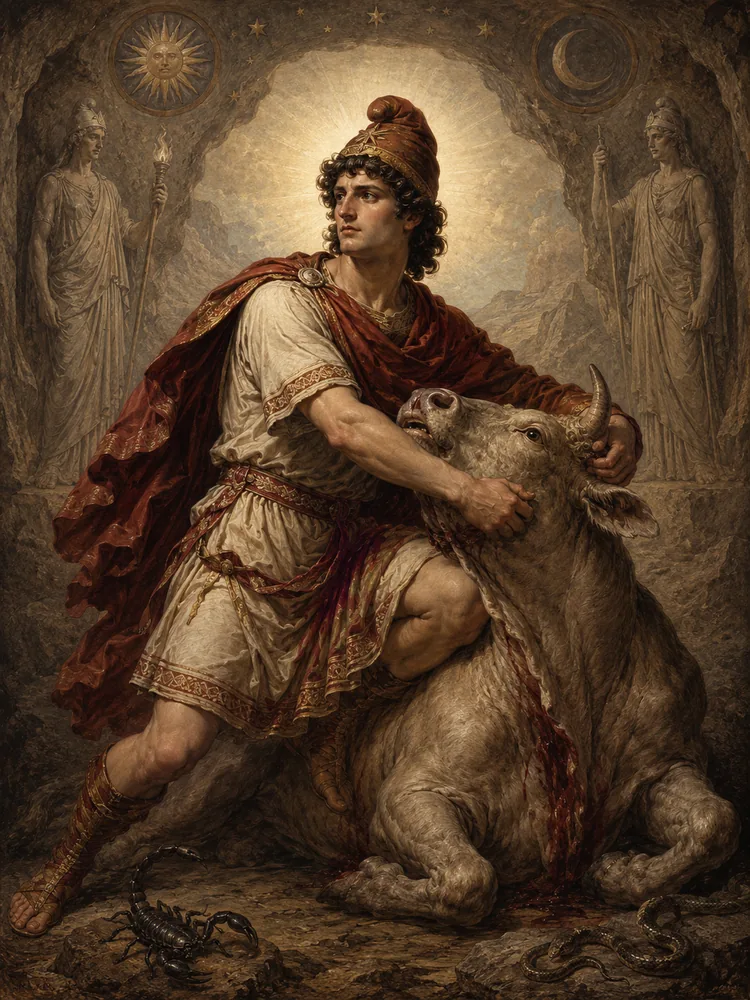
The Roman Mithras's central icon, attested in nearly every mithraeum and known as the tauroctony, depicts a young man in a Phrygian cap kneeling on a great bull, plunging a knife into its neck, while a dog and a serpent leap up to drink the blood from the wound and a scorpion attacks the bull's testicles. The scene is symbolically dense; modern interpreters have proposed a great variety of readings (David Ulansey, in The Origins of the Mithraic Mysteries, 1989, argued for a precessional-astrological interpretation, with the bull as Taurus the vernal-equinox constellation; other scholars have proposed cosmological, eschatological, or ritual readings). The cult's mysteries proper are not recorded — initiates were sworn to secrecy — but archaeology and the surviving monuments allow some reconstruction. There were seven grades of initiation, named for celestial bodies and ascended through ritual ordeals: Corax (Raven, under Mercury), Nymphus (Bridegroom, under Venus), Miles (Soldier, under Mars), Leo (Lion, under Jupiter), Perses (Persian, under Luna), Heliodromus (Sun-Runner, under Sol), and Pater (Father, under Saturn). Sacred meals of bread and wine were taken; ritual ordeals included tests of cold and heat. The mithraea themselves were small subterranean rooms, fitted out as caves, with the central tauroctony at one end and benches along the sides for perhaps thirty initiates.
The cult was exclusively male; it appealed particularly to soldiers (whose mobility carried it across the empire) and to the imperial bureaucracy (whose hierarchical discipline mirrored the cult's own structure). It was a serious rival to Christianity in the third century — both were salvation-cults, both had baptism-like initiations and ritual meals, both promised an afterlife — and its decline followed the Christian victory in the fourth century. The mithraea were systematically destroyed by Christians during the late fourth and fifth centuries; the religion left no continuing tradition, only its archaeology, its iconography, and its puzzling mythology.