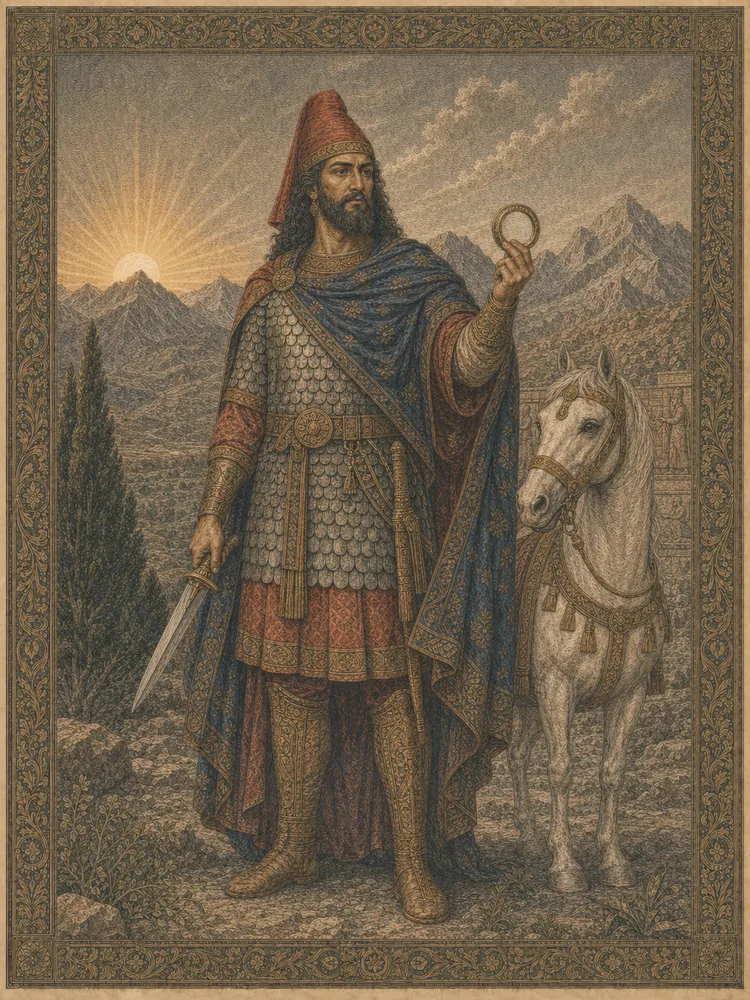
Mithra was one of the oldest of the Iranian yazatas, with cognates in the Vedic Mitra and a clear Indo-Iranian background; he was the lord of the covenant, the warrant of oaths, the patron of the warrior who fought for the just cause and of the king who ruled by righteous compact. His name in Avestan and Old Persian meant "covenant, agreement, contract," and the god personified that bond by which men committed themselves to one another and to the divine.
Mithra rode in a chariot drawn by four white horses, with the dawn going before him; he saw with ten thousand eyes everything that happened in the world, and he heard with ten thousand ears every oath sworn anywhere on earth. The man who broke an oath sworn by Mithra was hunted down by the god himself, who would never rest until the perjurer was brought to justice; the man who kept his oaths was Mithra's friend, and the god rode beside him in battle and gave victory.
His great Avestan hymn — Yasht 10, the Mihr Yasht — runs to over a thousand verses and is one of the most extended poetic compositions in the Iranian sacred literature. It celebrates Mithra in every aspect: as the rising sun, as the warrior on his horse, as the judge of the dead, as the guardian of cattle and pastures, as the protector of the righteous in battle and on the journey. The hymn is in some respects the most generous in the Avesta, a portrait of a god who is not merely worshipped but loved.
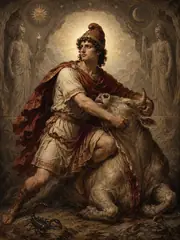
From this Iranian Mithra descended, through complex routes that we do not fully understand, the Roman cult of Mithras — the secret men's society of the Roman army that flourished from the second to the fourth century of our era, with its underground temples (mithraea), its grades of initiation, its banquet of bread and wine, and its iconic scene of the bull-killing. The Roman Mithras was a different god in many respects from the Iranian Mithra (the bull-killing has no Iranian counterpart, for example), and the relationship between the two was probably mediated by Hellenistic Cilician communities and by the wider Mediterranean syncretism of the post-Alexander period. But the name and the foundation were Iranian, and the Roman Mithras was at the deepest level a transformed version of the Avestan lord of the covenant. The Roman cult disappeared with the triumph of Christianity in the late fourth century; the Iranian Mithra, in his original form, was preserved by the Zoroastrian community and continues to be invoked by Parsis and Iranian Zoroastrians today.