A Compendium of the Ancient Gods
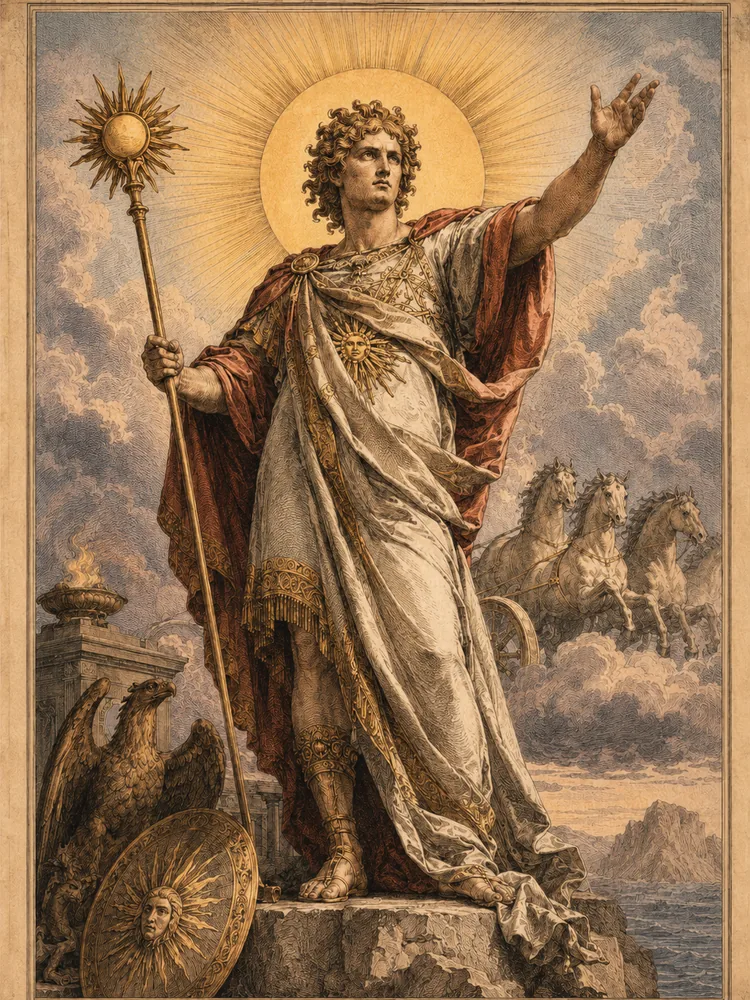
Sol Invictus, plate

Sol Invictus — "the Unconquered Sun" — was the great solar deity of the late Roman Empire, established as a state cult by the emperor Aurelian in 274 CE following his victories in the East. The cult had Eastern origins (Aurelian had been impressed by the cult of the sun-god of Emesa in Syria, and his reform drew on that example), but it was assimilated to older Roman solar traditions (the obscure indigenous sun-god Sol Indiges, of much greater Roman antiquity but minor cult-presence) and given a thoroughly Roman state character. Aurelian built a great temple of Sol on the Campus Agrippae, instituted a college of pontifices solis (priests of the sun), and made the cult one of the principal religions of the imperial state. The festival of Sol Invictus on December 25 — Dies Natalis Solis Invicti, the birthday of the Unconquered Sun, fixed at the winter solstice when the days began to lengthen and the sun's victory over winter was symbolized — became one of the major Roman festivals.

The cult survived as a major imperial religion for nearly half a century, through Diocletian and into the reign of Constantine, who continued to honor Sol Invictus on his coinage well after his patronage of Christianity began (his famous coins read SOLI INVICTO COMITI, "to the Unconquered Sun, his companion"). Constantine's eventual pivot toward Christianity displaced Sol Invictus from the imperial center, and the Christian observance of Christ's nativity on December 25 — first attested in this form in the mid-fourth century — appears to have been deliberately fixed on the same date, displacing the solar festival with the celebration of a different Sol Iustitiae (the Sun of Justice, as Christ was sometimes called in patristic typology). The historical relationship between Sol Invictus and the date of Christmas is thus not (as is sometimes loosely said) a case of Christianity adopting a pagan festival, but a case of Christianity competing with one and gradually displacing it. Sol Invictus's cult declined through the fourth century and was suppressed with the rest of the pagan state cults under Theodosius.

Curator’s note

What the sources say, and what later tradition added. The sources for this bay

The principal sources are the Historia Augusta's Life of Aurelian (a notoriously unreliable text but the principal narrative source for the establishment of the cult); Aurelius Victor, De Caesaribus 35; the Notitia Dignitatum and other administrative texts (for the priestly college); the abundant numismatic record. The Constantinian coinage with SOLI INVICTO COMITI is widely studied; see Bruun, Roman Imperial Coinage VII (1966). The relationship of December 25 to the solar festival is most carefully treated by Steven Hijmans (Sol: The Sun in the Art and Religions of Rome, 2009), who has argued that the Christian date was not directly borrowed from Sol Invictus but reflects a parallel calendar logic; the older view (associated with Hermann Usener and others) gave a more direct dependence.

When the sources speak

Dated witnesses for The Deified Virtues and the Imperial Mystery Cults. A date marks when the evidence was written down, not when the belief began. The whole timeline

c. 1000–750 BCE
Iron Age communities of Latium and neighboring peoples develop the cult landscapes later absorbed into Roman tradition.
traditional 753 BCE
Roman foundation chronology places Romulus and the first civic institutions at the beginning of the city’s sacred history.
traditional 7th–6th centuries BCE
The regal period is credited with priesthoods, calendars, temples, and the organization of public rites.
509–264 BCE
Republican expansion incorporates Latin, Sabine, Etruscan, and Italian cults through treaty, migration, and evocatio.
264–146 BCE
Mediterranean conquest accelerates Greek interpretation and the importation or redefinition of foreign gods.
204 BCE
The Magna Mater is formally brought from Pessinus during the Second Punic War.
1st century BCE
Varro, Cicero, and other antiquarians document rites and divine names amid civil war and institutional change.
27 BCE–14 CE
Augustan restoration monumentalizes selected ancestral cults and rewrites Roman sacred history.

Floor plan

The rooms follow one another in the order their peoples first appear in the written record.

  1. The Cradle of Citiesc. 3400 BCE to 395 CE. 115 works
  2. The Gift of the Nilec. 4000 BCE to 395 CE. 73 works
  3. The Olympian Orderc. 1600 BCE to 750 CE. 152 works
  4. The Persian Worldc. 2000 BCE to 1010 CE. 30 works
  5. The Levantine Borderlandsc. 1200 BCE to 500 CE. 20 works
  6. The Edges of Empirec. 2000 BCE to 1500 CE. 33 works
  7. The Etruscan Worldc. 900 BCE to 750 CE. 22 works
  8. The Roman Inheritancec. 1200 BCE to 500 CE. 58 works
  9. The Northern Inheritancec. 2000 BCE to 1600 CE. 131 works