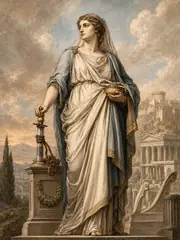
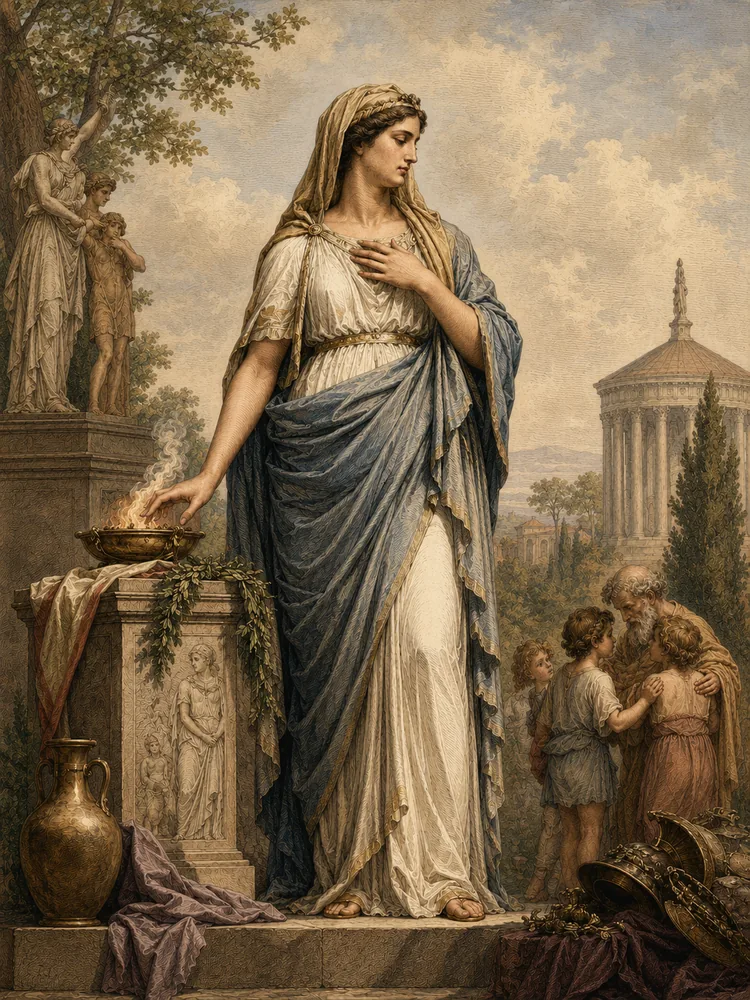
Pietas was the goddess of pietas — that is, of the right devotion of the citizen to the gods, to his country, and to his family. The Latin word does not translate well into modern English; "piety" has narrowed to a religious sense, while pietas was a comprehensive virtue covering all proper relations of obligation. The man who was pius rendered to the gods their due, served his country in war and peace, honored his parents, raised his children, kept faith with his friends and clients, was loyal to his patron, and observed the customs of his ancestors. It was the Roman virtue par excellence; Vergil's Aeneas is repeatedly called pius Aeneas, and the epithet meant that he was the embodiment of all these obligations rightly observed.
The deification of Pietas was relatively late as a state cult — her temple in the Forum Holitorium was vowed in 191 BCE by Manius Acilius Glabrio after his victory over Antiochus III at Thermopylae and dedicated in 181 BCE — but the principle she stood for was older than Rome itself. The temple's location was the site of a famous filial-piety tale: a daughter, said the tradition, had fed her imprisoned mother (or father) at her own breast, sustaining the parent's life when the prison-keepers had refused food; the deed had been discovered, the parent pardoned, and the spot consecrated to Pietas. The story was widely told and depicted in Roman art. Pietas was figured in iconography as a matron with a stork at her side (the stork was the proverbial type of filial piety, since young storks were said to feed their aged parents); she appeared on imperial coinage with regularity, particularly when the emperor wished to advertise the family-and-state-affirming character of his rule.
Curator’s note
What the sources say, and what later tradition added. The sources for this bay
The principal sources are Pliny, Natural History 7.121 (the filial-piety tale and the temple's foundation); Festus 209L; Livy 40.34. The conceptual treatment of pietas as the comprehensive Roman virtue is in Cicero, De Natura Deorum 1.116, De Inventione 2.66; modern scholarship has explored the term extensively (see Saller, Patriarchy, Property and Death in the Roman Family, 1994). The Vergilian use of pius Aeneas is foundational; the phrase appears at Aeneid 1.220, 1.305, 4.393, 5.685, 6.176, and many other places, becoming the hero's defining epithet.
When the sources speak
Dated witnesses for The Deified Virtues and the Imperial Mystery Cults. A date marks when the evidence was written down, not when the belief began. The whole timeline
- c. 1000–750 BCE
- Iron Age communities of Latium and neighboring peoples develop the cult landscapes later absorbed into Roman tradition.
- traditional 753 BCE
- Roman foundation chronology places Romulus and the first civic institutions at the beginning of the city’s sacred history.
- traditional 7th–6th centuries BCE
- The regal period is credited with priesthoods, calendars, temples, and the organization of public rites.
- 509–264 BCE
- Republican expansion incorporates Latin, Sabine, Etruscan, and Italian cults through treaty, migration, and evocatio.
- 264–146 BCE
- Mediterranean conquest accelerates Greek interpretation and the importation or redefinition of foreign gods.
- 204 BCE
- The Magna Mater is formally brought from Pessinus during the Second Punic War.
- 1st century BCE
- Varro, Cicero, and other antiquarians document rites and divine names amid civil war and institutional change.
- 27 BCE–14 CE
- Augustan restoration monumentalizes selected ancestral cults and rewrites Roman sacred history.