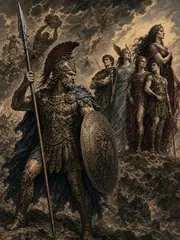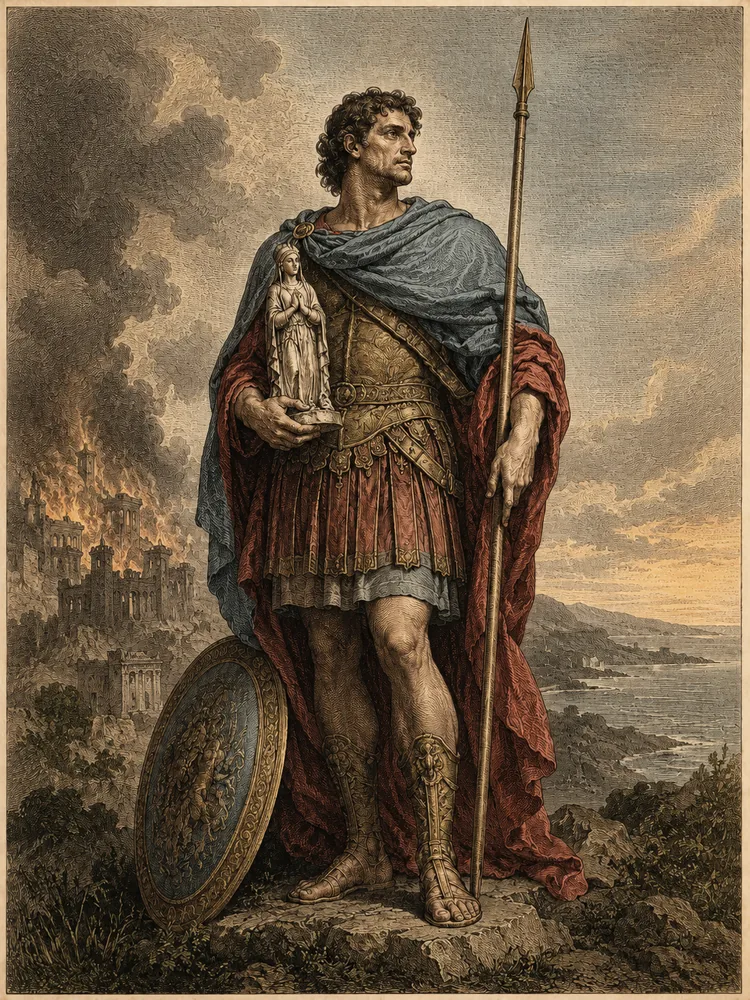
Aeneas was the son of the goddess Venus (the Roman Aphrodite) by the mortal Trojan prince Anchises, kinsman of the royal house of Troy. He fought at Troy as one of the second-rank Trojan heroes (Homer treats him with respect in the Iliad, where he is once rescued by Aphrodite from Diomedes and once by Poseidon from Achilles, in both cases because the gods foresaw a future role for him beyond the war's conclusion). When Troy at last fell, Aeneas escaped from the burning city carrying his aged father Anchises on his shoulders, leading his small son Ascanius (later called Iulus, ancestor of the Julian family) by the hand, and bearing the household Penates of Troy in his arms. His wife Creusa, lost in the flames, appeared to him as a ghost and told him that he was destined for a long voyage to a western land, where he should found a new city and a new line.
His wanderings (the matter of the first six books of Vergil's Aeneid) took him from Troy to Thrace (where he met the unhappy Polydorus), to Delos (where the oracle directed him to seek his ancient mother), to Crete (whither he wrongly went, mistaking the oracle), to the Strophades (where the harpies cursed him), to Buthrotum in Epirus (where he found his old comrade Helenus and Hector's widow Andromache living in a small reconstructed Troy and received guidance for the rest of the journey), to Sicily (where his father Anchises died and was buried at Drepanum), and at last — through a great storm raised by Juno (whose enmity, persistent throughout the epic, derived partly from Paris's slighting in the Judgment of the Goddesses and partly from her foreknowledge of Rome's future destruction of her favorite Carthage) — to the coast of Africa, where he was welcomed by Queen Dido of the new-built city of Carthage. Their love-affair (the matter of the fourth book of the Aeneid, one of the most famous tragic narratives in Latin literature) was ended by Mercury's command that Aeneas resume his journey toward Italy; Dido, abandoned, killed herself with his sword on a great pyre, cursing the Trojan and his line in the curse from which the Punic Wars (in Roman myth-historical understanding) would in time arise.
Aeneas reached Italy at last, came to Cumae and was guided by the Sibyl down to the underworld (the matter of the great sixth book), where he met the shade of his father Anchises and was shown the future of his line — the long parade of Roman heroes from Romulus to Augustus, an extraordinary literary device through which Vergil at one stroke connected the Trojan past to the Augustan present. Returning to the upper world, Aeneas sailed up the coast to the mouth of the Tiber, where the country was the kingdom of Latinus, who had been told by an oracle (delivered by his ancestor Faunus, treated in Book I above) that his daughter Lavinia must be given to a foreign suitor. Aeneas was that suitor; but Latinus's queen Amata preferred the local prince Turnus of the Rutuli, who had been promised Lavinia, and the war followed (the matter of the second six books of the Aeneid). Aeneas at length defeated Turnus in single combat (the poem's final scene, in which the slain Turnus's killing — though demanded by the rules of the duel and provoked by his wearing of the spoils of Aeneas's young friend Pallas — has long troubled readers, including the great Augustan jurist Servius); married Lavinia; and founded the new city of Lavinium, the first Trojan settlement in Italy. From his son Ascanius (Iulus) was descended the dynasty of Alba Longa, and from that dynasty four centuries later the founder of Rome.
The Aeneid's literary status is comparable in Latin to the Iliad's in Greek; it was, from its publication, the central work of the Roman literary canon, the basis of grammatical instruction (every Roman schoolboy memorized large portions), and the principal articulation of Roman religious and political self-understanding. The figure of pius Aeneas — the hero who at every step subordinates his personal desires to the demands of duty, who carries his father from the burning city, who leaves Dido for his mission's sake, who descends to the underworld for further instruction, who marries the woman he is told to marry, who founds the city he is told to found — was the Roman ideal made flesh, and Vergil's verse made it permanent.