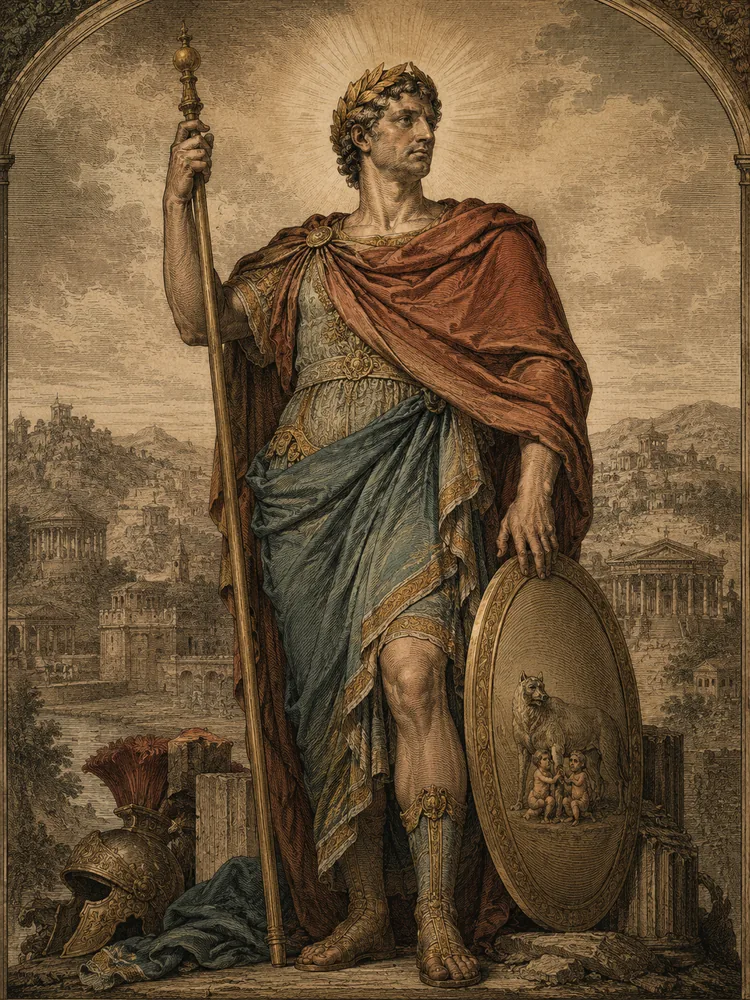
Romulus was the founder of Rome, traditionally on April 21, 753 BCE — the date being the calculated reconstruction of the Roman antiquarian Varro, on the basis of which the Roman calendar of years ab urbe condita ("from the city's founding") was reckoned. He was the son of Mars (the war-god of Rome) by the priestess Rhea Silvia, daughter of Numitor, the rightful king of Alba Longa, who had been deposed by his brother Amulius. Amulius, having seized the throne, had killed Numitor's sons and forced his daughter Rhea Silvia into the priesthood of Vesta, where her vow of chastity would prevent her from producing rival heirs. But Mars came to her in her sleep (or, in some versions, in a sacred grove during a ritual procession), and she conceived twins by him: Romulus and Remus.
Amulius, on discovering her pregnancy, had her imprisoned and ordered the twins exposed in the Tiber, expecting them to drown. The basket in which they were placed was carried by the flooding river to the foot of the Palatine hill, where it lodged against the roots of a fig-tree (the Ficus Ruminalis, still pointed out as a sacred tree in classical Rome). There the twins were found and suckled by a she-wolf — the famous Lupercal episode whose iconic representation (the bronze statue of the wolf with the twins beneath) became Rome's defining emblem — and afterward by the bird sacred to their father Mars, the woodpecker. They were eventually discovered by the shepherd Faustulus and his wife Acca Larentia (who in some traditions was the she-wolf, lupa being also slang for a prostitute, and the elevated tale of a literal wolf being a euphemism for a more prosaic origin); by them they were raised as shepherds among the rural folk of the Palatine.
When the twins came of age and learned their parentage, they led a successful uprising against Amulius, killed him, restored their grandfather Numitor to the throne of Alba Longa, and resolved to found a new city of their own. They returned to the place where they had been suckled and consulted the auspices to determine which of them should be the founder. Romulus took his stand on the Palatine, Remus on the Aventine; Remus saw six vultures first, but Romulus saw twelve — and the dispute over which omen prevailed (the priority of the first sighting versus the greater number of birds) was not resolved by the twins. Romulus began to mark out the wall of his new city; Remus, in mockery, leapt over the half-built wall; Romulus killed his brother on the spot, declaring "So shall it be for any other who leaps over my walls." The killing was the founding sacrifice; the city was Rome.
Romulus's reign as first king of Rome was long and elaborately narrated: the asylum he opened on the Capitoline (where any man fleeing his enemies might take refuge and become a citizen of the new city, providing the population for the foundation); the Rape of the Sabine Women (when the new city's surplus of men was given wives by the abduction of the daughters of the neighboring Sabines, leading to war and at last to a treaty by which the two peoples merged into one); the long peace with King Titus Tatius of the Sabines, ruling jointly with Romulus until his assassination; the establishment of the Roman political and religious institutions (the Senate, the patriciate, the centuries, the auspices, the various priesthoods); the wars with the neighboring peoples that gradually expanded Roman territory.
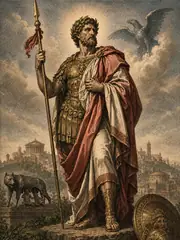
Romulus's death was preternatural. As he was reviewing his army in the Campus Martius, a sudden storm darkened the sky; when it cleared, Romulus had vanished. The Senate gave it out that he had been carried up to heaven — an account whose obvious convenience led to suspicion among the people that the senators had themselves murdered the king and concealed the body; but a respectable Roman named Julius Proculus (whose name, of course, would not seem accidental to the Julian family centuries later) came forward to say that Romulus had appeared to him on the road from Alba, in radiant form, and had announced that he had been received among the gods, and bade Rome cultivate the arts of war and governance, and that he himself would watch over the city as a god. The Romans accordingly worshipped Romulus thereafter under the divine name Quirinus (treated in Book I above), making him the third member of the archaic triad alongside Jupiter and Mars; though the historical priority is probably the other way around, with the older god Quirinus being secondarily identified with the founder. Whether the apotheosis-story preserves a memory of an older indigenous deification-tradition or whether it was a senatorial invention to cover an embarrassing political event, the figure of Romulus thereafter served Rome as both legendary founder and divine patron.