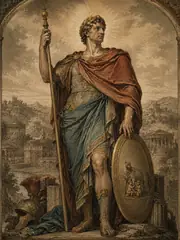
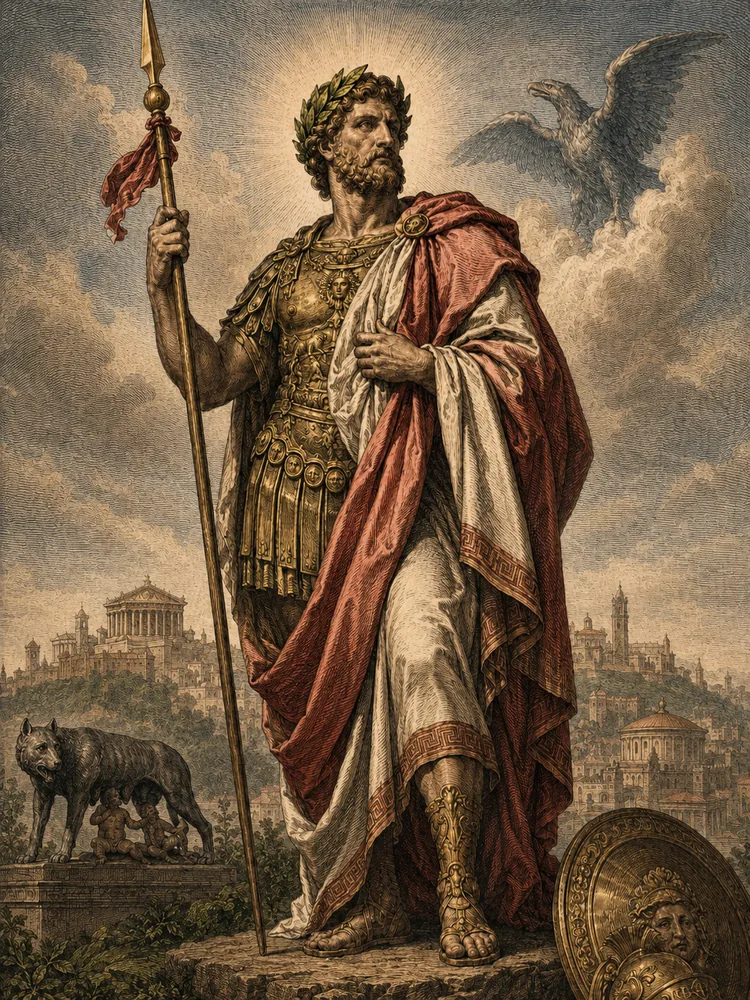
Quirinus was, in the developed Roman tradition, the deified form of Romulus, founder of the city, who upon his death (as told in his entry below) was carried up to heaven and there received the divine name Quirinus. But his place in Roman religion was older than the Romulus-identification. He was the third member of the archaic Capitoline triad — Jupiter, Mars, and Quirinus — that was supplanted in historical times by the later triad of Jupiter, Juno, and Minerva (the gods of the great Capitoline temple); the earlier triad reflected an Indo-European tripartite scheme of sovereign, warrior, and producer functions, with Quirinus as the divine representative of the third (the productive citizenry) just as Jupiter was the sovereign and Mars the warrior. He had his own flamen — the Flamen Quirinalis, one of the three major flamines of the Roman priesthood, alongside the flamines of Jupiter and Mars — and his own festival, the Quirinalia, on February 17. His Sabine origin was suspected by the ancients (he may have been the patron-god of the Sabine community on the Quirinal hill, brought into Roman religion when the two communities merged); his name was variously derived from quiris (the lance, or the citizen-body), from the Sabine town of Cures, or from the Quirinal hill itself.
The identification with the deified Romulus was already old by Cicero's time and complete by the imperial period; the apotheosis-of-Romulus narrative (treated in Romulus's entry) gave Quirinus a mythological story he had not originally had, and the older theology of the agricultural-citizen function was largely forgotten. The figure thereafter persisted as the divine name of Rome's founder, and as a poetic synonym for the Roman state itself — Vergil's Quirini sub regno ("under Quirinus's rule") in the Georgics meaning simply "in Rome."