A Compendium of the Ancient Gods
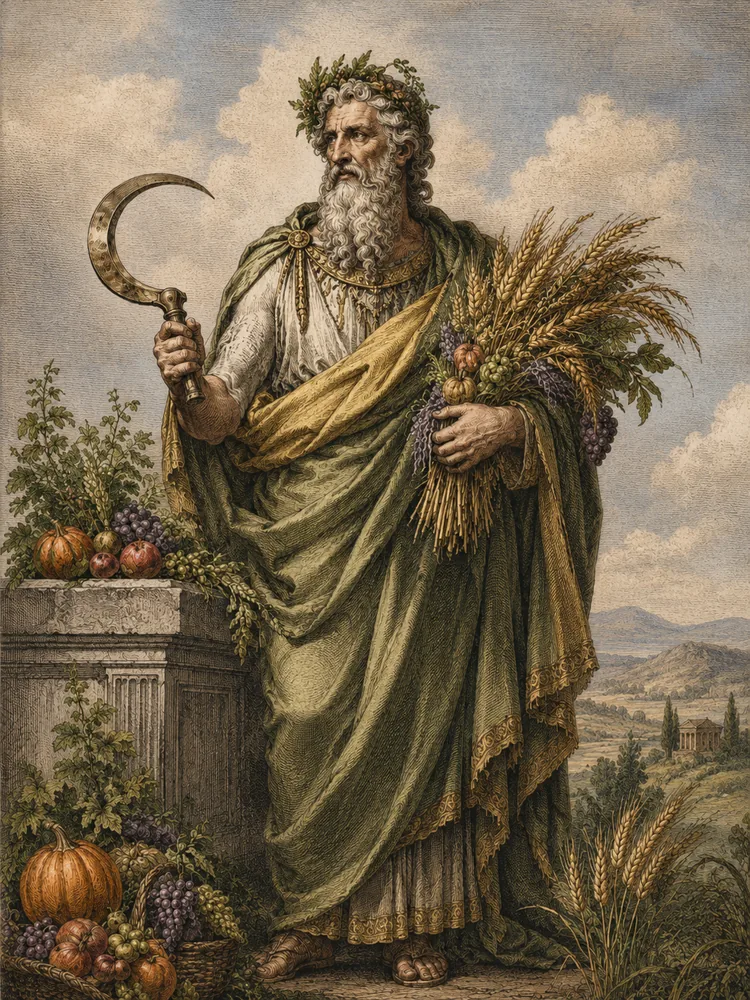
Saturn, plate

Saturn was the great agricultural god of early Latium — a deity of sowing (his name was anciently derived from sero, "to sow," though the etymology is uncertain), of the harvest, of plenty. The Roman antiquarian tradition gave him a story: driven from heaven by his son Jupiter (who had likewise driven his own father from heaven, and so on in the Hesiodic Greek pattern that the Romans had absorbed), Saturn had come to Italy and to the kingdom of Janus, where he had been received and where he had taught the local people the arts of cultivation. His reign in Italy was the Golden Age — a time of plenty, of social peace, when the earth gave its fruits without labor, when there were no slaves and no boundaries between persons, when men lived as the gods had lived before. The Saturnian Age came to an end with Saturn's withdrawal; but its memory was preserved in Rome's greatest annual festival, the Saturnalia.

The Saturnalia were held from December 17 to December 23 (originally just the first day, expanded over time), and were the supreme Roman festival of social inversion. During its days the law-courts were closed; schools were on holiday; gambling, normally illegal, was permitted; gifts were exchanged (the sigillaria, small wax or terracotta figures); a Lord of Misrule was chosen by lot to preside over each household's festivities; slaves were served by their masters at a great feast (and were given license to mock them, in safety from punishment, for the duration); the Phrygian cap of liberty was worn; and the social hierarchies of Roman life were temporarily reversed. The festival was a remembrance of the equality of the Golden Age and a release-valve for the year's accumulated rigors. Its date — coinciding with the winter solstice, the turning of the year — was significant; many of its features (the gift-giving, the festive eating, the temporary suspension of normal social distinctions) were absorbed by the medieval and modern Christmas-and-New-Year complex of festivities, of which the Saturnalia is one of the principal ancestors.

The Roman identification of Saturn with the Greek Titan Cronus was already old by the late Republic and complete by the imperial period. But the Italic Saturn had been originally distinct: an agricultural deity of plenty, not the swallowing tyrant of the Greek theogony, and his Roman cult preserved the older Italic character even after the literary identification. His temple at the foot of the Capitoline hill, restored in the Republic and again under Augustus, served as the state treasury (the aerarium populi Romani) and was one of the most important sacred buildings of the city; eight of its columns still stand.
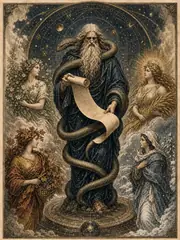
Curator’s note

What the sources say, and what later tradition added. The sources for this bay

The principal sources are Macrobius, Saturnalia (the entire work, organized as a dialogue at a Saturnalia banquet, is the most extensive ancient discussion); Ovid, Fasti 1.235–254; Vergil, Aeneid 8.319–325, Georgics 2.538; Livy 22.1.20 (the institution of the festival); Cicero, De Natura Deorum 2.64. The identification with Cronus is universal in literary sources of the late Republic and after; the Italic Saturn's separate identity has been recovered by modern scholarship through analysis of the cultic survivals (the position of the Saturnalia in the calendar, the agricultural character of the cult, the etymology of the name, the lack of the swallowing-of-children narrative in the genuinely Italic strata). The eight surviving columns of the Temple of Saturn at the Forum's western end belong to the third reconstruction, c. 4th century CE.

Kin in the sources

Each tie is quoted from the entry that states it.

The same god in other rooms

The ancient sources themselves name these as one god under different names. See Chronos, Cronus and Saturn hung together

When the sources speak

Dated witnesses for The Indigenous Italic Gods. A date marks when the evidence was written down, not when the belief began. The whole timeline

c. 1000–750 BCE
Iron Age communities of Latium and neighboring peoples develop the cult landscapes later absorbed into Roman tradition.
traditional 753 BCE
Roman foundation chronology places Romulus and the first civic institutions at the beginning of the city’s sacred history.
traditional 7th–6th centuries BCE
The regal period is credited with priesthoods, calendars, temples, and the organization of public rites.
509–264 BCE
Republican expansion incorporates Latin, Sabine, Etruscan, and Italian cults through treaty, migration, and evocatio.
264–146 BCE
Mediterranean conquest accelerates Greek interpretation and the importation or redefinition of foreign gods.
204 BCE
The Magna Mater is formally brought from Pessinus during the Second Punic War.
1st century BCE
Varro, Cicero, and other antiquarians document rites and divine names amid civil war and institutional change.
27 BCE–14 CE
Augustan restoration monumentalizes selected ancestral cults and rewrites Roman sacred history.

Floor plan

The rooms follow one another in the order their peoples first appear in the written record.

  1. The Cradle of Citiesc. 3400 BCE to 395 CE. 115 works
  2. The Gift of the Nilec. 4000 BCE to 395 CE. 73 works
  3. The Olympian Orderc. 1600 BCE to 750 CE. 152 works
  4. The Persian Worldc. 2000 BCE to 1010 CE. 30 works
  5. The Levantine Borderlandsc. 1200 BCE to 500 CE. 20 works
  6. The Edges of Empirec. 2000 BCE to 1500 CE. 33 works
  7. The Etruscan Worldc. 900 BCE to 750 CE. 22 works
  8. The Roman Inheritancec. 1200 BCE to 500 CE. 58 works
  9. The Northern Inheritancec. 2000 BCE to 1600 CE. 131 works