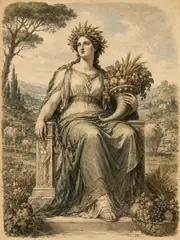
Ops was the Roman goddess of abundance, wealth, and the fruitfulness of the soil; her name in Latin meant simply "plenty" or "resource," and was in the same family as the verb opitulari, "to bring help." She was an old indigenous goddess, but at an early date she was identified with Greek Rhea, and through this identification she became the wife of Saturn and the mother of Jupiter, Juno, Neptune, and the rest of the Olympian generation in their Roman forms.
Her festivals were two: the Opiconsivia of August 25, kept four days after the Consualia and clearly linked to it (Saturn-Consus and Ops-Opiconsiva forming a divine pair, the storer and the abundance stored), and the Opalia of December 19, kept two days after the Saturnalia. The August rite was so archaic and sacred that none might attend save the Vestal Virgins and the flamen Quirinalis; even the Pontifex Maximus was barred. The December festival was more public and was felt as part of the great Saturnalian holiday, the time of the year's return.
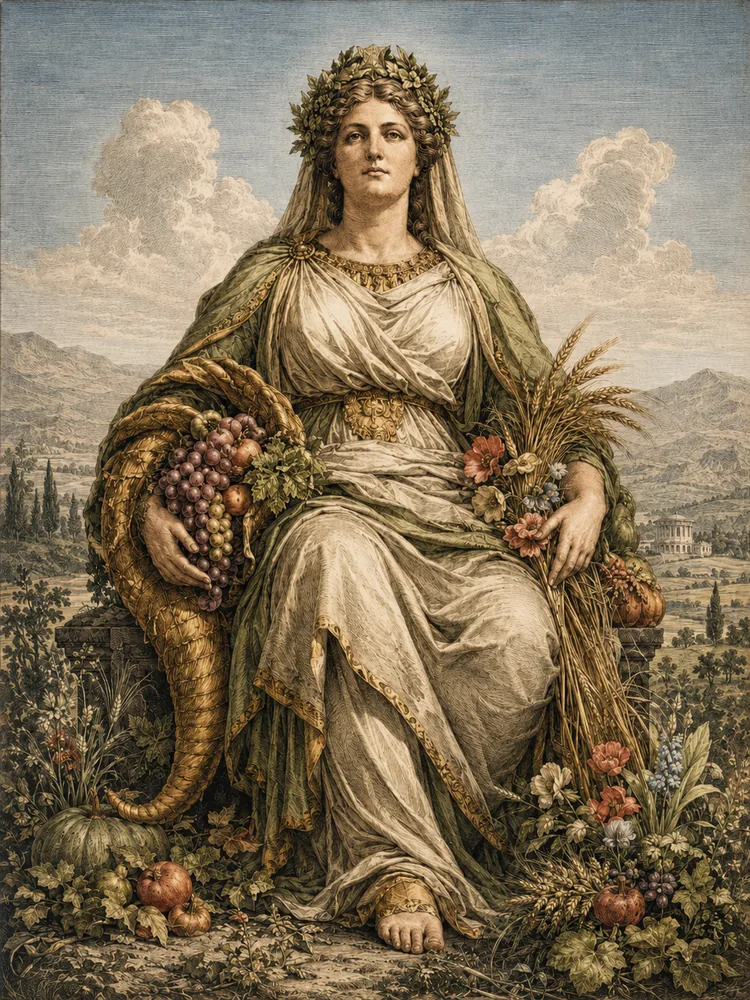
In her cult, Ops was approached with a peculiar gesture: the worshipper sat upon the earth and touched it with his hand while invoking her, for the abundance she represented was the abundance of the earth itself, and one must be in contact with the earth to address her. The same gesture is recorded for the worship of Tellus, with whom Ops shared much of her function. In imperial times Ops became also the protectress of the wealth of the state, and her image appeared on coins as a matron seated upon a throne with a sheaf of wheat or a cornucopia.