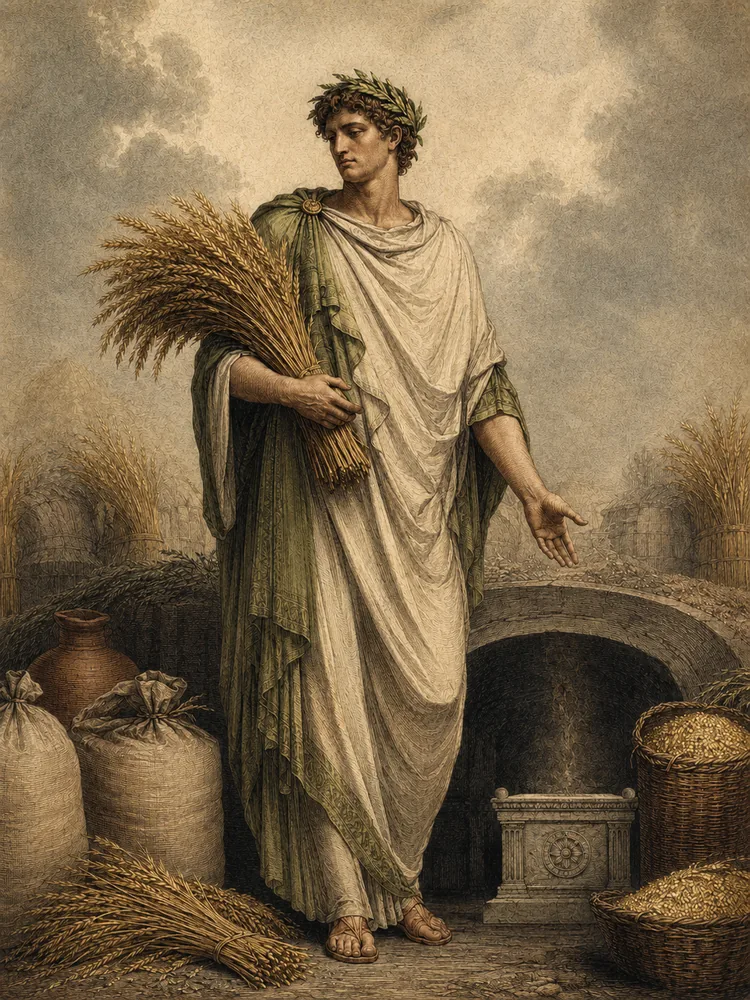

Consus was an ancient deity of the Roman countryside, the god of the gathered grain and of stores hidden away beneath the earth — for the prudent farmer in the old Italian way buried his harvest in a covered pit to save it from rot and from raiders. Consus's altar, which lay in the Circus Maximus at the foot of the Aventine, was likewise kept underground: it was uncovered only twice a year, on the Consualia of August (after the harvest) and on a corresponding rite of December (after the autumn sowing). On these days alone the altar was opened, sacrifices made, and games celebrated upon the Circus.
The most famous of these games was the Consualia of August, for at the very first Consualia in Rome — celebrated by Romulus to draw a crowd from neighboring tribes — the Romans seized the daughters of their Sabine guests and bore them off as wives. So says Livy. The Sabines made war upon Rome to recover their daughters, and the war was settled only by the daughters themselves, who threw themselves between the lines and reconciled their fathers with their husbands. Thereafter the Sabines were absorbed into the Roman state, and Consus's festival was kept as a memorial of the founding event.
Horses and mules — the beasts of the harvest — were given the day off on the Consualia, garlanded with flowers, and led through the streets in honor of the god; the chariot-races run upon the Circus were the only races in the Roman year that included mules as well as horses. The pontifices and the flamen Quirinalis officiated at the rite, but no flamen of Consus himself is recorded — for Consus was older than the priestly system that Rome had developed, and his cult retained an archaic simplicity.