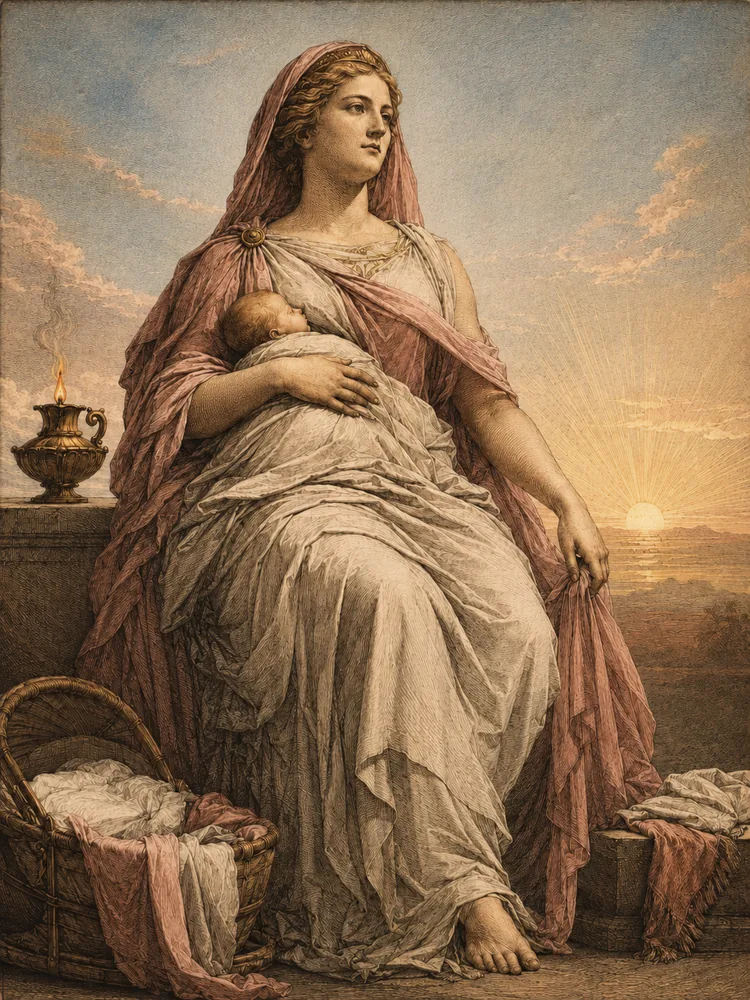
Mater Matuta was an ancient goddess of the dawn and of the bringing-forth — both of the day at sunrise and of the child at birth. Her name was understood by the Romans to mean "the Mother of the Morning," matuta being a derivative of the same root that gave them mane ("morning") and maturus ("ripe, ready"). Her great temple stood in the Forum Boarium near that of her companion-goddess Fortuna, and was attributed by tradition to the king Servius Tullius.
Her festival, the Matralia, was kept on the eleventh of June. The rite was peculiar: only married women in their first marriage might enter the temple on that day, and they were to bring with them not their own children but their sister's children, whom they would commend to the goddess. A slave-woman was symbolically driven from the sanctuary, and at the door the matrons would slap her face — a strange ceremony whose meaning was unclear to the Romans themselves. The most plausible explanation, given by Plutarch, is that it commemorated the goddess Ino-Leucothea, with whom Mater Matuta was identified in Hellenizing scholarship: Ino had taken the place of her own children to nurse the children of her sister Semele.
In her aspect as goddess of birth, Mater Matuta was particularly invoked by women in childbirth and by those who prayed for sons. The dedications recovered from her sanctuary at Satricum, an old temple-site some forty miles south of Rome, are largely terracotta figurines of swaddled infants — votive thanks for safe deliveries — and have given archaeologists one of the best assemblages of Italic religious art from the period before the Punic Wars.
Curator’s note
What the sources say, and what later tradition added. The sources for this bay
Mater Matuta is described by Ovid (Fasti 6.473-562, the Matralia entry, with the Ino-Leucothea identification), Plutarch (Camillus 5, Roman Questions 16-17), and Augustine (City of God 4.21). The temple in the Forum Boarium has been excavated; the discovery (1970s onward) of two rectangular temples of the Archaic period side by side, with the Mater Matuta and Fortuna sanctuaries, has confirmed the historicity of the Servian foundation tradition. The Satricum sanctuary, with its great deposit of votive infants, was excavated in the late nineteenth and early twentieth centuries; the votives are now in the Villa Giulia and the Museo Archeologico in Rome. The slap upon the slave-woman, a curious archaic feature, may be related to ritual exclusion of barren women or of women under another's authority — the fertile and free matron alone being permitted to address the mother-goddess.
When the sources speak
Dated witnesses for The Indigenous Italic Gods. A date marks when the evidence was written down, not when the belief began. The whole timeline
- c. 1000–750 BCE
- Iron Age communities of Latium and neighboring peoples develop the cult landscapes later absorbed into Roman tradition.
- traditional 753 BCE
- Roman foundation chronology places Romulus and the first civic institutions at the beginning of the city’s sacred history.
- traditional 7th–6th centuries BCE
- The regal period is credited with priesthoods, calendars, temples, and the organization of public rites.
- 509–264 BCE
- Republican expansion incorporates Latin, Sabine, Etruscan, and Italian cults through treaty, migration, and evocatio.
- 264–146 BCE
- Mediterranean conquest accelerates Greek interpretation and the importation or redefinition of foreign gods.
- 204 BCE
- The Magna Mater is formally brought from Pessinus during the Second Punic War.
- 1st century BCE
- Varro, Cicero, and other antiquarians document rites and divine names amid civil war and institutional change.
- 27 BCE–14 CE
- Augustan restoration monumentalizes selected ancestral cults and rewrites Roman sacred history.