A Compendium of the Ancient Gods
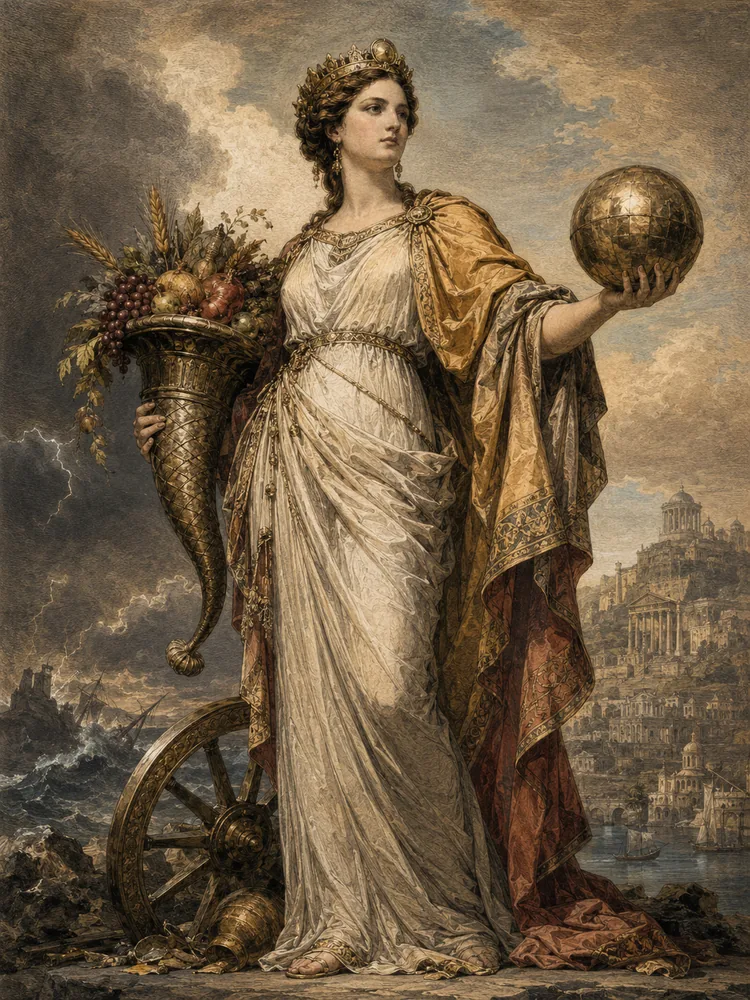
Fortuna, plate

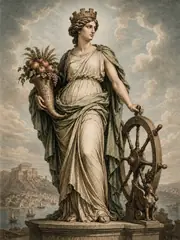
Fortuna was the Roman goddess of chance — the unpredictable element in human affairs, the gift or the affliction that came without warning, the breeze that carried one ship to harbor and dashed another upon the rocks. She was depicted with a wheel (the wheel of fortune that turns and lifts and casts down), with a cornucopia (the gifts she bestowed), with a rudder (her steering of human destinies), and standing upon a globe (her sovereignty over the earth). She was perhaps the most widely worshipped of all Roman deities; her shrines stood in every city of the Empire, and her festivals were many.

Her oldest cult-place in Italy was at Praeneste (modern Palestrina), where the great sanctuary of Fortuna Primigenia rose in terraces up the side of a hill — the largest sanctuary in Italy outside Rome, and the model for the Roman Pantheon and many later buildings. There the goddess gave oracular response by means of the sortes Praenestinae, lots inscribed with answers, drawn at random from a casket; the practice was old and was used by Roman magistrates for state inquiries.

In Rome herself, Fortuna had at least nine separate cult-places, each addressing a different aspect of her power: Fortuna Virilis (women's fortune), Fortuna Muliebris (matronly fortune), Fortuna Equestris (the equestrian order's fortune), Fortuna Publica (public fortune), Fortuna Huiusce Diei (the fortune of this particular day), Fortuna Redux (the fortune that brings travelers home), Fortuna Stata (the standing fortune), Fortuna Primigenia, and Fortuna of Servius Tullius. The proliferation of titles reflects the Roman instinct for specialist gods; each kind of fortune required its own shrine and its own approach.

By the imperial period, Fortuna was assimilated to the Greek Tyche and was treated by philosophical writers as the divine name for chance — sometimes seen as a power, sometimes as a personification of a non-divine reality. Pliny the Elder gives the bitter sociological view: "Throughout the whole world, at every place and hour, by every voice, Fortuna alone is invoked and named, alone accused, alone implicated, alone praised, alone censured, and revered with reproaches; she is volatile, fickle, faithless, deceitful... in such accounting we have placed all our affairs."
Curator’s note

What the sources say, and what later tradition added. The sources for this bay

Fortuna's various cults are documented throughout the Roman literature: Cicero (De Divinatione 2.85-87, the Praenestine lots), Livy (multiple references), Ovid (Fasti 6.569-636 — the great Fortuna passage), Plutarch (Roman Questions 36, 74, 100, 106; De Fortuna Romanorum), Pliny (Naturalis Historia 2.22, the famous lament). The Praenestine sanctuary was rediscovered after the World War II bombings of 1944 (which destroyed the medieval town built on top of it) and is now one of the most impressive surviving Roman religious complexes. The temple of Fortuna Virilis in the Forum Boarium (now S. Maria Egiziaca) is the temple discussed under Portunus above; modern scholarship now identifies it with Portunus rather than Fortuna, despite the older name. The literature on Fortuna is vast; Howard Patch (The Goddess Fortuna in Mediaeval Literature, 1927) traces her afterlife into Christian thought, where she became Boethius's Fortuna in the Consolation of Philosophy.

Kin in the sources

Each tie is quoted from the entry that states it.

The same god in other rooms

The ancient sources themselves name these as one god under different names. See Tyche and Fortuna hung together

When the sources speak

Dated witnesses for The Deified Virtues and the Imperial Mystery Cults. A date marks when the evidence was written down, not when the belief began. The whole timeline

c. 1000–750 BCE
Iron Age communities of Latium and neighboring peoples develop the cult landscapes later absorbed into Roman tradition.
traditional 753 BCE
Roman foundation chronology places Romulus and the first civic institutions at the beginning of the city’s sacred history.
traditional 7th–6th centuries BCE
The regal period is credited with priesthoods, calendars, temples, and the organization of public rites.
509–264 BCE
Republican expansion incorporates Latin, Sabine, Etruscan, and Italian cults through treaty, migration, and evocatio.
264–146 BCE
Mediterranean conquest accelerates Greek interpretation and the importation or redefinition of foreign gods.
204 BCE
The Magna Mater is formally brought from Pessinus during the Second Punic War.
1st century BCE
Varro, Cicero, and other antiquarians document rites and divine names amid civil war and institutional change.
27 BCE–14 CE
Augustan restoration monumentalizes selected ancestral cults and rewrites Roman sacred history.

Floor plan

The rooms follow one another in the order their peoples first appear in the written record.

  1. The Cradle of Citiesc. 3400 BCE to 395 CE. 115 works
  2. The Gift of the Nilec. 4000 BCE to 395 CE. 73 works
  3. The Olympian Orderc. 1600 BCE to 750 CE. 152 works
  4. The Persian Worldc. 2000 BCE to 1010 CE. 30 works
  5. The Levantine Borderlandsc. 1200 BCE to 500 CE. 20 works
  6. The Edges of Empirec. 2000 BCE to 1500 CE. 33 works
  7. The Etruscan Worldc. 900 BCE to 750 CE. 22 works
  8. The Roman Inheritancec. 1200 BCE to 500 CE. 58 works
  9. The Northern Inheritancec. 2000 BCE to 1600 CE. 131 works