A Compendium of the Ancient Gods
Roma, plate

Roma was the personification of the city of Rome, deified and given divine honors. She was a Hellenistic invention rather than an old Italic deity — the cult began in the Greek east, where cities had long been accustomed to deify themselves and their alliances, and where the Roman conqueror was a power to be honored. The first temple to Roma is recorded at Smyrna in 195 BCE, vowed in gratitude after the city had appealed successfully to Roman protection; thereafter many other Greek cities established cults of Roma. Roma the goddess was thus born abroad, and she returned to her city as a foreign import.

The cult was somewhat slow to take hold in Rome itself, where the Romans were embarrassed at the idea of self-worship; it acquired a regular footing only under Augustus, who associated Roma with his own divine numen and made the worship of "Roma and Augustus" the standard formula for the imperial cult in the provinces. The great temple of Venus and Roma — designed by Hadrian and built between 121 and 135 — was the largest temple in the city, and stood near the Colosseum on the site of the old vestibule of Nero's Golden House.

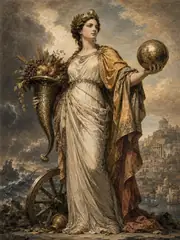
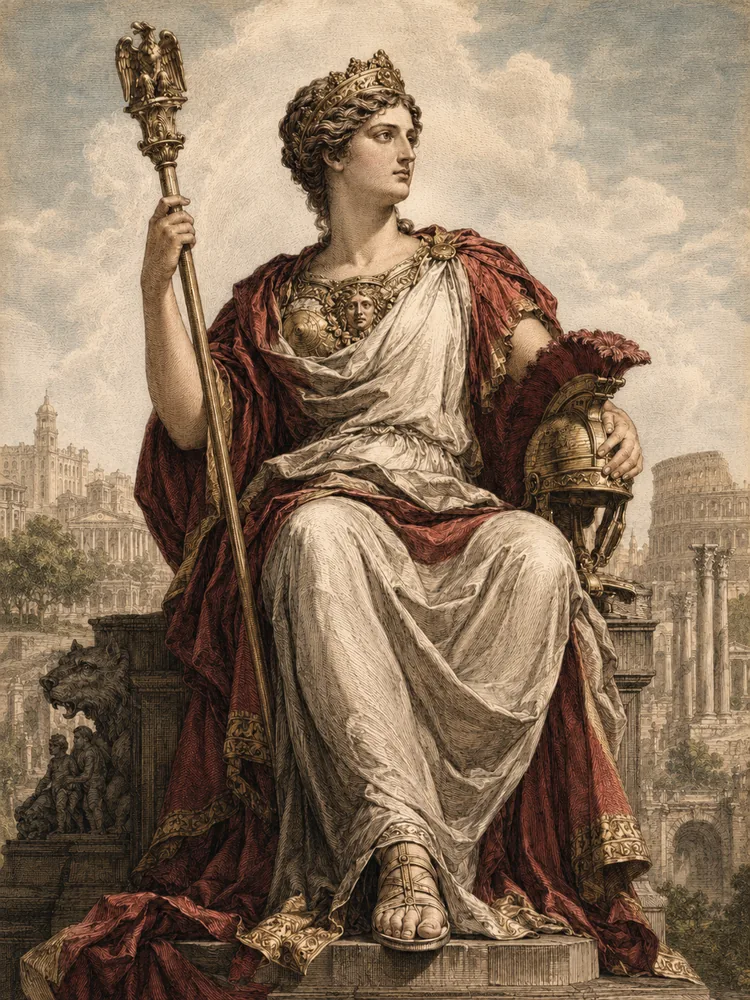
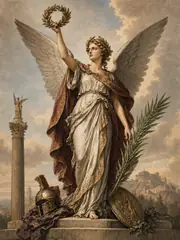
Roma was depicted as a stately matron, helmeted and armed (often with a Greek-style helmet), seated on a throne, holding a Victory in her hand and a globe. She is on the coins of every imperial dynasty from Augustus to the fall of the West, and her image was so familiar that it became indistinguishable in later centuries from the Christian iconography of personified cities and saints. The figure of Roma — Roma Aeterna, Eternal Rome — survived the Empire's fall and became one of the great mythic icons of European thought, invoked by every later regime from Charlemagne to Mussolini.

Curator’s note

What the sources say, and what later tradition added. The sources for this bay

The cult of Roma is documented from the Greek east (Tacitus, Annals 4.56 — Smyrna's claim of priority; OGIS 437 — the inscription of the temple) and from Rome itself (Cassius Dio 51.20, the development under Augustus; Suetonius, Augustus 52). The temple of Venus and Roma is described by the Historia Augusta (Hadrian 19.12); it is the largest known Roman temple, and substantial remains are preserved beside the Colosseum. The doubling of Venus and Roma was theological: Venus was the divine ancestress of the Julian house and so of Augustus and his successors; Roma was the city itself; together they constituted the divine basis of Roman imperial legitimacy. The literature on Roma as an idea is extensive; Marcus Aurelius's invocation of "Roma Aeterna" in the Meditations 4.23 is the most famous philosophical instance.

When the sources speak

Dated witnesses for The Deified Virtues and the Imperial Mystery Cults. A date marks when the evidence was written down, not when the belief began. The whole timeline

c. 1000–750 BCE
Iron Age communities of Latium and neighboring peoples develop the cult landscapes later absorbed into Roman tradition.
traditional 753 BCE
Roman foundation chronology places Romulus and the first civic institutions at the beginning of the city’s sacred history.
traditional 7th–6th centuries BCE
The regal period is credited with priesthoods, calendars, temples, and the organization of public rites.
509–264 BCE
Republican expansion incorporates Latin, Sabine, Etruscan, and Italian cults through treaty, migration, and evocatio.
264–146 BCE
Mediterranean conquest accelerates Greek interpretation and the importation or redefinition of foreign gods.
204 BCE
The Magna Mater is formally brought from Pessinus during the Second Punic War.
1st century BCE
Varro, Cicero, and other antiquarians document rites and divine names amid civil war and institutional change.
27 BCE–14 CE
Augustan restoration monumentalizes selected ancestral cults and rewrites Roman sacred history.

Floor plan

The rooms follow one another in the order their peoples first appear in the written record.

  1. The Cradle of Citiesc. 3400 BCE to 395 CE. 115 works
  2. The Gift of the Nilec. 4000 BCE to 395 CE. 73 works
  3. The Olympian Orderc. 1600 BCE to 750 CE. 152 works
  4. The Persian Worldc. 2000 BCE to 1010 CE. 30 works
  5. The Levantine Borderlandsc. 1200 BCE to 500 CE. 20 works
  6. The Edges of Empirec. 2000 BCE to 1500 CE. 33 works
  7. The Etruscan Worldc. 900 BCE to 750 CE. 22 works
  8. The Roman Inheritancec. 1200 BCE to 500 CE. 58 works
  9. The Northern Inheritancec. 2000 BCE to 1600 CE. 131 works